
Opening your dashboard
Class 12 Maths Chapter 23 Linear Programming: Competency-Based Questions (CBQ)
40 questions on Chapter 23, each worked through on its own page with the AI tutor. Class 12 Maths, ICSE 2026-27.
40 questions
1–6 marks · Mixed difficulty
- 13 marks
Question 1
Competency: Application
On a forest map with a 1 km grid, the range office is at the origin , the -axis points east and the -axis points north. A patrol zone lies east of the north–south boundary road (the -axis) and north of the east–west boundary road (the -axis). It is also bounded by three straight features: a highway along , a canal along and a railway line along . The zone includes its boundary, and the range office lies in the zone. (Hypothetical data.)
(a) Write the system of linear inequations whose solution set is the patrol zone.
(b) A camera trap stands at and a watchtower at . Which of them lies in the zone? For the one outside, name the feature that separates it from the zone.
(c) Find the corner points of the patrol zone.
- 21 mark
Question 2
Competency: Application
A drone-delivery start-up has its base at on a city map with a 1 km grid. An expressway runs along the line . The drones may fly only on the side of the expressway that contains the base, and may not fly over the expressway itself. (Hypothetical data.)
Which customer location can be served?
- 31 mark
Question 3
Competency: Analysis & Evaluation
On a town map (1 km grid), a quiet zone near a hospital is the open half-plane ; the boundary road is not part of it. (Hypothetical data.)
Assertion (A): A school at the point lies in the quiet zone.
Reason (R): The quiet zone contains the origin, so it contains every point whose coordinates are both positive.
- 41 mark
Question 4
Competency: Analysis & Evaluation
A school robotics club buys kits of type P and kits of type Q. Its conditions are , and . (Hypothetical data.)
Assertion (A): The feasible region of these conditions is a convex region.
Reason (R): Every corner point of this feasible region has whole-number coordinates.
- 51 mark
Question 5
Competency: Application
A textile dyeing unit mixes litres of indigo dye with litres of madder dye for each batch. The recipe says that the quantity of indigo used must not exceed the quantity of madder used by more than 5 litres. (Hypothetical data.)
Which inequation expresses this condition?
- 61 mark
Question 6
Competency: Application
A pharmaceutical unit fills cough-syrup bottles on two filling lines. Line X fills 1,200 bottles an hour and line Y fills 800 bottles an hour. An order needs at least 24,000 bottles. Line X runs for hours and line Y for hours. (Hypothetical data.)
Which constraint expresses the order?
- 71 mark
Question 7
Competency: Application
A dairy makes paneer ( kg a day) and ghee ( kg a day) from milk. A kilogram of paneer needs 5 litres of milk and a kilogram of ghee needs 25 litres; at most 500 litres of milk are available a day. Packing takes 6 minutes per kg of paneer and 12 minutes per kg of ghee, and the packing machine runs for at most 8 hours a day. (Hypothetical data.)
Which daily plan is possible?
- 83 marks
Question 8
Competency: Application
An event planner is putting up tents on a lawn for a wedding lunch. A small tent seats 25 guests and covers 50 m² of lawn; a large tent seats 60 guests and covers 100 m². Seats are needed for at least 420 guests, only 1,000 m² of the lawn can be used for tents, and the family wants at least 2 large tents. A small tent is rented for ₹ 4,000 and a large tent for ₹ 9,000. Let small and large tents be rented. (Hypothetical data.)
(a) Formulate the linear programming problem to minimise the total rent.
(b) Draw the feasible region and find its corner points.
(c) Find the least rent and the number of tents of each kind that gives it.
- 94 marks
Question 9
Competency: Application
A garment export unit makes cotton kurtas and denim jackets for an overseas buyer, in batches of 10 pieces. Every batch passes through a cutting section and a stitching section. (Hypothetical data.)
Cutting (hours per batch) Stitching (hours per batch) Profit (₹ per batch) Kurtas 1 2 3,000 Jackets 2 3 5,000 Hours available per week 80 140 The buyer's order needs at least 10 batches of jackets a week. Let batches of kurtas and batches of jackets be made in a week.
(a) Formulate the linear programming problem to maximise the weekly profit.
(b) Solve it graphically: find the corner points and the plan that gives the greatest profit.
(c) The buyer then pays more for kurtas, so the profit rises to ₹ 4,000 per batch of kurtas; nothing else changes. Find the new best plan and the new greatest profit.
- 101 mark
Question 10
Competency: Analysis & Evaluation
A carpenter makes chairs and tables a week. Her only limit is timber: (in units of planks), with , . (Hypothetical data.)
Assertion (A): The feasible region of this problem is bounded.
Reason (R): The origin satisfies every inequation of the form in which .
- 113 marks
Question 11
Competency: Analysis & Evaluation
A start-up rents out virtual machines (VMs) on its server cluster. A standard VM uses 2 processor cores and 4 GB of memory (RAM); a high-memory VM uses 2 cores and 16 GB of RAM. Let standard VMs and high-memory VMs be rented at a time. The limits on the cluster's cores and RAM give the feasible region shaded below, with corner points , , and . (Hypothetical data.)
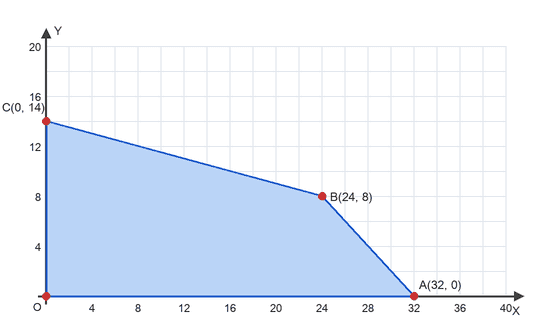
(a) Find the equations of the boundary lines and . Hence find the number of cores and the amount of RAM in the cluster.
(b) The rent is ₹ 10 an hour for a standard VM and ₹ 25 an hour for a high-memory VM. Find the mix of VMs that gives the greatest hourly income.
(c) The rent of a high-memory VM is raised to ₹ 50 an hour (the standard VM stays at ₹ 10). Which mix is now best? Explain why the feasible region did not have to be drawn again.
- 121 mark
Question 12
Competency: Application
A hydroponic farm grows lettuce in trays and basil in trays. The corner points of its feasible region are , , , and . The profit is ₹ 50 per tray of lettuce and ₹ 80 per tray of basil. (Hypothetical data.)
Which plan gives the greatest profit?
- 131 mark
Question 13
Competency: Application
A river ferry carries cars and two-wheelers. A car takes 12 m² of deck space and a two-wheeler 2 m²; the deck has 600 m² for vehicles. To finish loading on time, at most 100 vehicles are taken on a trip. The fare is ₹ 300 for a car and ₹ 80 for a two-wheeler. (Hypothetical data.)
Which load gives the greatest fare collection on one trip?
- 143 marks
Question 14
Competency: Application
An airline is fitting the cabin of a regional aircraft with economy seats () and business seats (). An economy seat, with its share of the aisle, needs 0.5 m² of cabin floor and a business seat needs 1.25 m²; 42.5 m² of floor is available for seating. The aircraft is certified to carry at most 64 passengers, and the airline wants at least 8 business seats. On a typical flight the fare collected is ₹ 4,500 per economy seat and ₹ 10,000 per business seat. (Hypothetical data.)
(a) Formulate the linear programming problem to maximise the fare collected on a flight.
(b) Solve it graphically.
(c) A designer proposes 40 economy seats and 20 business seats. Show that this layout is not possible and name the condition it breaks.
- 153 marks
Question 15
Competency: Analysis & Evaluation
A municipal recycling plant processes PET plastic ( tonnes a day) and glass ( tonnes a day). It can receive at most 10 tonnes of these materials a day. Its sorting line needs 2 hours per tonne of PET and 1 hour per tonne of glass, and runs for at most 16 hours a day. Its glass crusher can take at most 7 tonnes a day. The city wants to keep as much waste as possible out of the landfill. (Hypothetical data.)
(a) Taking (tonnes kept out of the landfill each day), find the maximum value of by the corner point method.
(b) Show that this maximum is reached by more than one plan, and describe all the best plans.
(c) The plant sells PET flakes at ₹ 25,000 per tonne and crushed glass at ₹ 3,000 per tonne. Among the best plans in (b), which should it choose to earn the most, and how much does it earn a day?
- 161 mark
Question 16
Competency: Analysis & Evaluation
A tile factory makes boxes of floor tiles and boxes of wall tiles a day. Its feasible region is bounded. The profit (in ₹) takes its greatest corner value, ₹ 24,000, at both corners and . (Hypothetical data.)
Assertion (A): Making 45 boxes of floor tiles and 20 boxes of wall tiles also gives the maximum profit of ₹ 24,000.
Reason (R): If the maximum value of occurs at two corner points of the feasible region, it occurs at every point of the line segment joining them.
- 173 marks
Question 17
Competency: Application
A city bus depot plans how many AC buses () and non-AC buses () to run on a busy route in the morning peak. An AC bus has 40 seats and a non-AC bus 50 seats, and at least 1,200 seats are needed in the peak. To keep the gap between buses short, at least 26 buses must run, and at least 6 of them must be AC buses. Running an AC bus in the peak costs ₹ 3,000 and a non-AC bus ₹ 2,000. The depot has enough buses of both kinds. (Hypothetical data.)
(a) Write the objective function and the constraints.
(b) Find the corner points of the feasible region and the plan with the least cost.
(c) The feasible region is unbounded. Show that the least corner value found in (b) is really the minimum cost.
- 181 mark
Question 18
Competency: Analysis & Evaluation
A security agency must post day guards and night guards at a warehouse, with , and . A day shift costs ₹ 500 and a night shift ₹ 700, so the wage bill is . The feasible region is unbounded. (Hypothetical data.)
Assertion (A): The wage bill has a minimum value, ₹ 4,400.
Reason (R): If the feasible region is unbounded, the objective function has no minimum value.
- 191 mark
Question 19
Competency: Analysis & Evaluation
A college library buys hardbound and paperback copies of a textbook. It needs at least 60 copies in all, at least 20 hardbound copies and at least 10 paperback copies. A hardbound copy costs ₹ 800 and a paperback copy ₹ 300. There are no other limits. (Hypothetical data.)
Which statement about the total cost is correct?
- 201 mark
Question 20
Competency: Analysis & Evaluation
A student solves an LPP with the constraints , , , .
Assertion (A): The corner points of the feasible region are , and , so the maximum value of is 12.
Reason (R): When the feasible region is unbounded, the largest corner value is the maximum of only if the open half-plane has no point in common with the feasible region.
- 213 marks
Question 21
Competency: Application
A cement plant must supply at least 600 GJ of heat a day to its kiln by burning coal ( tonnes a day) and biomass pellets ( tonnes a day). Coal gives 24 GJ per tonne and biomass pellets 15 GJ per tonne. Under its emission permit, the plant may burn at most 16 tonnes of coal a day, and its supplier can deliver at most 30 tonnes of pellets a day. Coal costs ₹ 8,000 per tonne and pellets ₹ 6,000 per tonne. (Hypothetical data.)
(a) Formulate the linear programming problem to minimise the daily fuel cost.
(b) Draw the feasible region and find its corner points.
(c) Find the least daily fuel cost and the fuel mix that gives it.
- 223 marks
Question 22
Competency: Application
A cricket academy runs batting sessions and bowling sessions a week. Each session of either kind books one practice net for 2 hours, and the academy can book at most 40 net-hours a week. Each batting session needs 1 hour of the head coach's time for planning and video review, and each bowling session needs 2 hours; the head coach can give at most 30 hours a week. At least 4 bowling sessions must be held for the fast bowlers. The academy collects ₹ 1,500 for a batting session and ₹ 1,200 for a bowling session. (Hypothetical data.)
(a) Formulate the linear programming problem to maximise the weekly fee income.
(b) Solve it graphically.
(c) A sponsor will support the academy only if it holds at least 8 batting sessions and at least 12 bowling sessions a week. Show that no weekly plan can meet this together with the academy's limits.
- 233 marks
Question 23
Competency: Analysis & Evaluation
A mobile-repair shop does screen replacements ( a day) and battery replacements ( a day). A screen job takes 45 minutes of technician time and a battery job 30 minutes; the technicians have 14 hours (840 minutes) a day between them. A replacement screen costs the shop ₹ 1,500 and a battery ₹ 800, and the parts budget is ₹ 24,000 a day. After the cost of the part, the shop earns ₹ 600 on a screen job and ₹ 350 on a battery job. (Hypothetical data.)
(a) Show that the constraints are and , with , .
(b) Find the corner points of the feasible region and the maximum of over it.
(c) Jobs come in whole numbers. The owner rounds the optimal corner down to the plan , and also tries and . Which of these plans are possible, and which earns the most?
- 241 mark
Question 24
Competency: Analysis & Evaluation
A spinning mill plans how many tonnes of cotton yarn () and blended yarn () to produce each week, with constraints on machine hours and labour. The manager has drawn the feasible region and found its corner points. Then the market price of cotton yarn rises, so the profit per tonne of cotton yarn goes up; the machine hours and labour available do not change. (Hypothetical situation.)
Assertion (A): To find the new best plan, the manager only has to evaluate the new profit function at the corner points she has already found; she need not draw the feasible region again.
Reason (R): The feasible region of an LPP is fixed by its constraints alone and does not depend on the objective function.
- 251 mark
Question 25
Competency: Analysis & Evaluation
The freight division of a railway must decide how many wagons to send on each of 300 routes, subject to thousands of constraints on engines, crews and track time. (Hypothetical situation.)
Assertion (A): The railway should solve this LPP by the graphical corner point method.
Reason (R): Linear programming problems with many variables and constraints can be solved efficiently with software, such as spreadsheet solvers.
- 263 marks
Question 26
Solve the following LPP graphically: Maximize subject to constraints
, , , , .
- 273 marks
Question 27
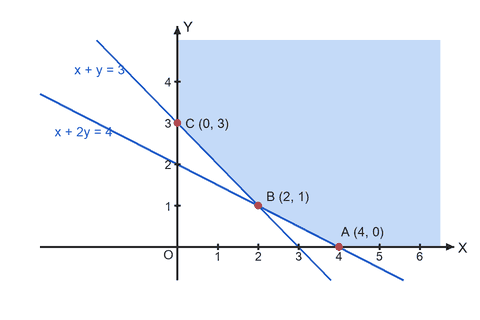
The feasible region for an LPP is shown in the given figure. Evaluate at each of the corner points of this region. Find the minimum value of , if it exists.
- 283 marks
Question 28
Solve the following linear programming problem graphically.
Minimize subject to the constraints
, , , .
- 293 marks
Question 29
A manufacturer of electronic circuits has a stock of 200 resistors, 120 transistors and 150 capacitors and is required to produce two types of circuits and . Type requires 20 resistors, 10 transistors and 10 capacitors. Type requires 10 resistors, 20 transistors, and 30 capacitors. If the profit on Type circuit is ₹ 50 and on Type circuit is ₹ 60, formulate this problem as an LPP, so that manufacturer can maximize his profit.
- 303 marks
Question 30
A firm has to transport 1200 packages using large vans which can carry 200 packages each and small vans which can take 80 packages each. The cost for engaging each large van is ₹ 400 and each small van is ₹ 200. Not more than ₹ 3000 is to be spent on the job and the number of large vans cannot exceed the number of small vans. Formulate this problem as an LPP, given that objective is to minimize cost.
- 313 marks
Question 31
A company manufactures two types of screws and . All the screws have to pass through a threading machine and a slotting machine. A box of Type screws requires 2 minutes on the threading machine and 3 minutes on the slotting machine. A box of Type screws requires 8 minutes on the threading machine and 2 minutes on the slotting machine. In a week, each machine is available for 60 hours. On selling these screws, the company gets a profit of ₹ 100 per box on Type screws and ₹ 170 per box on Type screws. Formulate this problem as an LPP, given that the objective is to maximize profit.
- 323 marks
Question 32
A man rides his motorcycle at the speed of 50 km/h. He has to spend ₹ 2 per km on petrol. If he rides it at a faster speed of 80 km/h, the petrol cost increases to ₹ 3 per km. He has ₹ 120 to spend on petrol and one hour's time. He wishes to find the maximum distance that he can travel. Express this problem as a linear programming problem.
- 333 marks
Question 33
Refer to Q.20. Solve the LPP graphically and determine the maximum profit of the manufacturer.
- 343 marks
Question 34
Solve the following linear programming problems graphically: Maximize subject to , , , .
- 355 marks
Question 35
Match correctly statements given in column I with those given in column II.
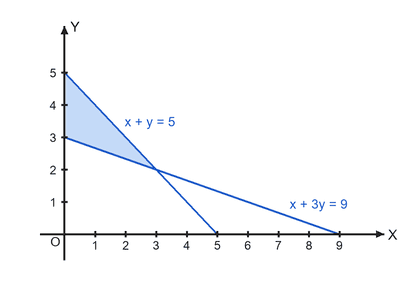
Column I Column II 1. Maximize subject to , , , , . (a) Maximize subject to the constraints , , , . 2. Two tailors and earn ₹ 150 and ₹ 200 per day, respectively. can stitch 6 shirts and 4 pants per day, while can stitch 10 shirts and 4 pants per day. Form an LPP to minimize the labour cost to produce at least 60 shirts and 32 pants. (b) ₹ 100 3. Aman has ₹ 1500 to purchase rice and wheat for his grocery shop. Each sack of rice and wheat costs ₹ 180 and ₹ 120, respectively. He can store a maximum number of 10 bags in his shop. He will earn a profit of ₹ 11 per bag of rice and ₹ 9 per bag of wheat. Formulate a linear programming problem to maximize Aman's profit. (c) 19 4. Calculate the maximum profit in Q.3. (d) 5. The feasible region of an LPP is shown in the figure. If , then at which corner point does the maximum value of occur? (e) Minimize subject to constraints , , , . Figure for item 5:
- 364 marks
Question 36
The month of September is celebrated as the "Rashtriya Poshan Maah" across the country. Following a healthy and well-balanced diet is crucial in order to supply the body with the proper nutrients it needs. A balanced diet also keeps us mentally fit and promotes improved brain activity.

A dietician wishes to minimize the cost of a diet involving two types of foods, food ( kg) and food ( kg) which are available at the rate of ₹ 16/kg and ₹ 20/kg, respectively. The feasible region satisfying the constraints is shown in the figure.
Based on the above information, answer the following questions:
(i) Identify and write the constraints which determine the given feasible region in the figure.
(ii) If the objective is to minimize cost , find the values of and at which cost is minimum. Also, find minimum cost, assuming that minimum cost is possible for the given unbounded region.
- 375 marks
Question 37
Flood relief (using boats and helicopters): Severe flooding has affected several villages in a state. The disaster response team is using boats and helicopters to deliver essential supplies.
A boat trip takes 2 hours and can carry 50 kg of supplies. A helicopter trip takes 1 hour and can carry 80 kg of supplies. The team can operate for a maximum of 60 hours per day and carry not more than 2000 kg of supplies daily. Each boat trip costs ₹ 500 and each helicopter trip costs ₹ 1500.
Minimize the total cost of operation while ensuring maximum supply delivery.
Based on the above information, answer the following questions:
(i) What is the objective function in this problem?
(A) Maximize cost (B) Minimize cost (C) Minimize cost (D) Maximize cost
(ii) What does the constraint represent?
(A) Time available (B) Weight capacity (C) Number of trips (D) Fuel cost
(iii) Which constraint ensures the weight of supplies does not exceed 2000 kg?
(A) (B) (C) (D)
(iv) What does the variable represent?
(A) Number of helicopters (B) Number of hours available (C) Boat trips (D) Cost in rupees
(v) What method is best to solve this LPP with two variables?
(A) Algebraic method (B) Substitution (C) Graphical method (D) Matrix method
- 385 marks
Question 38
Post-disaster debris clearance: A coastal town has been hit by a severe hurricane, leaving behind a massive amount of debris. The local authorities need to clear the debris quickly to allow access for aid and reconstruction. They have two types of heavy machinery: excavators and bulldozers, and a limited budget for fuel and operator hours.
- Excavator: Can clear 10 tons of debris per hour; consumes 5 litres of fuel per hour; requires 1 operator.
- Bulldozer: Can clear 8 tons of debris per hour; consumes 4 litres of fuel per hour; requires 1 operator.
The town has a total of 500 litres of fuel available daily and 60 operator hours. They want to clear at least 300 tons of debris from residential areas and at least 200 tons from main roads. The primary objective is to maximize the tons of debris cleared per day.
Based on the above information, answer the following questions:
(i) What is the main objective of the linear programming model in this scenario?
(A) Minimize fuel consumption (B) Maximize the number of machinery used (C) Maximize the total tons of debris cleared (D) Minimize the number of operator hours
(ii) Let be the number of hours excavators are used and be the number of hours bulldozers are used. Which inequality represents the constraint on the total available fuel?
(A) (B) (C) (D)
(iii) Considering the operator hour limit, which constraint should be included in the linear programming model?
(A) (B) (C) (D)
(iv) Which set of inequalities correctly represents the minimum debris clearance requirements from residential areas and main roads?
(A) ,
(B)
(C) (residential), (main roads)
(D) (residential), (main roads)
(v) The objective function to be maximized is
(A) (B) (C) (D)
- 396 marks
Question 39
Humanitarian food aid distribution: A large international aid organization is distributing two types of food packages, nutritional packs and survival packs, to three affected regions (Region P, Region Q, Region R) hit by famine. They have limited stock and want to ensure equitable distribution while meeting minimum caloric needs.
- Nutritional pack: Provides 2000 calories; weighs 0.5 kg.
- Survival pack: Provides 3000 calories; weighs 0.8 kg.
The organization has 15,000 kg of total transport capacity available per day. They have daily supply of 10,000 nutritional packs and 8000 survival packs.
Minimum daily requirements for each region:
Region P: 500,000 calories; Region Q: 700,000 calories; Region R: 600,000 calories
The organization wants to maximize the total number of food packages distributed.
Based on the information, answer the following questions:
(i) What is the main objective of this linear programming model?
(A) Maximize total calories delivered (B) Maximize total weight of food distributed (C) Maximize the total number of food packages distributed (D) Minimize distribution cost (not specified in scenario)
(ii) Let the total number of nutritional packs distributed be and the total number survival packs distributed be . Which equation represents the objective function to be maximized?
(A) (B) (C) (D)
(iii) Which set of inequalities correctly represent the supply constraints for nutritional packs and survival packs?
(A) , (B) (C) , (D) , ,
(iv) Which inequality correctly represents the total transport capacity constraint (in kg)?
(A) (B) (C) (D)
(v) What is the total minimum caloric requirement that needs to be met by the distributed packs?
(A) calories (B) calories (C) packages (D) kg
(vi) Which inequality correctly represents the total caloric demand constraint?
(A) (B) (C) (D) ,
- 404 marks
Question 40
Food and medicine supply during war: The government of a country involved in a war has requested aid from the international community to supply food and medicine to its citizens. The army is responsible for distributing the aid, while the UN and national aid organizations are handling transportation. The goal is to maximize the total aid supplied while minimizing costs.
Maximize: (total aid supplied) subject to:
(budget constraint); (transportation constraint)
(non-negativity constraints)
Based on the above information, answer the following questions:
(i) What is the objective function in this linear programming problem?
(A) Minimize costs (B) Maximize total aid supplied (C) Minimize transportation costs (D) Maximize budget
(ii) What is the constraint that ensures that the total budget is not exceeded?
(A) (B) (C) (D)
(iii) If the cost of each food packet increases by ₹ 5, what will be the new objective function coefficient for ?
(A) (B) (C) (D)
(iv) What is the feasible region for this linear programming problem?
(A) A triangle with vertices , and
(B) A rectangle with vertices , , and
(C) A convex polygon with vertices , , , and
(D) Cannot be determined