Solution:
Key idea: To solve an LPP graphically we choose the decision variables, write the objective function and the constraints, draw the feasible region, find its corner points and evaluate the objective function at each corner (corner point method). For a bounded region the best corner value is the optimum.
Step 1 — Choose the decision variables.
Let the firm make x rings and y chains per day.
Step 2 — Write the objective function.
The profit is ₹ 300 on a ring and ₹ 190 on a chain, so the daily profit (in ₹) is
Z=300x+190y
This profit is to be maximized.
Step 3 — Write the constraints.
At most 24 items are made in a day.
x+y≤24
A ring takes 1 hour and a chain half an hour, and at most 16 hours are available, so x+21y≤16. Multiplying by 2,
2x+y≤32
The numbers of items cannot be negative, so x≥0 and y≥0.
Step 4 — Draw the feasible region.
The line x+y=24 passes through (24,0) and (0,24).
The line 2x+y=32 passes through (16,0) and (0,32).
Both inequalities hold at O, so the region is on the origin side of both lines, in the first quadrant.
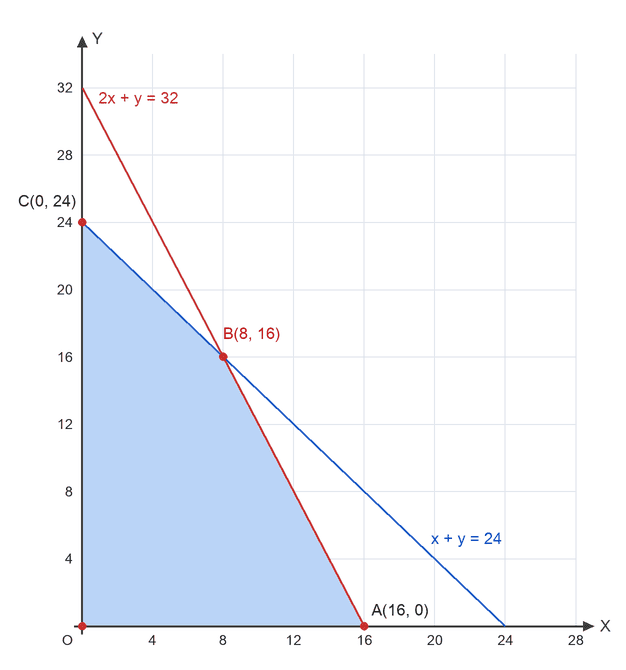
Step 5 — Find the corner points.
Three corners lie on the axes: O(0,0), A(16,0) and C(0,24).
Corner B is where the two lines meet.
We take 2x+y=32 and subtract x+y=24; this removes y.
x=8
Then y=24−8, so y=16 and B is (8,16).
Step 6 — Evaluate Z at the corners.
The region is bounded, so we put each corner into Z.
| Corner point | Z=300x+190y |
|---|
| O(0,0) | 300×0+190×0=0 |
| A(16,0) | 300×16+190×0=4800 |
| B(8,16) | 300×8+190×16=5440 ← maximum |
| C(0,24) | 300×0+190×24=4560 |
The greatest value is 5440, at B(8,16).
Therefore, the firm should make 8 gold rings and 16 gold chains a day, for a maximum profit of ₹ 5440.
