Solution:
Key idea: To solve an LPP graphically we choose the decision variables, write the objective function and the constraints, draw the feasible region, find its corner points and evaluate the objective function at each corner (corner point method). For a bounded region the best corner value is the optimum. For an unbounded region, the smallest corner value m is the minimum only if the open half-plane Z<m has no point in common with the region; we check this by writing Z as a sum of the constraint expressions with positive multipliers. Since the prices are per kg, we measure both grains in kg.
Step 1 — Choose the decision variables.
Let the daily diet contain x kg of wheat and y kg of rice.
Step 2 — Write the objective function.
Wheat costs ₹ 4 per kg and rice ₹ 6 per kg, so the cost (in ₹) is
Z=4x+6y
This cost is to be minimized.
Step 3 — Find the nutrients in one kilogram.
One gram of wheat gives 0.1 g protein and 0.25 g carbohydrates, so 1 kg (1000 g) of wheat gives 100 g protein and 250 g carbohydrates.
In the same way, 1 kg of rice gives 50 g protein and 500 g carbohydrates.
Step 4 — Write the constraints.
The child needs at least 50 g protein a day.
100x+50y≥50
Dividing by 50 gives
2x+y≥1
The child needs at least 200 g carbohydrates a day.
250x+500y≥200
Dividing by 50 gives
5x+10y≥4
The amounts of grain cannot be negative, so x≥0 and y≥0.
Step 5 — Draw the feasible region.
The line 2x+y=1 passes through (0.5,0) and (0,1).
The line 5x+10y=4 passes through (0.8,0) and (0,0.4).
The origin satisfies neither inequality, so the region lies on the far side of both lines.
It is unbounded.
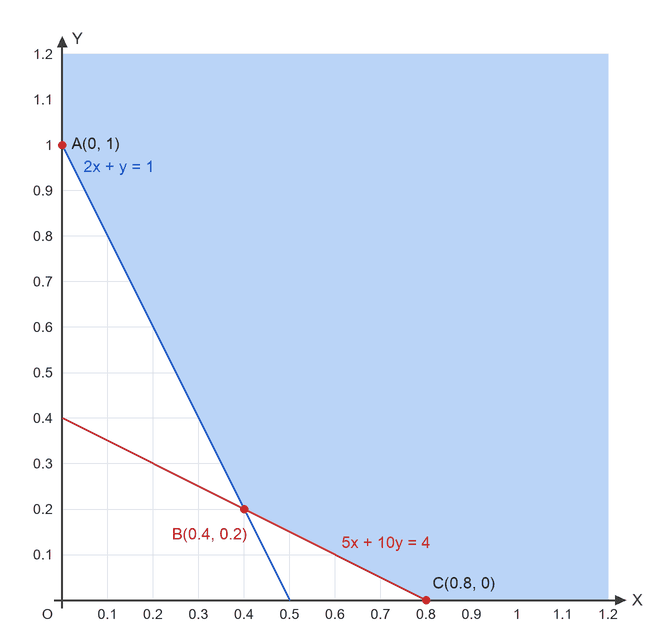
Step 6 — Find the corner points.
Corner A is where 2x+y=1 meets the y-axis, so A is (0,1).
Corner B is where the two lines meet.
From 2x+y=1, we get y=1−2x, and we put this into the second equation.
5x+10(1−2x)=4
5x+10−20x=4
−15x=−6
x=0.4
Then y=1−0.8, so y=0.2 and B is (0.4,0.2).
Corner C is where 5x+10y=4 meets the x-axis, so C is (0.8,0).
Step 7 — Evaluate Z at the corners.
We put each corner into Z=4x+6y.
| Corner point | Z=4x+6y |
|---|
| A(0,1) | 4×0+6×1=6 |
| B(0.4,0.2) | 4×0.4+6×0.2=2.8 ← minimum |
| C(0.8,0) | 4×0.8+6×0=3.2 |
The smallest corner value is 2.8, at B(0.4,0.2).
Step 8 — Check the unbounded region.
We write Z using the two constraints that meet at B.
4x+6y=32(2x+y)+158(5x+10y)
In the region, 2x+y≥1 and 5x+10y≥4, so
4x+6y≥32+1532
4x+6y≥2.8
So the half-plane 4x+6y<2.8 has no point in common with the region, and 2.8 is the minimum.
Note: The question ends with "maximum daily requirements", but the 50 g and 200 g were given as the minimum daily requirements, so the mixture must provide at least these amounts.
Therefore, the minimum cost is ₹ 2.80 a day, with 0.4 kg (400 g) of wheat and 0.2 kg (200 g) of rice.
