Solution:
Key idea: To solve an LPP graphically we choose the decision variables, write the objective function and the constraints, draw the feasible region, find its corner points and evaluate the objective function at each corner (corner point method). For a bounded region the best corner value is the optimum.
Step 1 — Choose the decision variables.
Let the manufacturer produce x units of A and y units of B in a week.
Step 2 — Write the objective function.
The profit is ₹ 20 on each A and ₹ 30 on each B, so the weekly profit (in ₹) is
Z=20x+30y
This profit is to be maximized.
Step 3 — Write the constraints.
The permanent orders need at least 14 of A and 16 of B.
x≥14,y≥16
Product A takes half an hour and B one hour, and the week has 60 hours, so 21x+y≤60. Multiplying by 2,
x+2y≤120
The turnover 200x+300y (in ₹) must be at least ₹ 10,000. Dividing by 100,
2x+3y≥100
Step 4 — Draw the feasible region.
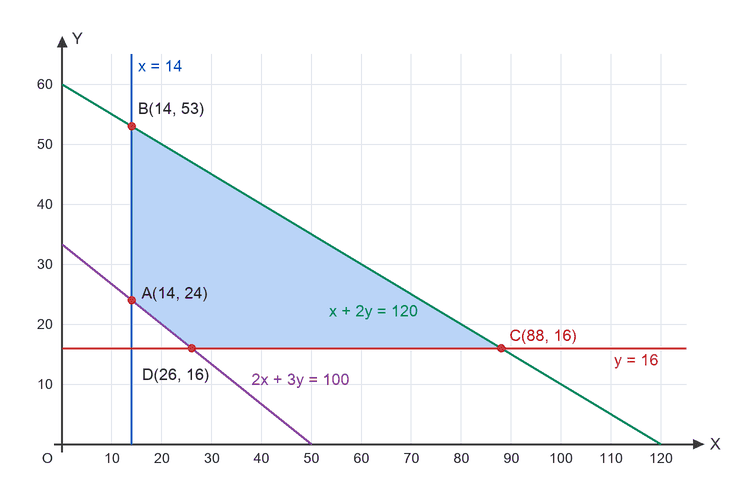
The region lies to the right of x=14, above y=16, on the origin side of x+2y=120 and on the far side of 2x+3y=100.
It is a bounded quadrilateral.
Step 5 — Find the corner points.
Corner A is on x=14 and 2x+3y=100, so 3y=72; hence y=24 and A is (14,24).
Corner B is on x=14 and x+2y=120, so 2y=106; hence y=53 and B is (14,53).
Corner C is on y=16 and x+2y=120, so x+32=120; hence x=88 and C is (88,16).
Corner D is on y=16 and 2x+3y=100, so 2x=52; hence x=26 and D is (26,16).
Step 6 — Evaluate Z at the corners.
The region is bounded, so we put each corner into Z.
| Corner point | Z=20x+30y |
|---|
| A(14,24) | 20×14+30×24=1000 |
| B(14,53) | 20×14+30×53=1870 |
| C(88,16) | 20×88+30×16=2240 ← maximum |
| D(26,16) | 20×26+30×16=1000 |
The greatest value is 2240, at C(88,16). It uses 44+16 hours, the full 60-hour week.
Note: The book's printed answer (48 of A and 16 of B, profit ₹ 1440) fits a 40-hour week, since 24 + 16 hours make 40. With the printed 60-hour week the optimum is 88 of A and 16 of B.
Therefore, 88 units of A and 16 units of B should be produced each week, for a maximum profit of ₹ 2240.
