Solution:
Key idea: To solve an LPP graphically we choose the decision variables, write the objective function and the constraints, draw the feasible region, find its corner points and evaluate the objective function at each corner (corner point method). For a bounded region the best corner value is the optimum.
Step 1 — Choose the decision variables.
Let x hectares be planted with cabbage and y hectares with potatoes.
Step 2 — Write the objective function.
The profit is ₹ 2000 per hectare on cabbage and ₹ 1500 per hectare on potatoes, so the profit (in ₹) is
Z=2000x+1500y
This profit is to be maximized.
Step 3 — Write the constraints.
At most 10 hectares are planted in all.
x+y≤10
Cabbage takes at least 2 and not more than 8 hectares, and potatoes at least 1 and not more than 6.
2≤x≤8,1≤y≤6
Step 4 — Draw the feasible region.
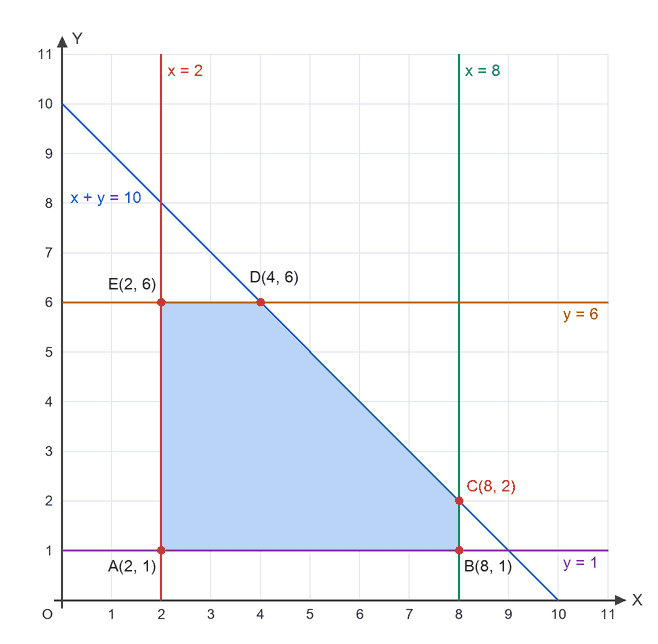
The last two conditions give the rectangle 2≤x≤8, 1≤y≤6. The line x+y=10 cuts off its top right corner, leaving a pentagon.
Step 5 — Find the corner points.
Two corners are corners of the rectangle: A(2,1) and B(8,1), and a third is E(2,6).
On x=8 and x+y=10, we get y=2, so C is (8,2).
On y=6 and x+y=10, we get x=4, so D is (4,6).
Step 6 — Evaluate Z at the corners.
The region is bounded, so we put each corner into Z.
| Corner point | Z=2000x+1500y |
|---|
| A(2,1) | 2000×2+1500×1=5500 |
| B(8,1) | 2000×8+1500×1=17500 |
| C(8,2) | 2000×8+1500×2=19000 ← maximum |
| D(4,6) | 2000×4+1500×6=17000 |
| E(2,6) | 2000×2+1500×6=13000 |
The greatest value is 19000, at C(8,2).
Note: The book's printed answer (4 hectares of cabbage, 6 of potatoes, ₹ 18,000) uses ₹ 1500 per hectare for cabbage and ₹ 2000 for potatoes, the reverse of the printed profits.
Therefore, the farmer should plant 8 hectares of cabbage and 2 hectares of potatoes, for a maximum profit of ₹ 19,000.
