Solution:
Key idea: To solve an LPP graphically we choose the decision variables, write the objective function and the constraints, draw the feasible region, find its corner points and evaluate the objective function at each corner (corner point method). For a bounded region the best corner value is the optimum. For an unbounded region, the smallest corner value m is the minimum only if the open half-plane Z<m has no point in common with the region; we check this by writing Z as a sum of the constraint expressions with positive multipliers.
Step 1 — Choose the decision variables.
Let the company buy x mixes from supplier S and y mixes from supplier T.
Step 2 — Write the objective function.
A mix from S costs ₹ 10 and a mix from T costs ₹ 4, so the cost (in ₹) is
Z=10x+4y
This cost is to be minimized.
Step 3 — Write the constraints.
Chemical A: the mixes give 4 and 1 units, and at least 80 units are needed.
4x+y≥80
Chemical B: the mixes give 2 and 1 units, and at least 60 units are needed.
2x+y≥60
The numbers of mixes cannot be negative, so x≥0 and y≥0.
Step 4 — Draw the feasible region.
The line 4x+y=80 passes through (20,0) and (0,80).
The line 2x+y=60 passes through (30,0) and (0,60).
The origin satisfies neither inequality, so the region lies on the far side of both lines.
It is unbounded.
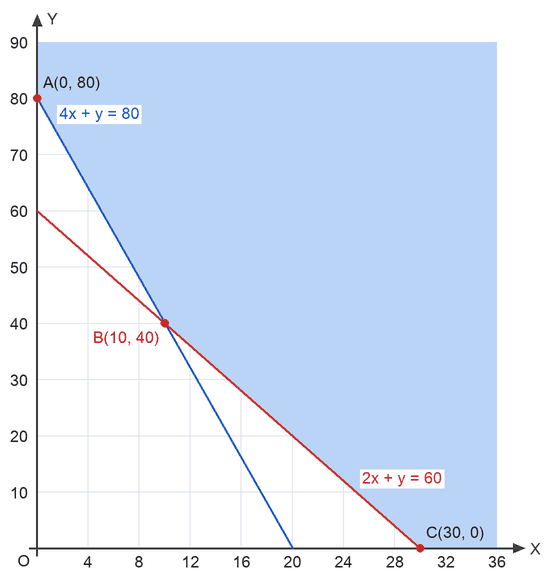
Step 5 — Find the corner points.
Corner A is where 4x+y=80 meets the y-axis, so A is (0,80).
Corner B is where the two lines meet.
We take 4x+y=80 and subtract 2x+y=60; this removes y.
2x=20
x=10
Then y=60−20, so y=40 and B is (10,40).
Corner C is where 2x+y=60 meets the x-axis, so C is (30,0).
Step 6 — Evaluate Z at the corners.
We put each corner into Z=10x+4y.
| Corner point | Z=10x+4y |
|---|
| A(0,80) | 10×0+4×80=320 |
| B(10,40) | 10×10+4×40=260 ← minimum |
| C(30,0) | 10×30+4×0=300 |
The smallest corner value is 260, at B(10,40).
Step 7 — Check the unbounded region.
We write Z using the two constraints that meet at B.
10x+4y=(4x+y)+3(2x+y)
In the region, 4x+y≥80 and 2x+y≥60, so
10x+4y≥80+180
10x+4y≥260
So the half-plane 10x+4y<260 has no point in common with the region, and 260 is the minimum.
Therefore, the company should buy 10 mixes from supplier S and 40 mixes from supplier T, for a minimum cost of ₹ 260.
