
Opening your dashboard
Class 11 Physics Chapter 11: Rotational Motion - Moment of Inertia and Torque Solutions
67 textbook questions with step-by-step answers, free to read, for ISC 2026-27.
Get talked through Ch 11, not just shown the answer
Reading a finished solution is not the same as being able to do it. The AI tutor takes one question at a time and works it with you, in your own words, until you can.
- Ask it out loud, in your own words
- It gives you the next step, not the answer
- Stuck on part (ii)? Start there
67 questions with solutions
1–5 marks · Mixed difficulty
The first 25 solutions are on this page. This chapter is a long one, so the rest open on their own page to keep this one quick to load.
- 11 mark
Question 1
When a mass is rotating in a plane about a fixed point, its angular momentum is directed along
Solve with AIAnswer
(A) the radius
(B) the tangent to orbit
(C) line at an angle of 45° to the plane of rotation
- Correct
(D) the axis of rotation
Answer: (D) The axis of rotation
Concept: The angular momentum of a particle about a point is . A vector product is perpendicular to both of the vectors that form it.
Step 1 — Find the plane of the two vectors. The mass moves in a plane, so its position vector (from the fixed point) and its momentum both lie in that plane.
Step 2 — Find the direction of L. Their vector product is perpendicular to this plane, which is the direction of the axis of rotation through the fixed point. Its sense along the axis is given by the right-hand rule.
- (A) The radius lies in the plane of rotation, but is perpendicular to every vector in that plane.
- (B) The tangent to the path is the direction of the velocity, which also lies in the plane of rotation.
- (C) A vector product of two vectors in a plane makes with that plane, never .
Therefore, the angular momentum is directed along the axis of rotation, option (D).
- 21 mark
Question 2
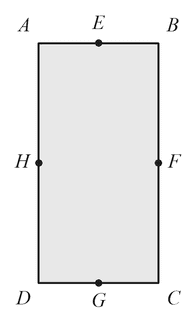
In a rectangle (), the moment of inertia along which axis will be minimum?
 Solve with AI
Answer
(A) BC
(B) BD
(C) HF
- Correct
(D) EG
Answer: (D) EG
Concept: The moment of inertia of a body about an axis is smallest when its mass lies as close as possible to that axis. For a thin uniform rectangular plate of mass and width measured at right angles to an axis, about a central axis and about an edge.
Step 1 — Name the sides. Treat as a thin uniform plate of mass , with and . , , , are the mid-points of the sides, so and pass through the centre.
Step 2 — Find I about EG. is parallel to the long side , through the centre. The plate's width across is the short side :
Step 3 — Find I about HF and about BC. is parallel to through the centre, and the width across it is . is an edge, and the width across it is :
Step 4 — Compare with the diagonal. About the diagonal , integrating over the plate gives , which is more than , because the corners and are far from .
Step 5 — Choose the smallest. Since , the axis gives the least moment of inertia: it runs along the long direction, so all the mass is within of it.
- (A) This is an edge of the plate; mass lies up to a distance from it, so , four times .
- (B) This gives , which is larger than .
- (C) This axis crosses the long side, so mass lies up to a distance from it and .
Therefore, the moment of inertia is least about EG, option (D).
- 31 mark
Question 3
In which case use of angular velocity is useful
Solve with AIAnswer
- Correct
(A) when the body is rotating
(B) when the body moves in a straight line
(C) when the body is changing its direction of motion
(D) none of these
Answer: (A) When the body is rotating
Concept: Angular velocity is the rate at which the angle turned about an axis changes. It is most useful when a body turns about an axis, because then every particle of the body has the same , although their linear speeds differ.
Step 1 — See why it suits rotation. In a rotating body, particles at different distances from the axis move with different speeds , but all turn through the same angle in the same time. One number, , describes the motion of the whole body.
Step 2 — Choose the option. So angular velocity is useful when the body is rotating.
- (B) In straight-line motion nothing turns about an axis, so angular velocity does not describe the motion; linear velocity does.
- (C) A body changing its direction may move along any curve; angular velocity is natural only when it turns about a fixed axis or centre, which is the case of rotation in option (A).
- (D) This is wrong because option (A) describes a case where angular velocity is useful.
Therefore, angular velocity is useful when the body is rotating, option (A).
- 41 mark
Question 4
The moment of inertia of a body about a given axis is . Initially, the body is at rest. In order to produce a rotating kinetic energy of 1500 joules, an angular acceleration of must be applied about that axis for a duration of
Solve with AIAnswer
(A) 4 s
- Correct
(B) 2 s
(C) 8 s
(D) 10 s
Answer: (B) 2 s
Concept: Rotational kinetic energy is . For uniform angular acceleration from rest, .
Step 1 — Find the angular velocity needed. We put the given kinetic energy, 1500 J, and moment of inertia, , into :
Step 2 — Find the time. The body starts from rest, so and we divide by :
- (A) After 4 s, , and the kinetic energy would be .
- (C) After 8 s, , and the kinetic energy would be .
- (D) After 10 s, , and the kinetic energy would be .
Therefore, the angular acceleration must act for 2 s, option (B).
- 51 mark
Question 5
A solid cylinder of mass and radius rolls down an inclined plane of height without slipping, starting from rest. The speed of its centre of mass when it reaches the bottom is
Solve with AIAnswer
(A)
- Correct
(B)
(C)
(D)
Answer: (B)
Concept: When a body rolls without slipping, friction does no work, so the loss of potential energy ( = height of the incline, the height through which the centre of mass falls) equals the gain in kinetic energy, translational plus rotational. Rolling without slipping means .
Step 1 — Write the kinetic energy at the bottom. The figure shows the rolling cylinder.
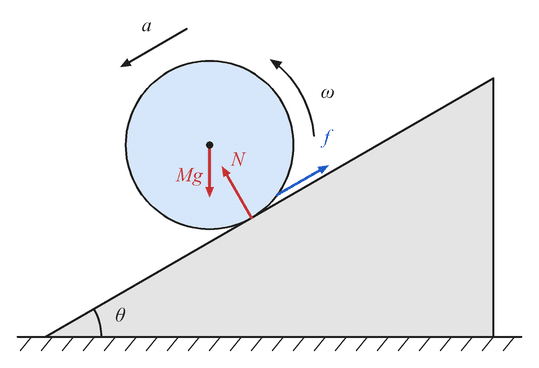
A solid cylinder has . Its kinetic energy is:
Step 2 — Use conservation of energy. The cylinder starts from rest, so all of this kinetic energy comes from the loss of potential energy, and we set the two equal:
- (A) This is the speed of a body that slides down without friction and without turning; a rolling cylinder puts part of its energy into rotation, so it is slower.
- (C) This comes from turning the fraction upside down, instead of .
- (D) This does not even have the unit of speed: has the unit , so its square root is in .
Therefore, the speed at the bottom is , option (B).
- 61 mark
Question 6
The moment of inertia of a hoop of radius and mass , about any tangent line will be
Solve with AIAnswer
- Correct
(A)
(B)
(C)
(D)
Answer: (A)
Concept: Parallel axes theorem: , where is the moment of inertia about a parallel axis through the centre of mass and is the distance between the axes. For a thin hoop, about the axis through its centre perpendicular to its plane, and about a diameter.
Step 1 — Identify the tangent. The options point to a tangent in the plane of the hoop, in the figure, which is parallel to the diameter and a distance from it.
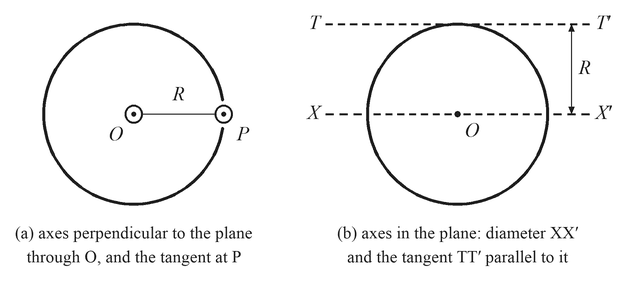
Step 2 — Apply the parallel axes theorem. We add to the moment of inertia about the diameter:
- (B) This is the moment of inertia about a diameter; the term for the shift to the tangent has been left out.
- (C) This is the moment of inertia about the axis through the centre perpendicular to the plane of the hoop.
- (D) This is the moment of inertia of a uniform disc about its diameter, not of a hoop.
Note: a tangent perpendicular to the plane of the hoop (at in the figure) would give , which is not among the options.
Therefore, about a tangent in its plane the hoop has , option (A).
- 71 mark
Question 7
The torque acting on a body is the rotational analogue of
Solve with AIAnswer
(A) mass of the body
(B) linear kinetic energy of the body
(C) linear velocity of the body
- Correct
(D) force in linear motion
Answer: (D) Force in linear motion
Concept: Each quantity of linear motion has a rotational analogue: mass ↔ moment of inertia, velocity ↔ angular velocity, force ↔ torque, linear momentum ↔ angular momentum. Newton's second law, , has the rotational form .
Step 1 — Compare the two laws. A force changes the linear motion of a body, as shows, and a torque changes its rotational motion, as shows.
Step 2 — Choose the option. So torque plays the part in rotation that force plays in linear motion.
- (A) The rotational analogue of mass is the moment of inertia.
- (B) The rotational analogue of linear kinetic energy is rotational kinetic energy, .
- (C) The rotational analogue of linear velocity is angular velocity.
Therefore, torque is the rotational analogue of force, option (D).
- 81 mark
Question 8
The ratio of rotational and translational kinetic energies of a sphere is
Solve with AIAnswer
(A) 2/9
(B) 2/7
- Correct
(C) 2/5
(D) 7/2
Answer: (C) 2/5
Concept: A rolling body has translational kinetic energy and rotational kinetic energy . The stem names neither the kind of sphere nor its motion; as the options intend, we take a solid sphere rolling without slipping. A solid sphere has about a diameter, and rolling without slipping gives .
Step 1 — Find the rotational kinetic energy. We put and into :
Step 2 — Divide by the translational kinetic energy. The translational kinetic energy is :
- (A) This would need , which is not the moment of inertia of a sphere (solid , hollow ).
- (B) This is the ratio of rotational to total kinetic energy, .
- (D) This is the ratio of total to rotational kinetic energy.
Therefore, the ratio of rotational to translational kinetic energy of a solid sphere rolling without slipping is 2/5, option (C).
- 91 mark
Question 9
A body is rolling without slipping on a horizontal plane. If the rotational energy of the body is 40% of the total kinetic energy, then the body might be
Solve with AIAnswer
(A) cylinder
- Correct
(B) hollow sphere
(C) solid cylinder
(D) ring
Answer: (B) Hollow sphere
Concept: For a body of mass and radius rolling without slipping, write , where the number depends only on the shape of the body; then and , so the rotational fraction is .
Step 1 — Set the fraction equal to 40%. We put :
Step 2 — Find the body. is the moment of inertia of a hollow sphere about a diameter.
- (A) A thin-walled (hollow) cylinder has , giving a rotational fraction of 50%; a solid cylinder gives ; neither gives 40%.
- (C) A solid cylinder has , so the rotational fraction is , about 33%.
- (D) A ring has , so the rotational fraction is , or 50%.
Therefore, the body is a hollow sphere, option (B).
- 101 mark
Question 10
If the moment of inertia of a disc about an axis tangentially and parallel to its surface be , then what will be the moment of inertia about the axis tangential but perpendicular to the surface?
Solve with AIAnswer
- Correct
(A)
(B)
(C)
(D)
Answer: (A)
Concept: For a uniform disc of mass and radius : about the axis through the centre perpendicular to its plane, ; about a diameter, . A parallel axis a distance away adds (parallel axes theorem).
Step 1 — Identify the two axes. The figure shows them: is the tangent in the plane of the disc (parallel to the diameter ), and the axis at is the tangent perpendicular to the plane. Each is a distance from a parallel axis through the centre.
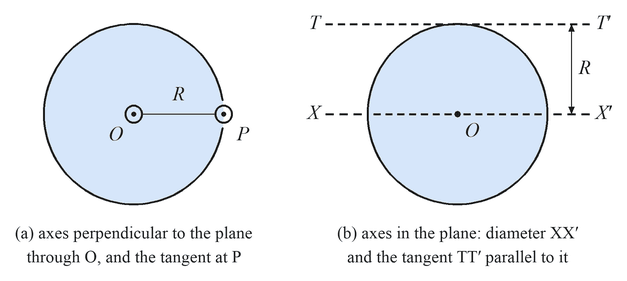
Step 2 — Find I about the tangent in the plane. We shift from the diameter by :
Step 3 — Find I about the tangent perpendicular to the plane. We shift from the central perpendicular axis by :
Step 4 — Express I′ in terms of I. We divide the two results:
- (B) This would make (three-quarters of ), but the parallel axes theorem gives .
- (C) This confuses with : is , not .
- (D) This writes the value of itself, , as if it were a multiple of .
Therefore, the moment of inertia about the tangent perpendicular to the surface is , option (A).
- 111 mark
Question 11
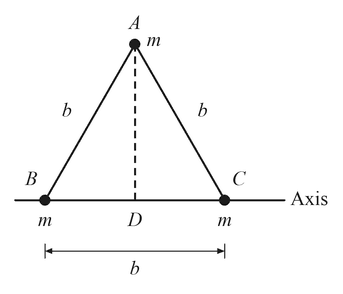
Three point masses each of mass are placed at the corners of an equilateral triangle of side . The moment of inertia of the system about an axis coinciding with one side of the triangle is
 Solve with AI
Answer
(A)
(B)
- Correct
(C)
(D)
Answer: (C)
Concept: The moment of inertia of point masses about an axis is , where is the perpendicular distance of each mass from the axis.
Step 1 — Find the distances from the axis BC. The masses at and lie on the axis, so their distances are zero. The mass at is at the perpendicular distance , the altitude of the triangle:
Step 2 — Add the contributions. Only the mass at contributes:
- (A) This puts all three masses at a distance from the axis, but two of them lie on the axis.
- (B) This takes the distance of from the axis as the side instead of the altitude .
- (D) This would need to be from the axis, but the altitude is .
Therefore, the moment of inertia about one side is , option (C).
- 121 mark
Question 12
A flywheel rotating about a fixed axis has a kinetic energy of 360 joules when its angular speed is 30 rad/sec. The moment of inertia of the wheel about the axis of rotation is
Solve with AIAnswer
(A)
(B)
- Correct
(C)
(D)
Answer: (C)
Concept: The kinetic energy of a body rotating about a fixed axis is .
Step 1 — Make I the subject. We rearrange the formula:
Step 2 — Substitute the data. We put and :
- (A) This moment of inertia would give a kinetic energy of , not 360 J.
- (B) With it would be only .
- (D) With it would be .
Therefore, the moment of inertia of the flywheel is , option (C).
- 131 mark
Question 13
A wheel is rotating at 900 rpm about its axis. When the power is cut off, it comes to rest in one minute. The angular retardation (assuming to be uniform) in is
Solve with AIAnswer
- Correct
(A)
(B)
(C)
(D)
Answer: (A)
Concept: For uniform angular acceleration, , and an angular speed of revolutions per second is rad/s.
Step 1 — Convert the initial speed. 900 rpm is revolutions per second, so:
Step 2 — Find the angular acceleration. The wheel stops, with , after :
The minus sign shows a retardation of .
- (B) A retardation of would stop the wheel in , two minutes.
- (C) A retardation of would take 180 s.
- (D) A retardation of would take 240 s.
Therefore, the angular retardation is , option (A).
- 141 mark
Question 14
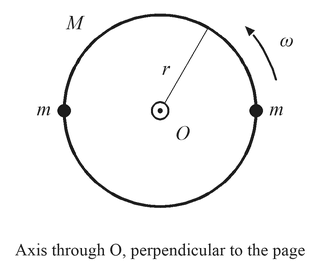
A thin circular ring of mass and radius is rotating about its axis with a constant angular velocity . Two objects each of mass are attached gently to the opposite ends of a diameter of the ring. The ring will now rotate with an angular velocity of
 Solve with AI
Answer
(A)
- Correct
(B)
(C)
(D)
Answer: (B)
Concept: When no external torque acts about the axis, angular momentum is conserved: . Attaching the masses gently means they bring no torque of their own about the axis.
Step 1 — Picture the set-up. The figure shows the ring turning about the axis through its centre, perpendicular to its plane, with the two masses at the ends of a diameter.
Step 2 — Write the moments of inertia. At first, . Each added mass is at distance from the axis, so afterwards:
Step 3 — Apply conservation of angular momentum. We set :
- (A) With this value the angular momentum afterwards would be , less than the starting , although no external torque acts; the form belongs to the elastic-collision velocity formula, which does not apply here.
- (C) This counts only one of the two attached masses.
- (D) This is the ratio turned upside down; it would make the ring speed up, although its moment of inertia has increased.
Therefore, the ring now rotates with angular velocity , option (B).
- 151 mark
Question 15
Name the axis about which a uniform cube will have minimum moment of inertia.
Solve with AIWritten solution
Solution:
Concept: For a given body, the moment of inertia is least about an axis through its centre of mass, since by the parallel axes theorem any parallel axis elsewhere adds .
Step 1 — Look at axes through the centre. A uniform cube of mass and side is so symmetric that its moment of inertia is the same, , about every axis through its centre: the line joining the centres of opposite faces, a body diagonal joining opposite corners, or any other.
Step 2 — Choose the axis. So the minimum is obtained about any axis through the centre of the cube, for example the axis joining two opposite corners through the centre.
Note: the book names the diagonal through the centre; it does give the least value, , but so does every other axis through the centre.
Therefore, the moment of inertia is minimum about an axis through the centre of the cube, such as the diagonal joining opposite corners, where .
- 161 mark
Question 16
Does moment of inertia depend upon the angular velocity of the body?
Solve with AIWritten solution
Solution:
Concept: The moment of inertia depends on the masses of the particles and on their distances from the axis.
Step 1 — Check what changes with ω. In a rigid body the distances of the particles from the axis do not change when it spins faster or slower, so stays the same.
Therefore, no, the moment of inertia of a rigid body does not depend on its angular velocity; it depends only on the mass, its distribution and the axis.
- 171 mark
Question 17
A handle is put near the circumference of the wheel of a hand-driven grinding machine. Why?
Solve with AIWritten solution
Solution:
Concept: The torque of a force about the axis is , which for a force at right angles to the arm is . The larger the distance from the axis, the larger the torque for the same force.
Step 1 — Apply it to the handle. A handle near the circumference is as far from the axis as possible, so a small force on it gives a large torque, and the wheel is easy to turn.
Therefore, the handle is put near the circumference to make the arm large, so that a given force produces a large torque .
- 181 mark
Question 18
“The cap of a pen can easily be opened with the help of two fingers than with one finger”. Explain why?
Solve with AIWritten solution
Solution:
Concept: Two equal and opposite parallel forces whose lines of action are a distance apart form a couple. A couple has a turning effect (moment) but no net force, as panel (b) of the figure shows.
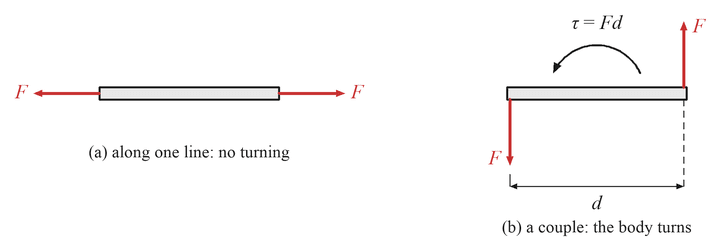
Step 1 — Use two fingers. Two fingers push on opposite sides of the cap in opposite directions. Both forces turn the cap the same way, so together they form a couple of moment , where is the diameter of the cap.
Step 2 — Compare with one finger. One finger alone gives a torque of only about the axis, half as much, and also pushes the pen sideways.
Therefore, two fingers open the cap more easily because together they apply a couple, whose moment is greater than the torque of one finger's force, and it turns the cap without pushing the pen sideways.
- 191 mark
Question 19
A ladder is kept at rest with its upper end against a wall and the lower end on the ground. The ladder is more likely to slip when a mass stands on it at the top than at the bottom. Why?
Solve with AIWritten solution
Solution:
Concept: For the ladder to be at rest, the net force and the net torque on it must be zero. The ladder slips when the friction it needs at the ground is more than the limiting friction .
Step 1 — Draw the forces. The figure shows the forces on the ladder : the wall's push at the top, the weight of the ladder at its middle, the weight of the person, and at the ground the normal reaction and friction .
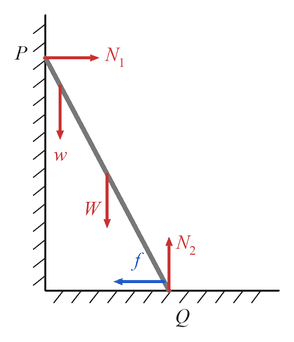
Step 2 — Use the balance of forces. Horizontally, ; vertically, , which does not depend on where the person stands.
Step 3 — Take torques about the foot Q. The weights and tend to turn the ladder about so that its top slides down the wall, and the push of the wall turns it the other way. For balance, the torque of must equal the total torque of the weights. The torque of is times its horizontal distance from , which is largest when the person is at the top. So , and therefore the friction needed, , is largest then.
Therefore, a person at the top has the largest torque about the foot of the ladder, so the wall's push and hence the friction needed at the ground are largest, while the limiting friction stays the same; the ladder is then most likely to slip.
- 201 mark
Question 20
Which physical quantities are expressed by the following?
(a) rate of change of angular momentum
(b) moment of momentum
Solve with AIWritten solution
Solution:
Concept: Torque is related to angular momentum by , and the angular momentum of a particle is , the moment of its linear momentum about a point.
Step 1 — Answer part (a). The rate of change of angular momentum, , is the torque.
Step 2 — Answer part (b). The moment of (linear) momentum, , is the angular momentum.
Therefore, (a) the rate of change of angular momentum is torque, and (b) the moment of momentum is angular momentum.
- 211 mark
Question 21
“A wrench of longer arm as compared to a wrench of shorter arm is preferred.” Why?
Solve with AIWritten solution
Solution:
Concept: Torque is , of magnitude , where is the distance from the axis to the point where the force acts. The figure shows the arm and the force .
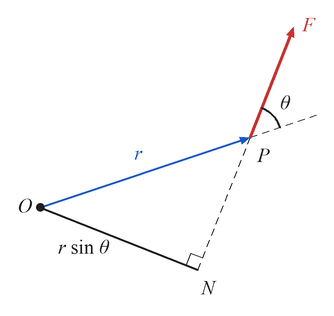
Step 1 — Compare the two wrenches. To loosen a nut a fixed torque is needed. Since for a force at right angles to the arm, a longer arm (larger ) needs a smaller force for the same torque.
Therefore, a wrench with a longer arm is preferred because the larger arm gives the needed torque with a smaller force.
- 221 mark
Question 22
When a tree is cut, the cutter makes a cut on the side facing the direction in which the tree is meant to fall. Why? Explain.
Solve with AIWritten solution
Solution:
Concept: A body turns about a pivot when a torque acts on it. The weight of the tree, acting at its centre of gravity, has a torque about any point it is not directly above.
Step 1 — See what the cut does. The cut removes wood on the chosen side, so on that side the trunk is no longer supported. The uncut wood on the far side becomes a hinge about which the tree can turn.
Step 2 — Find the torque of the weight. As soon as the tree leans slightly towards the cut, the line of action of its weight passes on the cut side of this hinge. The weight then has a torque about the hinge that turns the tree towards the cut, and the turning grows as it leans more.
Therefore, the cut is made on the side towards which the tree should fall so that the tree's weight produces a torque about the uncut part, and the tree turns and falls on that side.
- 231 mark
Question 23
If the Earth were suddenly contracted to th of its present radius without change in its mass, then what will be the effect on the duration of the day?
Solve with AIWritten solution
Solution:
Concept: No external torque acts on the Earth about its axis, so stays constant. Treating the Earth as a uniform sphere, , and the day lasts .
Step 1 — Write the conservation law in terms of T. Since , the constant angular momentum gives:
With unchanged, this means .
Step 2 — Put in the new radius. The radius becomes , so the day becomes:
Therefore, the day would become shorter, lasting hours.
- 241 mark
Question 24
What is the S.I. unit of radius of gyration?
Solve with AIWritten solution
Solution:
Concept: The radius of gyration is defined by ; it is a distance from the axis.
Step 1 — Find the unit. has the unit , which is the metre.
Therefore, the S.I. unit of radius of gyration is the metre (m).
- 251 mark
Question 25
What is the physical significance of radius of gyration?
Solve with AIWritten solution
Solution:
Concept: The radius of gyration of a body about an axis is the distance from the axis at which, if the whole mass were placed, the moment of inertia would be the same: .
Step 1 — State what K tells us. measures how the mass of the body is distributed about the axis. A large means the mass lies mostly far from the axis; a small means it lies close to it.
Therefore, the radius of gyration is a measure of the distribution of the body's mass about a given axis.
- 261 mark
Question 26
Is radius of gyration of a body a constant quantity?
- 271 mark
Question 27
You are given two spheres of same mass and same radius, one is solid sphere and the other is a hollow sphere. Which has larger moment of inertia about its diameter?
- 281 mark
Question 28
Write down the equations for (i) angular momentum and (ii) torque in terms of moment of inertia.
- 291 mark
Question 29
Moment of inertia is called rotational inertia. Why?
- 302 marks
Question 30
When the axis of rotation of a body changes, does the moment of inertia also change? Why?
- 312 marks
Question 31
Two forces equal in magnitude but opposite in direction act on a rigid body. Under what conditions does the body rotate?
- 322 marks
Question 32
A rigid body is rotating. Is it necessary that a net torque acts on the body?
- 332 marks
Question 33
Using the S.I. units of torque and angular acceleration, show that the S.I. unit of moment of inertia is .
- 342 marks
Question 34
“The rotational vectors are represented by straight lines lying along the axis of rotation.” Why?
- 352 marks
Question 35
For calculating the moment of inertia of a body, can we assume the whole mass of the body to be concentrated at its centre of mass?
- 362 marks
Question 36
Define moment of inertia. Name the factors on which the moment of inertia depends.
- 372 marks
Question 37
What is the physical significance of moment of inertia?
- 382 marks
Question 38
Define radius of gyration. What is the purpose of defining it?
- 392 marks
Question 39
Name a physical quantity which has the same dimensions as that of torque. What is the difference between the two?
- 402 marks
Question 40
What is the torque exerted by the gravitational force of the Sun on the Earth? Explain.
- 412 marks
Question 41
An external force acts on a rigid body, but the torque is zero. What conclusions can be made from this?
- 422 marks
Question 42
An electron moves round the nucleus of an atom in a circular path. What is the direction of the angular momentum of the electron?
- 432 marks
Question 43
Show that the torque acting on a body is equal to the product of moment of inertia and the angular acceleration of the body.
- 442 marks
Question 44
How is angular momentum of a rigid body related to its moment of inertia?
- 452 marks
Question 45
What is the S.I. unit and dimensional formula of angular momentum?
- 462 marks
Question 46
Write down the relation connecting torque and angular momentum?
- 472 marks
Question 47
Explain the law of conservation of angular momentum.
- 482 marks
Question 48
Write down the equation for the work done in rotatory motion.
- 492 marks
Question 49
Derive an expression for the rotational kinetic energy.
- 502 marks
Question 50
A hollow sphere and a solid sphere of the same dimensions rotate about the same axis with the same angular velocity. Which has greater kinetic energy?
- 512 marks
Question 51
The equatorial diameter of the Earth is greater than the polar diameter. How would the moment of inertia of the Earth change if some mass from near the equator were removed and transferred to the polar regions to make the Earth a perfect sphere?
- 522 marks
Question 52
The torque acting on a particle about an arbitrary origin is zero, what can you say about its angular momentum?
- 532 marks
Question 53
The angular velocity of revolution of the Earth around the Sun increases, when it comes closer to the Sun. Why?
- 542 marks
Question 54
What will be the effect on the duration of the day if the Earth suddenly contracts?
- 552 marks
Question 55
If the Earth were to suddenly contract to of its present radius, without any change in its mass, then what will be the effect on the duration of the day?
- 563 marks
Question 56
Establish the relation between torque and angular acceleration. Hence define moment of inertia.
- 573 marks
Question 57
State and explain the principle of conservation of angular momentum.
- 583 marks
Question 58
Prove that the time rate of change of the angular momentum of a particle is equal to the torque acting on it.
- 593 marks
Question 59
Derive an expression for the kinetic energy of a rotating body and hence define moment of inertia. What is the physical significance of moment of inertia?
- 603 marks
Question 60
What is a rigid body? Explain the conditions for the equilibrium of rigid bodies.
- 613 marks
Question 61
Derive the equations of rotational motion.
- 625 marks
Question 62
(a) Define angular velocity and angular acceleration.
(b) Derive the equations of rotational motion for a body moving with uniform angular acceleration.
- 635 marks
Question 63
(a) Define torque. Show that it is equal to the product of force and lever arm.
(b) Define angular momentum. What is its physical significance?
- 645 marks
Question 64
(a) Define moment of inertia and radius of gyration.
(b) State (i) parallel axes theorem and (ii) perpendicular axes theorem.
- 655 marks
Question 65
(a) Define torque and angular momentum. How are they related?
(b) State and prove the law of conservation of angular momentum.
- 665 marks
Question 66
(a) Derive an expression for the kinetic energy of a rotating body.
(b) Show that the work done to rotate a body is equal to .
- 675 marks
Question 67
Write down expressions for the M.I. of (a) a disc and (b) a ring
(i) about an axis passing through its centre and perpendicular to its plane,
(ii) about its diameter and
(iii) about a tangent in the plane of the body
What Class 11 Physics Ch 11 covers
The sections of the chapter, in the order the book takes them. Every question above comes from one of these.
- 01Moment of Force and Principle of Moments
- 02Rigid Body Rotation and Equilibrium
- 03Equations of Rotational Motion
- 04Moment of Inertia and Radius of Gyration
- 05Torque and Angular Acceleration
- 06Angular Momentum and Its Conservation
More ways to study this chapter
The same chapter asked three other ways. Practise it, revise it, and see what the board has set on Ch 11 before.
Class 11 Physics Ch 11 questions students ask
How many questions are there in Class 11 Physics Ch 11?
67 questions. Every one is solved step by step on this page.
Are these Class 11 Physics solutions free?
Yes. Every question and its full working is free to read, with no account needed.
Can I download the Class 11 Physics Ch 11 solutions as a PDF?
There is no PDF to download. Every solution is on this page instead, which means it is searchable, always the current syllabus, and readable on a phone. Use your browser's print option if you want it on paper.