
Question 191 markMedium
A ladder is kept at rest with its upper end against a wall and the lower end on the ground. The ladder is more likely to slip when a mass stands on it at the top than at the bottom. Why?
Confirming your payment
Sign up now and get 250 free tokens.
Rotational Motion - Moment of Inertia and Torque · Question 19 of 67
A ladder is kept at rest with its upper end against a wall and the lower end on the ground. The ladder is more likely to slip when a mass stands on it at the top than at the bottom. Why?
Solution:
Concept: For the ladder to be at rest, the net force and the net torque on it must be zero. The ladder slips when the friction it needs at the ground is more than the limiting friction .
Step 1 — Draw the forces. The figure shows the forces on the ladder : the wall's push at the top, the weight of the ladder at its middle, the weight of the person, and at the ground the normal reaction and friction .
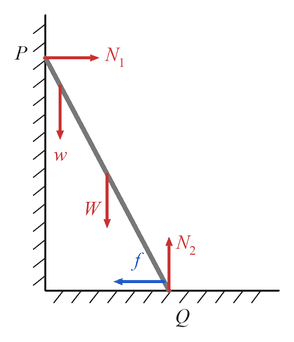
Step 2 — Use the balance of forces. Horizontally, ; vertically, , which does not depend on where the person stands.
Step 3 — Take torques about the foot Q. The weights and tend to turn the ladder about so that its top slides down the wall, and the push of the wall turns it the other way. For balance, the torque of must equal the total torque of the weights. The torque of is times its horizontal distance from , which is largest when the person is at the top. So , and therefore the friction needed, , is largest then.
Therefore, a person at the top has the largest torque about the foot of the ladder, so the wall's push and hence the friction needed at the ground are largest, while the limiting friction stays the same; the ladder is then most likely to slip.