
Question 432 marksMedium
Show that the torque acting on a body is equal to the product of moment of inertia and the angular acceleration of the body.
Confirming your payment
Sign up now and get 250 free tokens.
Rotational Motion - Moment of Inertia and Torque · Question 43 of 67
Show that the torque acting on a body is equal to the product of moment of inertia and the angular acceleration of the body.
Solution:
Concept: A rigid body rotating about a fixed axis is made of particles moving in circles about the axis, all with the same angular velocity and angular acceleration . A particle at distance has tangential acceleration .
Step 1 — Look at one particle. The figure shows a body turning about an axis through , perpendicular to the page. A particle of mass is at distance from the axis.
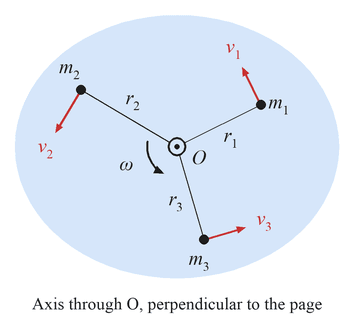
Its tangential acceleration is , so the tangential force on it is:
Step 2 — Find the torque on this particle. This force is at right angles to the radius, so its torque about the axis is:
Step 3 — Add over all particles. The total torque is the sum over every particle; is the same for all of them:
Step 4 — Recognise the moment of inertia. The sum is the moment of inertia of the body about the axis. The internal forces between particles cancel in pairs and give no net torque, so is the external torque.
Therefore, : the torque on a rigid body equals its moment of inertia times its angular acceleration.