
Question 312 marksEasy
Two forces equal in magnitude but opposite in direction act on a rigid body. Under what conditions does the body rotate?
Confirming your payment
Sign up now and get 250 free tokens.
Rotational Motion - Moment of Inertia and Torque · Question 31 of 67
Two forces equal in magnitude but opposite in direction act on a rigid body. Under what conditions does the body rotate?
Solution:
Concept: Two equal and opposite forces always give zero net force. They give a non-zero torque only if their lines of action are different; such a pair is a couple, with moment , where is the perpendicular distance between the lines of action.
Step 1 — Forces along the same line. If the two forces act along the same line, as in panel (a) of the figure, their torques about any point cancel and the body does not rotate.
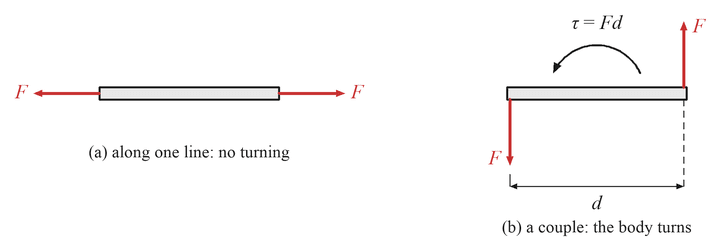
Step 2 — Forces along parallel but different lines. If their lines of action are parallel but a distance apart, as in panel (b), they form a couple of moment , and the body rotates.
Therefore, the body rotates when the lines of action of the two forces do not coincide, so that they form a couple of moment .