
Question 655 marksMedium
(a) Define torque and angular momentum. How are they related?
(b) State and prove the law of conservation of angular momentum.
Confirming your payment
Sign up now and get 250 free tokens.
Rotational Motion - Moment of Inertia and Torque · Question 65 of 67
(a) Define torque and angular momentum. How are they related?
(b) State and prove the law of conservation of angular momentum.
Solution:
Concept: Torque and angular momentum are the rotational analogues of force and linear momentum. Just as , torque is the rate of change of angular momentum.
Step 1 — Define torque and angular momentum (part a). The torque of a force acting at a point with position vector from is ; the angular momentum of a particle of momentum at position is . The figure shows , and the perpendicular .
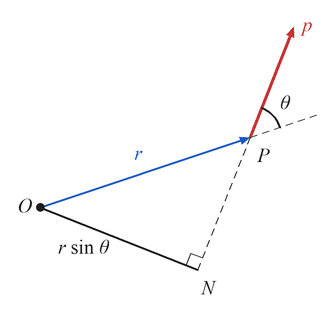
Step 2 — Find the relation (part a). We differentiate :
The first term is zero because is parallel to itself, and , so:
Torque equals the rate of change of angular momentum. For a rigid body about a fixed axis this becomes .
Step 3 — State the law (part b). If no external torque acts on a body or system, its total angular momentum remains constant.
Step 4 — Prove the law (part b). For a system, the internal forces come in equal and opposite pairs along the line joining the particles, so their torques cancel, and equals the net external torque. If that torque is zero:
Hence is constant. For a body turning about a fixed axis, , so:
Step 5 — Give examples. A skater pulling in their arms reduces and spins faster; a diver tucks in to somersault faster; the Earth moves faster in its orbit when it is nearer the Sun.
Therefore, (a) torque and angular momentum are related, with torque equal to the rate of change ; (b) with no external torque, , so angular momentum is conserved and .