
Question 645 marksMedium
(a) Define moment of inertia and radius of gyration.
(b) State (i) parallel axes theorem and (ii) perpendicular axes theorem.
Confirming your payment
Sign up now and get 250 free tokens.
Rotational Motion - Moment of Inertia and Torque · Question 64 of 67
(a) Define moment of inertia and radius of gyration.
(b) State (i) parallel axes theorem and (ii) perpendicular axes theorem.
Solution:
Concept: The moment of inertia of a body about an axis is . The two theorems let us find it about one axis from its value about another.
Step 1 — Define moment of inertia (part a). The moment of inertia of a body about an axis is the sum of the products of the masses of its particles and the squares of their perpendicular distances from the axis:
It measures the body's rotational inertia. Its S.I. unit is .
Step 2 — Define radius of gyration (part a). The radius of gyration of a body about an axis is the distance from the axis at which the whole mass could be placed to give the same moment of inertia:
Step 3 — State the parallel axes theorem (part b, i). The moment of inertia of a body about any axis equals its moment of inertia about a parallel axis through its centre of mass plus the product of its mass and the square of the distance between the two axes:
Step 4 — Show why it holds. In the figure the axes through the centre of mass and through are both perpendicular to the page, a distance apart. A particle of mass is at measured from , at distance from and from .
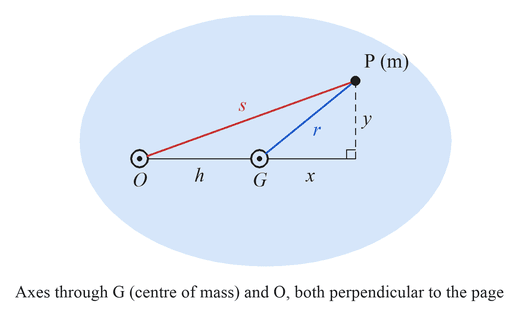
From the right-angled triangle, , which expands to:
Multiplying by and adding for all particles:
Since is the centre of mass, , and , so .
Step 5 — State the perpendicular axes theorem (part b, ii). For a plane lamina, the moment of inertia about an axis perpendicular to its plane equals the sum of its moments of inertia about two mutually perpendicular axes lying in its plane and meeting at the point where the perpendicular axis passes through it:
Step 6 — Show why it holds. In the figure the lamina lies in the plane and the axis is perpendicular to it through . A particle at is at distance from the axis, from the axis and from the axis, with .
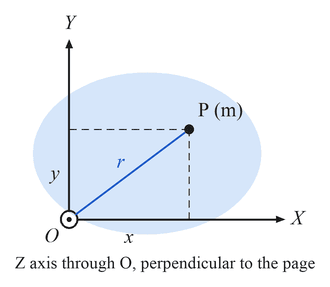
Adding over the lamina:
Therefore, (a) and ; (b) (i) for parallel axes, and (ii) for a plane lamina.