
Question 635 marksMedium
(a) Define torque. Show that it is equal to the product of force and lever arm.
(b) Define angular momentum. What is its physical significance?
Confirming your payment
Sign up now and get 250 free tokens.
Rotational Motion - Moment of Inertia and Torque · Question 63 of 67
(a) Define torque. Show that it is equal to the product of force and lever arm.
(b) Define angular momentum. What is its physical significance?
Solution:
Concept: Torque (moment of force) measures the turning effect of a force about a point or axis; angular momentum (moment of momentum) measures the quantity of rotational motion. Both are vector products with the position vector .
Step 1 — Define torque (part a). The torque of a force about a point is the vector product of the position vector of the point of application (from ) and the force:
Its magnitude is , where is the angle between and . Its S.I. unit is the newton metre (N m).
Step 2 — Find the lever arm. The figure shows the force acting at , its line of action drawn back to , and the perpendicular from to it. This perpendicular distance is the lever arm (moment arm).
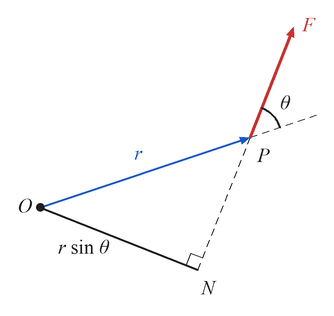
In the right-angled triangle , the angle at between and the line of action is , so:
Step 3 — Show that torque is force times lever arm. We put this into :
So the magnitude of the torque is the force multiplied by the perpendicular distance of its line of action from the axis.
Step 4 — Define angular momentum (part b). The angular momentum of a particle about a point is the moment of its linear momentum about , the vector product of its position vector and its momentum:
Its magnitude is , which is the momentum times the perpendicular distance from to the line of (see the figure). For a rigid body rotating about a fixed axis, . Its S.I. unit is (J s).
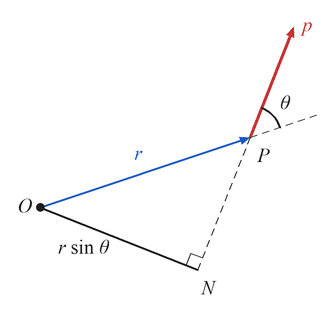
Step 5 — Give its physical significance. Angular momentum is the rotational analogue of linear momentum and measures the quantity of rotational motion of a body. Torque is its rate of change (), and when no external torque acts it is conserved. This explains, for example, why a skater spins faster on pulling in their arms and why a planet moves faster near the Sun.
Therefore, (a) torque has magnitude , the force times its lever arm; (b) angular momentum , or for a rigid body, measures the quantity of rotation, changes only under a torque and is conserved when there is none.