
Question 625 marksMedium
(a) Define angular velocity and angular acceleration.
(b) Derive the equations of rotational motion for a body moving with uniform angular acceleration.
Confirming your payment
Sign up now and get 250 free tokens.
Rotational Motion - Moment of Inertia and Torque · Question 62 of 67
(a) Define angular velocity and angular acceleration.
(b) Derive the equations of rotational motion for a body moving with uniform angular acceleration.
Solution:
Concept: Rotation about a fixed axis is described by the angle turned (the angular displacement), its rate of change , and the rate of change of , the angular acceleration . These play the parts of displacement, velocity and acceleration in linear motion.
Step 1 — Define angular velocity (part a). The angular velocity of a body is the rate of change of its angular displacement:
Its S.I. unit is . It is a vector along the axis of rotation, with its sense given by the right-hand rule.
Step 2 — Define angular acceleration (part a). The angular acceleration is the rate of change of angular velocity:
Its S.I. unit is .
Step 3 — Set up part (b). Let a body turn about a fixed axis with uniform angular acceleration . At its angular velocity is ; at time it is , and it has turned through an angle .
Step 4 — First equation. Since is constant, we integrate from time to time . We write the variables of integration as and , so that they are not confused with the upper limits and :
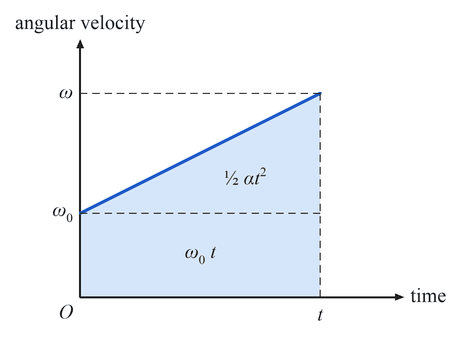
Step 5 — Second equation. The rate of change of is the angular velocity, at time , so we integrate it from to , again with as the variable of integration:
The figure shows the same result: is the area under the – line, a rectangle plus a triangle .
Step 6 — Third equation. By the chain rule the angular acceleration can be written as , or . We set this equal to and integrate, using and as the variables of integration:
Therefore, (a) and ; (b) for uniform angular acceleration, , and .