Opening your dashboard
Class 11 Physics Chapter 11 Rotational Motion - Moment of Inertia and Torque: Practice Questions
156 questions on Chapter 11, each worked through on its own page with the AI tutor. Class 11 Physics, ICSE 2026-27.
156 questions
1–4 marks · Mixed difficulty
- 11 mark
Question 1
A force N acts at the point whose position vector is m. (Hypothetical data.) What is the perpendicular distance of the origin from the line of action of the force?
- 23 marks
Question 2
A cyclist pushes vertically down on a pedal with a force N. The crank , from the axle to the pedal, is m long. (Hypothetical data.) The figure shows the crank below the horizontal, pointing forward.
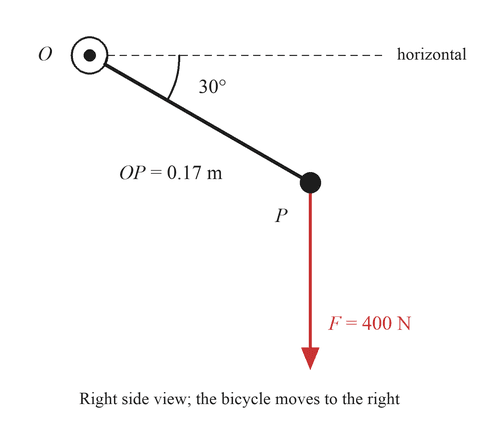
(a) Find the torque of the push about the axle when the crank is horizontal and pointing forward.
(b) Find the torque in the position shown in the figure.
(c) What is the torque when the crank points straight down? Explain your answer.
- 31 mark
Question 3
Two like parallel forces of N and N act on a rigid bar at two points m apart. (Hypothetical data.) Where does the line of action of their resultant cut the bar?
- 43 marks
Question 4
A shopkeeper's beam balance has its two arms of unequal lengths (left) and (right) about its pivot , as shown. The beam is level when both pans are empty. (Hypothetical data.) A packet placed in the left pan is balanced by standard masses of kg in the right pan. The same packet placed in the right pan is balanced by kg in the left pan.

(a) Find the true mass of the packet.
(b) Find the ratio of the arm lengths.
- 51 mark
Question 5
A driver turns a steering wheel of diameter cm by pushing with each hand at opposite ends of a diameter. Each hand pushes with a force of N along the rim (tangent to it), and the two forces are in opposite directions. (Hypothetical data.) What are the torque about the axis of the wheel and the net force on the wheel due to the two hands?
- 64 marks
Question 6
A uniform ladder , m long and of mass kg, rests with its upper end against a smooth vertical wall and its foot on a rough horizontal floor, m from the wall, as shown. (Hypothetical data.) Take .

(a) Find the force exerted by the wall on the ladder.
(b) Find the normal reaction and the friction force exerted by the floor.
(c) Find the least coefficient of friction between the ladder and the floor for the ladder to stay at rest.
- 71 mark
Question 7
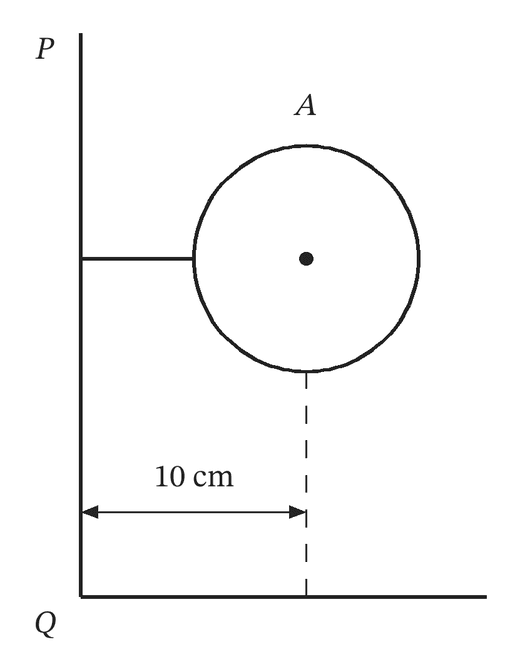
Two coins and lie on a record turntable rotating steadily at rpm, at distances of cm and cm from its axis, and turn with it without slipping. (Hypothetical data.) What is the ratio of the centripetal acceleration of to that of ?
- 83 marks
Question 8
A person holds a kg dumbbell in the hand with the forearm horizontal and the upper arm vertical, as shown. The forearm and hand together have a mass of kg, and their weight acts at , cm from the elbow joint . The weight of the dumbbell acts at , cm from . The biceps muscle is attached to the forearm at , cm from , and pulls vertically upward with a force . (Hypothetical data.) Take .

(a) Find the force exerted by the biceps.
(b) Find the size and direction of the force exerted on the forearm at the elbow joint.
- 94 marks
Question 9
A uniform plank , m long and of mass kg, rests on top of a flat wall so that the end overhangs the edge of the wall by m, as shown. The plank is not fixed to the wall. A student of mass kg walks slowly from along the overhanging part towards . (Hypothetical data.) Take .
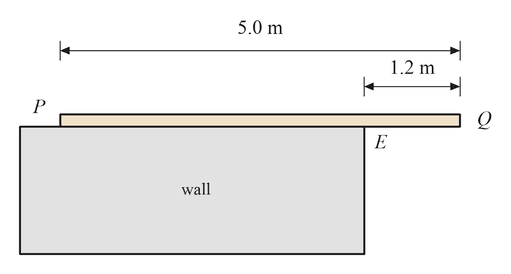
(a) How far beyond the edge can the student walk before the plank starts to tip?
(b) Can the student reach the end ? What is the least mass that must be placed at the end so that the student can just stand at ?
- 102 marks
Question 10
The three blades of a ceiling fan sweep a circle of diameter mm, and the fan turns steadily at revolutions per minute. (Hypothetical data.)
(a) Find the angular velocity of the fan in .
(b) Find the linear speed of the tip of a blade and of a point on the blade cm from the axis. Which of the two quantities, angular velocity or linear speed, is the same for every point of a blade?
- 111 mark
Question 11
The graph shows how the angular velocity of an electric motor's shaft changes with time . It speeds up uniformly from rest to in s, runs steadily until s, and then slows down uniformly to rest at s. (Hypothetical data.)
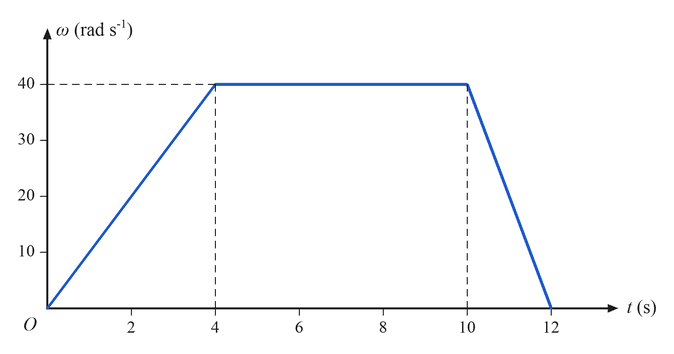
Through what total angle does the shaft turn in the s?
- 123 marks
Question 12
The drum of a washing machine is spinning at when the motor is switched off. It then slows down with a uniform angular retardation of . (Hypothetical data.)
(a) Find the angle through which the drum turns while its angular velocity falls to half its starting value.
(b) Find the further angle it turns through before it stops.
(c) Find the time taken for each of these two stages, and comment on your answers.
- 132 marks
Question 13
A car starts from rest and speeds up uniformly to in s on a straight road. Each wheel has a radius of m and turns without slipping on the road, so the speed of the car is at every instant. (Hypothetical data.)
(a) Find the angular acceleration of a wheel.
(b) Find the number of revolutions made by a wheel in the s.
- 144 marks
Question 14
An electric potter's wheel starts from rest and speeds up uniformly to rpm in s. The motor is then switched off, and the wheel slows down uniformly, coming to rest after making more revolutions. (Hypothetical data.)
(a) Find the angular acceleration while the wheel speeds up.
(b) Find the number of revolutions it makes while speeding up.
(c) Find the angular retardation after the motor is switched off and the time the wheel takes to stop.
- 151 mark
Question 15
A motor shaft is turning anticlockwise at when a constant clockwise angular acceleration of is applied to it for s. (Hypothetical data.) Through what total angle does the shaft turn during these s, counting turning in both directions?
- 161 mark
Question 16
A light toy wheel has four spokes, and a small ball of mass g is fixed on each spoke. The balls are at distances of cm, cm, cm and cm from the axle. (Hypothetical data.) What is the radius of gyration of the system of balls about the axle?
- 173 marks
Question 17
A bicycle wheel is modelled as follows: the rim and tyre together have a mass of kg, all at a mean distance of m from the axle; the hub has a mass of kg, all at m from the axle; the mass of the spokes is negligible. (Hypothetical data.)
(a) Find the moment of inertia of the wheel about its axle.
(b) Find its radius of gyration, and explain why it is a little less than m.
(c) A g reflector is clipped to the spokes m from the axle. By what percentage does the moment of inertia increase?
- 182 marks
Question 18
A flywheel of mass kg has a moment of inertia of about its axis of rotation. (Hypothetical data.)
(a) Find its radius of gyration about this axis.
(b) A thin ring has all its mass on its rim. What radius must a thin ring of the same mass have so that it has the same moment of inertia about its own axis? Use your answer to explain the meaning of the radius of gyration.
- 193 marks
Question 19
A playground merry-go-round is a platform of mass kg and radius m, with a moment of inertia of about its vertical axis. Four children, each of mass kg, ride on it. Treat each child as a particle. (Hypothetical data.)
(a) Find the moment of inertia of the platform and the children about the axis when all four children sit at the edge, m from the axis.
(b) Find it again when all four move in to m from the axis.
(c) Find the radius of gyration of the whole system in each case.
- 201 mark
Question 20
In each of three systems, , and , a total mass of kg is fixed on a light rod, which turns about an axis through its end perpendicular to the rod. (Hypothetical data.)
: one kg mass at m from .
: four kg masses at m, m, m and m from .
: two kg masses at m and m from .
Which arrangement of their moments of inertia about the axis is correct?
- 211 mark
Question 21
The figure shows the top view of a three-wing revolving door, which can turn freely about a vertical axis through . Its moment of inertia about this axis is . Person A pushes on one wing at , m from the axis, with a force N at right angles to the wing, trying to turn the door clockwise. At the same time person B pushes on another wing at , m from the axis, with a force N at right angles to that wing, trying to turn it anticlockwise. (Hypothetical data.)
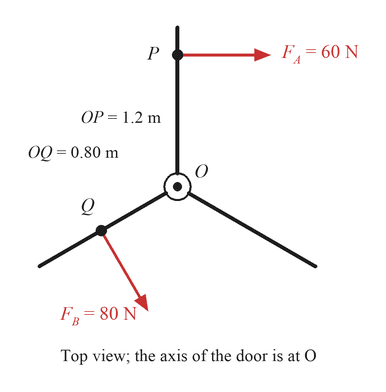
Friction is negligible. What is the angular acceleration of the door?
- 223 marks
Question 22
A bicycle is held upside down on a stand, and its front wheel is spinning freely at . The wheel has a moment of inertia of about its axle, and its rim is m from the axle. The brake pads are now pressed against the rim with a total normal force of N; the coefficient of friction between the pads and the rim is . (Hypothetical data.) Neglect friction at the axle.
(a) Find the frictional torque on the wheel.
(b) Find the angular retardation of the wheel.
(c) Find the time the wheel takes to stop and the angle it turns through while stopping.
- 231 mark
Question 23
Different steady torques are applied in turn to two wheels and , free to turn about fixed axles, and the angular acceleration of each is measured. The graph shows the results: the line for passes through and the line for through . (Hypothetical data.)
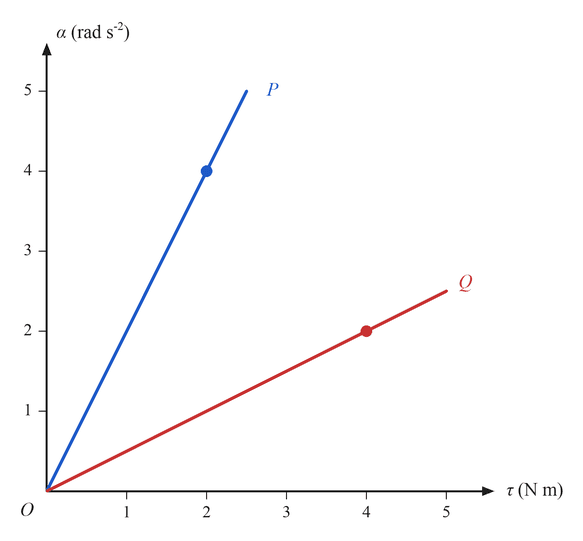
What is the ratio of their moments of inertia?
- 243 marks
Question 24
A tightrope walker of mass kg stands on a rope. For turning (toppling) sideways about the rope, the walker's body has a moment of inertia of . The walker leans slightly, so that their centre of mass is cm to one side of the vertical plane through the rope. (Hypothetical data.) Take .
(a) Find the torque of the walker's weight about the rope at that instant.
(b) Find the walker's angular acceleration about the rope at that instant.
(c) The walker now carries a long horizontal pole whose centre is directly above the rope; the pole adds to the walker's moment of inertia about the rope. For the same lean, find the new angular acceleration, and explain how the pole helps the walker keep their balance.
- 253 marks
Question 25
A toy spinner has two small g weights fixed at the ends of a light cross-bar, each cm from the axle. A string is wound round the axle, which has a radius of cm, and is pulled with a steady force of N, so that the spinner starts to turn from rest about the axle. (Hypothetical data.) Neglect the moment of inertia of the cross-bar and axle, and friction.
(a) Find the moment of inertia of the spinner about the axle.
(b) Find its angular acceleration.
(c) The string is pulled for s. Find the angular velocity of the spinner when the string comes off.
- 261 mark
Question 26
An ice-hockey puck of mass slides at a steady along a straight line on smooth ice. Point is from this line, and is the point of the line nearest to . (Hypothetical data.)
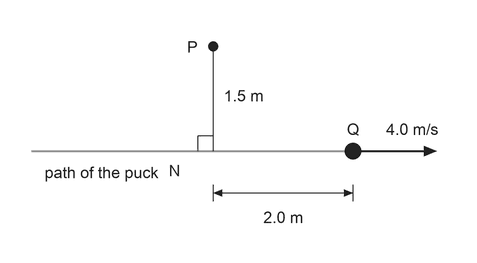
What is the magnitude of the angular momentum of the puck about when the puck is at , beyond , as shown?
- 273 marks
Question 27
A student sits on a stool that can turn freely about a vertical axis. The student holds a bicycle wheel above their head with its axle vertical, as shown. The wheel spins at , anticlockwise as seen from above, and its moment of inertia about its axle is . The student, the stool and the wheel (not counting the wheel's spin) have a moment of inertia of about the stool's axis. At first the stool is at rest. (Hypothetical data.)
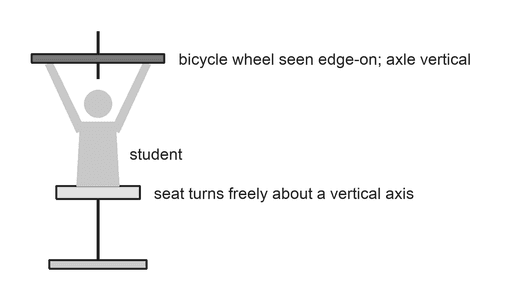
The wheel keeps spinning at about its own axle throughout. Ignore friction in the stool's bearing.
(a) The student turns the wheel upside down, so that its axle is again vertical. Find the angular velocity of the stool afterwards and its sense of rotation.
(b) Find the angular velocity of the stool if the student had instead turned the axle only until it was horizontal.
(c) In (a) the stool gains kinetic energy although no external torque acts about its axis. Where does this energy come from?
- 281 mark
Question 28
A small puck slides on a smooth horizontal table, tied to a light string. In set-up (1), the string passes through a small hole at and is slowly pulled down from below, so the puck circles inwards. In set-up (2), the other end of the string is tied to a thin fixed vertical post, and the string winds round the post as the puck moves.
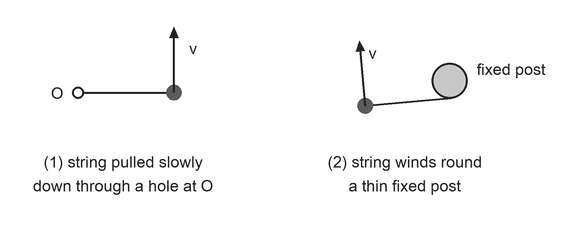
Which statement is correct?
- 294 marks
Question 29
A science museum has a large rotating platform, a uniform disc of mass and radius that turns freely about a vertical axle through its centre . It is turning anticlockwise (seen from above) at . A student of mass runs at along the tangent at , in the same direction as the rim moves there, and jumps on at , as shown. (Hypothetical data.)
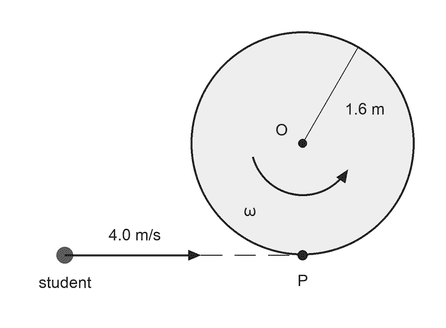
Treat the student as a particle and ignore friction at the axle.
(a) Find the angular velocity of the platform with the student on it.
(b) Find the total kinetic energy before and after the student jumps on, and explain why some is lost.
(c) Find the angular velocity if the student had run at the same speed in the opposite direction along the same tangent.
- 302 marks
Question 30
A car travels due north along a level road, and its wheels roll without slipping.
(a) In which direction does the angular momentum of each wheel's spin point?
(b) The driver brakes and the car slows down. In which direction is the torque that the brakes exert on each wheel?
- 313 marks
Question 31
An electric bus stores energy in a flywheel, a uniform solid steel disc of mass and radius spinning about its own axis. At each charging stop the flywheel is spun up to . Between stops it drives the bus until it has slowed to , after which it must be charged again. (Hypothetical data.)
(a) Find the moment of inertia of the flywheel about its axis.
(b) How much energy does the flywheel give up between two stops, and what fraction of the energy stored at is this?
(c) If the bus draws an average power of from the flywheel, for how long can it run between stops?
- 321 mark
Question 32
A winch lifts a load of mass at a steady speed. The rope winds onto a drum of radius , which a motor turns at , as shown. (Hypothetical data.)

Taking and ignoring friction and the mass of the rope, the power delivered to the drum is
- 333 marks
Question 33
A small revolving stage has a moment of inertia of about its vertical axle and starts from rest. A stagehand pushes on its rim with a constant force of , always along the tangent at a radius of , for exactly one revolution. A constant frictional torque of opposes the motion all the time. (Hypothetical data.)
(a) Find the work done by the stagehand, and the work done against friction, during this revolution.
(b) Find the kinetic energy and the angular speed of the stage when the push ends.
(c) After the push ends, how many more revolutions does the stage make before it stops?
- 341 mark
Question 34
Two flywheels and spin about their axles with equal angular momenta. The moment of inertia of is four times that of . The ratio of their kinetic energies, , is
- 353 marks
Question 35
The rotor of a laboratory centrifuge, with its tubes, has a moment of inertia of about its axis. A constant torque brings it from rest to in . Ignore friction. (Hypothetical data.)
(a) Find the torque.
(b) Find the work done by the motor during these .
(c) Find the average power, and the power delivered at the end of the . Explain why the two values differ.
- 361 mark
Question 36
A flat irregular plate of mass has its centre of mass at . Points and lie on a straight line through , on opposite sides of it, with and , as shown. The moment of inertia of the plate about an axis through perpendicular to the plate is . (Hypothetical data.)
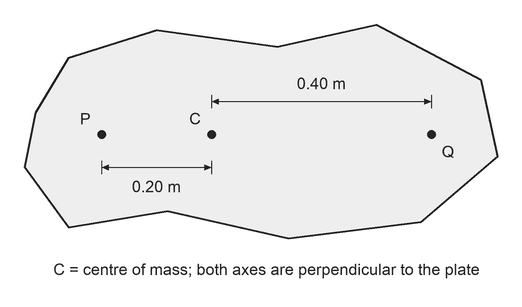
The moment of inertia of the plate about the parallel axis through is
- 374 marks
Question 37
A carpenter's square is made of two thin uniform steel strips joined at right angles at . Arm is long and has mass ; arm is long and has mass , as shown. Treat each arm as a thin rod. (The moment of inertia of a thin uniform rod of mass and length about a perpendicular axis through its centre is .) (Hypothetical data.)
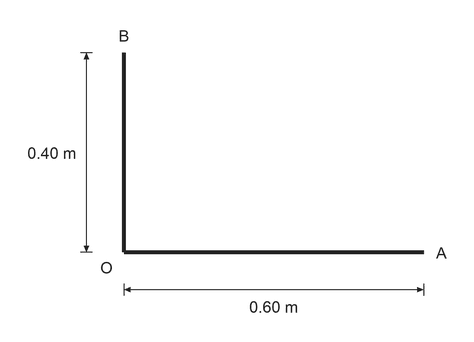
(a) Find the moment of inertia of the square about an axis through perpendicular to its plane.
(b) Find its moments of inertia about the line and about the line , and show that they agree with your answer to (a).
(c) Locate the centre of mass of the square, and find its moment of inertia about an axis through perpendicular to its plane.
- 382 marks
Question 38
A student tries to use the theorem of perpendicular axes, , for a uniform solid sphere of mass and radius , taking , and along three mutually perpendicular diameters.
(a) Show that the theorem gives a wrong result here.
(b) State the condition under which the theorem may be used. Then use it to find the moment of inertia of a thin uniform disc of mass and radius about a diameter, given that its moment of inertia about its own axis is .
- 393 marks
Question 39
A satellite spins about the axis of its body, which is a uniform solid cylinder of mass and radius . Two flat solar panels, each of mass and long, stick out on opposite sides. Each panel lies in a plane containing the spin axis and runs along a radius from to from the axis, as shown in the view along the spin axis. For this purpose, each panel may be treated as a thin uniform rod long. (Hypothetical data.)
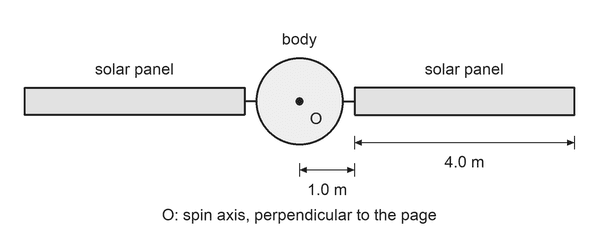
(a) Find the moment of inertia of one panel about the spin axis.
(b) Ignoring the light struts, find the moment of inertia of the whole satellite about the spin axis, and the fraction of it that comes from the panels.
(c) Find the radius of gyration of the satellite about the spin axis.
- 402 marks
Question 40
A uniform disc and a thin ring have the same mass and the same radius .
(a) How far from the centre of the disc must an axis perpendicular to the disc pass, so that the disc's moment of inertia about it equals the ring's moment of inertia about the ring's own axis (through its centre, perpendicular to its plane)?
(b) For , find this distance and describe where all such axes can be.
- 411 mark
Question 41
Measurements show that the moment of inertia of the Earth about its spin axis is about , where is its mass and its radius. For comparison, about a diameter, a uniform solid sphere has and a thin spherical shell has . What does the Earth's value show?
- 423 marks
Question 42
A roller is a thick-walled steel tube of length , with outer radius and inner radius . The density of steel is . (Hypothetical data.)
(a) Find the mass of the tube.
(b) Treat the tube as a solid cylinder of radius from which a coaxial solid cylinder of radius has been removed, and find its moment of inertia about its axis.
(c) Show that your answer equals , where is the mass of the tube, and compare it with , the value for a thin-walled tube of the same mass and outer radius.
- 431 mark
Question 43
A pendulum is made of a uniform rod of mass and length , hanging from a horizontal axle through its top end , with a uniform disc of mass and radius fixed to its lower end. The disc lies in the plane of swing, and its centre is below , as shown. (Hypothetical data.)

The moment of inertia of the pendulum about the axle is
- 443 marks
Question 44
A thin ring, a thin-walled hollow cylinder long and a uniform solid cylinder long each have mass and radius . (Hypothetical data.)
(a) Find the moment of inertia of each about its own axis.
(b) Explain why the ring and the hollow cylinder have the same moment of inertia, although the cylinder is much longer.
(c) Explain, in terms of where the mass lies, why the solid cylinder's value is only half as large, and find its radius of gyration about its axis.
- 451 mark
Question 45
A uniform metal rod of mass is long and has a radius of . (Hypothetical data.) Treating it as a solid cylinder, its moment of inertia about its own long axis (the axis running along its length) is
- 461 mark
Question 46
A bicycle wheel of radius rolls without slipping along a level road, its centre moving at . A small pebble is stuck in the tyre. At the instant shown, is on the rising (rear) side of the wheel, above the road.
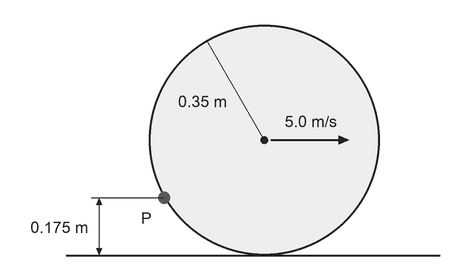
The speed of the pebble at this instant is
- 473 marks
Question 47
A small solid ball rolls without slipping down a track and round a vertical loop of radius , starting from rest at a height above the bottom of the loop, as shown. The ball's own radius is very small compared with . Take . (Hypothetical data.)
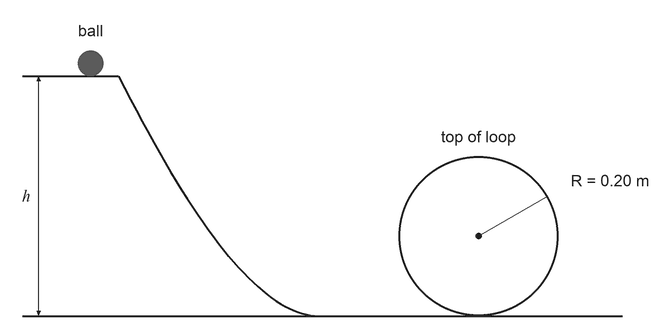
(a) What is the least speed the ball must have at the top of the loop if it is not to lose contact with the track?
(b) Find the least value of for which the ball gets round the loop.
(c) A small block sliding without friction would need . Explain why the rolling ball needs a greater height.
- 481 mark
Question 48
A rear-wheel-drive car speeds up along a level road, and all its wheels roll without slipping. Ignoring air drag and rolling resistance, in which directions does the road's friction act on the rear (driven) wheels and on the front (free) wheels?
- 492 marks
Question 49
A coin rolls on a horizontal plane. What fraction of its total kinetic energy is rotational?
- 502 marks
Question 50
A ring, a disc and a sphere all of the same radius and mass roll down an inclined plane from the same height . Which of the three reaches bottom (i) earliest and (ii) latest?
- 512 marks
Question 51
A wheel moving down a perfectly frictionless inclined plane will undergo slipping (not rolling) motion. Is it true?
- 522 marks
Question 52
“The mass of a flywheel is concentrated on the rim”. Why?
- 532 marks
Question 53
How is the swimmer jumping into water from a height be able to make loop in air?
- 542 marks
Question 54
“There are two propellers in a helicopter.” Why?
- 551 mark
Question 55
A metal ring is melted and a solid sphere is made out of it. What happens to the M.I. about a vertical axis through the centre?
- 562 marks
Question 56
How will you distinguish between a hard-boiled egg and a raw egg by spinning each on a table top?
- 572 marks
Question 57
Explain how a cat is able to land on its feet when thrown into air?
- 582 marks
Question 58
If the ice on the polar caps of the Earth melts, how will it affect the duration of the day?
- 592 marks
Question 59
(i) Give the location of centre of mass of a sphere and a ring.
(ii) Does the centre of mass of a body necessarily be inside the body?
- 602 marks
Question 60
A child sits stationary at one end of a long trolley moving uniformly with a speed on a smooth horizontal floor. If the child gets up and runs about on the trolley in any manner, what is the speed of the C.M. of the (trolley + child) system?
- 611 mark
Question 61
A planet (such as a comet) revolves round a massive star in a highly elliptical orbit. Is its angular momentum constant over the entire orbit? Ignore any mass loss.
- 623 marks
Question 62
A particle starts rotating from rest according to the formula . Find the angular velocity and the acceleration at the end of 5 s.
- 633 marks
Question 63
The initial angular velocity of a heavy flywheel rotating on its axis is . Its angular velocity decreases due to friction. At the end of the first minute, its angular velocity is . What is its angular velocity at the end of third minute, if the frictional force is constant?
- 643 marks
Question 64
A wheel starts rotating with an angular velocity of 2 rad/s. If it rotates with a constant angular acceleration 4 rad/s², what angle does the wheel rotate through in 2.0 s? What is the angular speed after 2.0 s?
- 653 marks
Question 65
A flywheel is rotating at the rate of 100 rpm and slows down at a constant rate of 1 rad/s². Calculate the time required to stop the flywheel and the number of rotations made by the flywheel before coming to rest.
- 663 marks
Question 66
The number of revolutions made by a flywheel change from 300 rpm to 1500 rpm in 10 s. Calculate angular acceleration assuming it to be uniform. Also calculate the number of revolutions made during the time.
- 673 marks
Question 67
When a constant torque is applied, a wheel is turned from rest through 200 radians in 10 s. What is its angular acceleration? If the same torque continues to act, what is the angular velocity of the wheel after 15 s from the start?
- 683 marks
Question 68
Starting from rest, a centrifuge accelerates uniformly at the rate of 40 rad/s². What is the number of revolutions made by it when its angular velocity becomes 1800 rev/min?
- 693 marks
Question 69
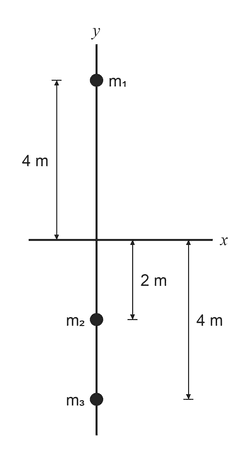
Three point masses kg, kg and kg are placed along a straight line along the -axis as shown in the given figure. What is the moment of inertia of the system about the -axis?
- 703 marks
Question 70
Three masses of 2 kg, 3 kg and 4 kg are located at the vertices of an equilateral triangle of side 1 m. What is the M.I. of the system about an axis along the altitude of the triangle and passing through the 3 kg mass?
- 713 marks
Question 71
The mass of a uniform rod is 0.4 kg and its length is 2 m. Calculate the radius of gyration of the rod about an axis passing through its centre of mass and perpendicular to its length.
- 723 marks
Question 72
Calculate the moment of inertia of a uniform disc of mass 0.4 kg and radius 10 cm about an axis passing through its edge and perpendicular to the plane of the disc.
- 733 marks
Question 73
Calculate the percentage increase in the moment of inertia about the axis of symmetry of a flywheel when the diameter of the flywheel is increased by 2%.
- 743 marks
Question 74
When a constant torque is applied to a flywheel at rest, its angular velocity increases by 10 rad/s in 2 s. Calculate the torque applied if the moment of inertia of the flywheel about the axis of rotation is 200 kg m².
- 753 marks
Question 75
A uniform disc of moment of inertia 1 kg m² rotates with a speed of 120 rpm. Calculate the torque required to stop the disc in 10 revolutions.
- 763 marks
Question 76
The power of a motor is 15 HP and its maximum angular speed is 150 rad s⁻¹. What is the corresponding torque?
- 773 marks
Question 77
A wheel of grindstone has applied at its axle 2 cm in radius, a constant tangential force of 600 N. Find the change in angular momentum acquired after 8 s and also the torque acting.
- 783 marks
Question 78
What is the torque acting on the bob of mass of a simple pendulum of length , when the string of the pendulum makes an angle with the vertical? When is the torque (i) zero and (ii) maximum?
- 793 marks
Question 79
A flywheel has a mass 200 kg and radius of gyration 0.6 m. It is given an angular speed of 150 rpm in 90 rotations starting from rest. Determine the torque assuming it to be constant that acted on the flywheel.
- 803 marks
Question 80
A grindstone has moment of inertia 600 kg m². A constant couple is applied on it. As a result, it acquires a speed of 150 rpm in 10 s, after starting from rest. Calculate the couple.
- 813 marks
Question 81
A car of mass 1000 kg moves on a circular track of radius 100 m with a speed of 40 m/s. Calculate the magnitude of its angular momentum relative to the centre of the track.
- 823 marks
Question 82
A uniform sphere of radius 0.25 m and mass 2 kg rotates about its diameter. What is the angular momentum when the angular speed is 5 rad/s?
- 833 marks
Question 83
The mean distance of the Moon from the Earth is km and it rotates around the Earth in 27.3 days. What is the angular momentum of the Moon around the Earth? Mass of the Moon kg.
- 843 marks
Question 84
The maximum and minimum distance of a comet from the Sun are m and m. If its velocity nearest to the sun is m s⁻¹, what is the velocity in the farthest position? Assume circular path for the comet.
- 853 marks
Question 85
The mass of a star is kg and its radius is km. It rotates about its axis with an angular speed of rad/s. Calculate the speed of the star when it collapses to a radius of km. Assume the moment of inertia of the star to be .
- 863 marks
Question 86
Calculate the angular momentum and rotational kinetic energy of the Earth about its own axis. Given mass of the Earth is kg and its radius km. [Moment of inertia of the Earth about its axis of rotation is .]
- 873 marks
Question 87
An oxygen molecule has a mass of kg and a moment of inertia of kg m² about an axis passing through the centre and perpendicular to the line joining the two oxygen atoms. The molecule is moving at a speed of 500 m/s and its rotational kinetic energy is two-thirds its translational K.E. Calculate its angular velocity.
- 883 marks
Question 88
A flywheel of mass 400 kg and one metre radius makes 600 rev/minute. Assuming its mass to be concentrated at the rim, calculate the angular velocity, M.I. and energy of the flywheel.
- 893 marks
Question 89
A circular disc of mass 100 g and radius 10 cm is making 2 rps about an axis passing through its centre and perpendicular to its plane. Calculate its kinetic energy.
- 903 marks
Question 90
Calculate the total K.E. of the Earth, assuming it to be a uniform spherical body moving around the Sun with a speed of 30 km s⁻¹ and spinning about its own axis? Mass of the Earth kg. Radius of the Earth km?
- 913 marks
Question 91
A circular disc of mass 4 kg and radius 1 m rolls on a smooth table with a uniform velocity of 0.5 m s⁻¹. Calculate its (a) rotating K.E. and (b) translational K.E.
- 923 marks
Question 92
Calculate the kinetic energy of a hollow metal sphere of mass 2 kg, which rolls over a horizontal surface with a linear velocity of 20 cm/s.
- 933 marks
Question 93
A thin uniform rod 0.75 m long and having a mass 1.5 kg rotates 7 times per second about an axis passing through its centre of gravity and perpendicular to its length. Find its kinetic energy.
- 943 marks
Question 94
The mass of a hoop of radius 0.30 m is 2 kg. It rolls along a horizontal floor so that its centre of mass has a speed of 2 m/s. What is the work done to stop it?
- 953 marks
Question 95
If a constant torque of 500 N m turns a wheel of moment of inertia 100 kg m² about an axis through its centre, find the angular velocity and the kinetic energy gained in 2 seconds.
- 963 marks
Question 96
The flywheel of an engine when acted upon by a constant torque rotates at the rate of 3000 rev/min and develops a power of 10 kW. Find the torque acting on the wheel.
- 971 mark
Question 97
In an orbital motion, the angular momentum vector is
- 981 mark
Question 98
A force of acts on O, the origin of the coordinate system. The torque about the point is
- 991 mark
Question 99
Angular momentum of the particle rotating with a central force is constant due to
- 1001 mark
Question 100
When a torque acting upon a system is zero, then which of the following will be constant?
- 1011 mark
Question 101
A disc of moment of inertia is acted upon by a constant torque of 40 N m. Starting from rest, the time taken by it to acquire an angular velocity of 24 rad/s is
- 1021 mark
Question 102
A mass hangs with the help of a string wrapped around a pulley on a frictionless bearing. The pulley has mass and radius . Assuming pulley to be a perfect uniform circular disc, the acceleration of the mass , if the string does not slip on the pulley, is
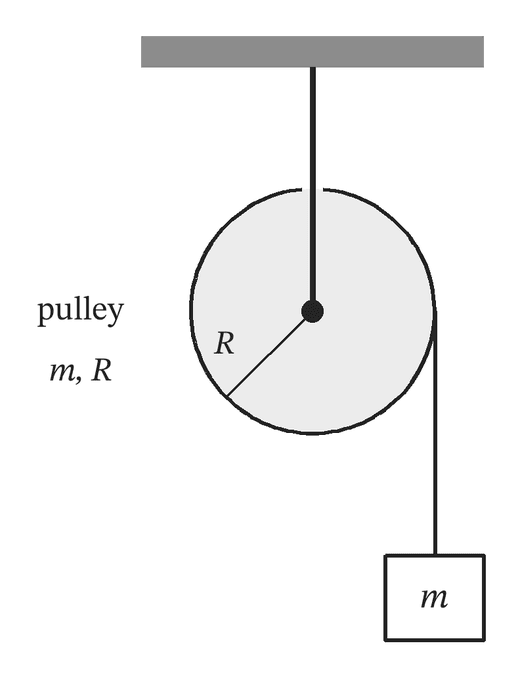
- 1031 mark
Question 103
A bar of length carrying a small mass at one of its ends rotates with a uniform angular speed in a vertical plane about the mid-point of the bar. During the rotation, at some instant of time when the bar is horizontal, the mass is detached from the bar, but the bar continues to rotate with same . The mass moves vertically up comes back and reaches the bar at the same place. At that place, the acceleration due to gravity is [One or more options may be correct. Choose the correct option(s).]
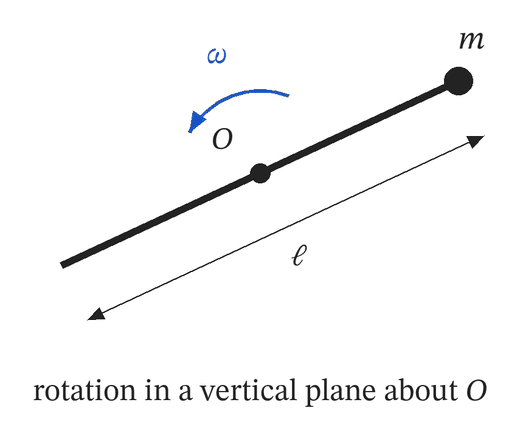
(A) This is possible if the quantity is an integer.
(B) The total time of flight of the mass is proportional to .
(C) The total distance travelled by the mass in air is proportional to .
(D) The total distance travelled by the mass in air and its total time of flight are both independent on its mass.
- 1041 mark
Question 104
A force is acting at a point . The value of for which angular momentum about origin is conserved is
- 1051 mark
Question 105
A rod of weight is supported by two parallel knife edges and and is in equilibrium in a horizontal position. The knives are at a distance from each other. The centre of mass of the rod is at distance from . The normal reaction on is
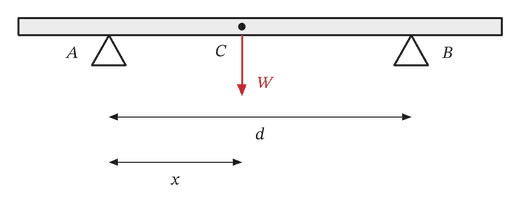
- 1061 mark
Question 106
Two particles and are moving as shown in the given figure. Their total angular momentum about the point is
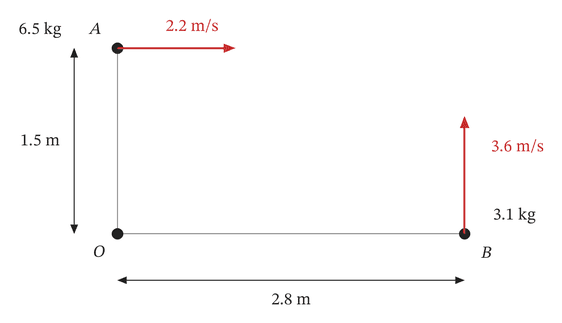
- 1071 mark
Question 107
An automobile moves on a road with a speed of . The radius of its wheel is 0.45 m and moment of inertia of the wheel about its axis of rotation is . If the vehicle is brought to rest in 15 s, the magnitude of average torque transmitted by its brakes to the wheel is
- 1081 mark
Question 108
From a disc of radius and mass , a circular hole of diameter , whose rim passes through the centre is cut. What is the moment of inertia of the remaining part of the disc about a perpendicular axis, passing through the centre?
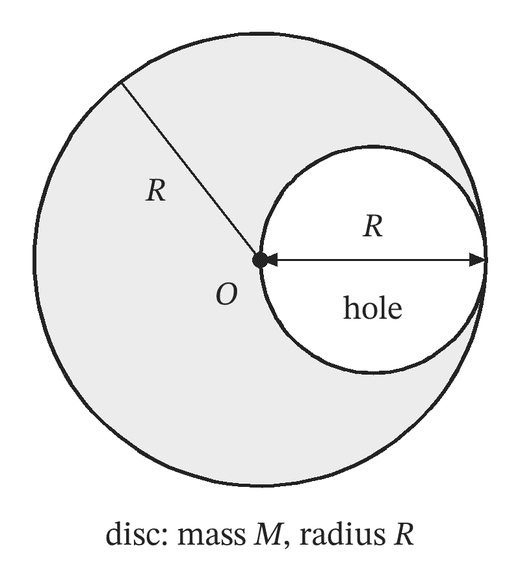
- 1091 mark
Question 109
A solid cylinder of mass 50 kg and radius 0.5 m is free to rotate about the horizontal axis. A massless string is wound round the cylinder with one end attached to it and other hanging freely. Tension in the string required to produce an angular acceleration of 2 revolutions is
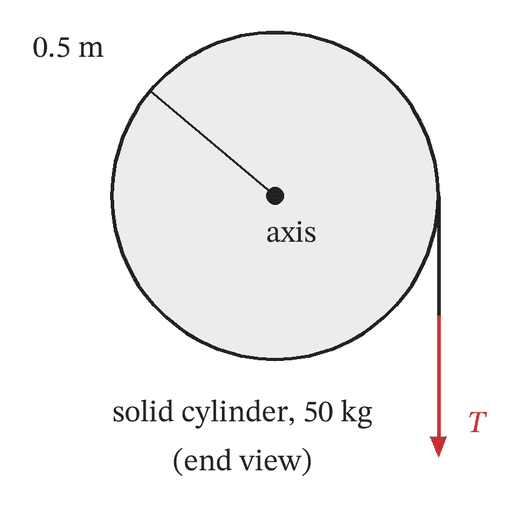
- 1101 mark
Question 110
A solid sphere is rotating in free space. If the radius of the sphere is increased keeping mass same, which one of the following will not be affected?
- 1111 mark
Question 111
A rod of length 50 cm is pivoted at one end. It is raised such that it makes an angle of 30° from the horizontal as shown in the given figure and released from rest. Its angular speed when it passes through the horizontal (in rad ) will be ()
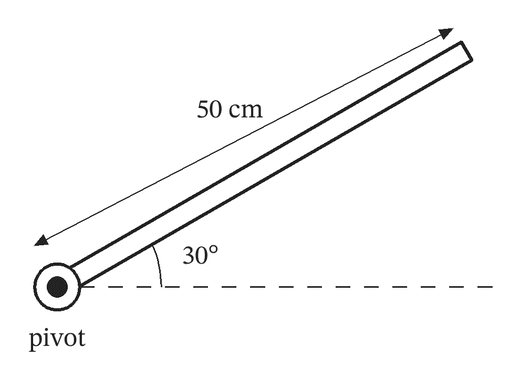
- 1121 mark
Question 112
The magnitude of torque on a particle of mass 1 kg is 2.5 N m about the origin. If the force acting on it is 1 N and the distance of the particle from the origin is 5 m, the angle between the force and the position vector is (in radians)
- 1131 mark
Question 113
A rigid massless rod of length has two masses attached at each end as shown in the figure. The rod is pivoted at point on the horizontal axis. When released from initial horizontal position, its instantaneous angular acceleration will be
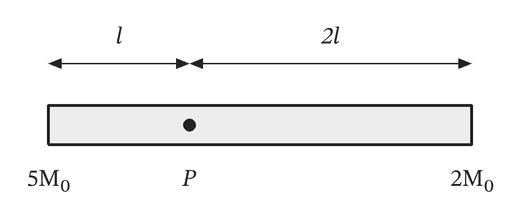
- 1141 mark
Question 114
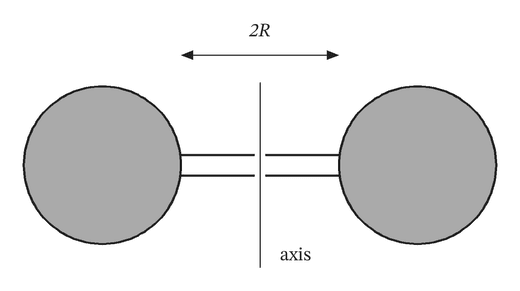
Two identical spherical balls of mass and radius each are stuck on two ends of a rod of length and mass as shown in the figure. The moment of inertia of the system about the axis passing perpendicularly through the centre of the rod is
- 1151 mark
Question 115
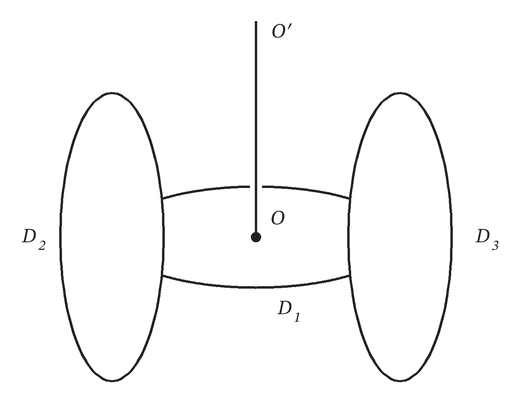
A circular disc of mass and radius has two identical discs and of the same mass and radius attached rigidly at its opposite ends. The moment of inertia of the system about the axis , passing through the centre of , as shown in the given figure will be
- 1161 mark
Question 116
A particle of mass 20 g is released with an initial velocity 5 m/s along the curve from the point , as shown in the given figure. The point is at height from point . The particle slides along the frictionless surface. When the particle reaches point , its angular momentum about will be (take )

- 1171 mark
Question 117
The moment of inertia of a solid sphere, about an axis parallel to its diameter and at a distance of from it, is . Which one of the graphs represents the variation of with correctly?

- 1181 mark
Question 118
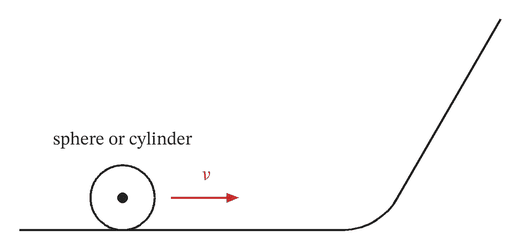
A solid sphere and solid cylinder of identical radii approach an incline with the same linear velocity as shown in the figure. Both roll without slipping all throughout. The two climb maximum height and on the incline. The ratio is given by
- 1191 mark
Question 119
A thin smooth rod of length and mass is rotating freely with angular speed about an axis perpendicular to the rod and passing through its centre. Two beads of mass and negligible size are at the centre of the rod initially. The beads are free to slide along the rod. The angular speed of the system, when the beads reach the opposite ends of the rod, will be
- 1201 mark
Question 120
Moment of inertia of a body about a given axis is . Initially the body is at rest. In order to produce a rotational kinetic energy of 1200 J, the angular acceleration of must be applied about the axis for a duration of
- 1211 mark
Question 121
A stationary horizontal disc is free to rotate about its axis. When a torque is applied on it, its kinetic energy as a function of , where is the angle by which it has rotated, is given as . If its moment of inertia is , then the angular acceleration of the disc is
- 1221 mark
Question 122
A solid sphere of mass and radius is divided into two unequal parts. The first part has a mass of and is converted into a uniform disc of radius . The second part is converted into a uniform solid sphere. Let be the moment of inertia of the disc about its axis and be the moment of inertia of the new sphere about its axis. The ratio is given by
- 1231 mark
Question 123
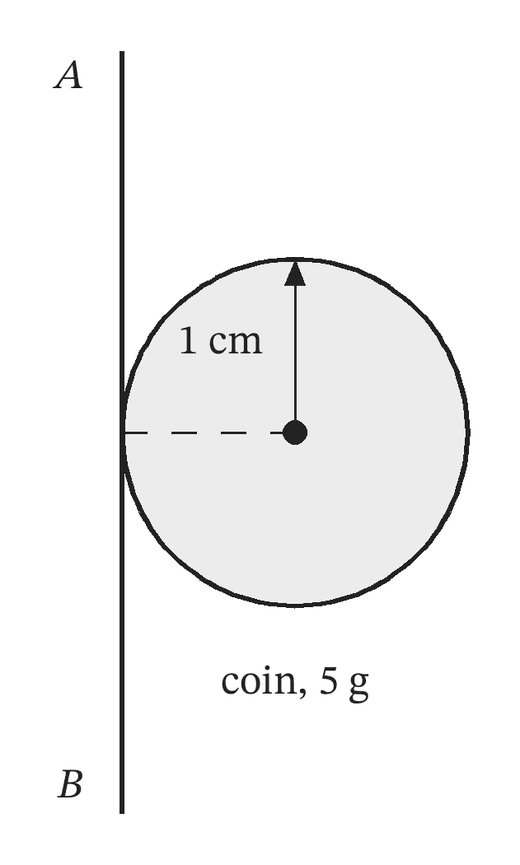
A metal coin of mass 5 g and radius 1 cm is fixed to a thin stick of negligible mass as shown in the given figure. The system is initially at rest. The constant torque, that will make the system rotate about at 25 rotations per second in 5 s, is close to
- 1241 mark
Question 124
Two coaxial discs, having moments of inertia and , are rotating with respective angular velocities and , about their common axis. They are brought in contact with each other and thereafter they rotate with a common angular velocity. If and are the final and initial total energies, then is
- 1251 mark
Question 125
The time dependence of the position of a particle of mass is given by . Its angular momentum, with respect to the origin, at time s is
- 1261 mark
Question 126
A solid cylinder of mass 2 kg and radius 4 cm is rotating about its axis at the rate of 3 rpm. The torque required to stop after revolutions is
- 1271 mark
Question 127
The radius of gyration of a uniform rod of length , about an axis passing through a point away from the centre of the rod and perpendicular to it, is
- 1281 mark
Question 128
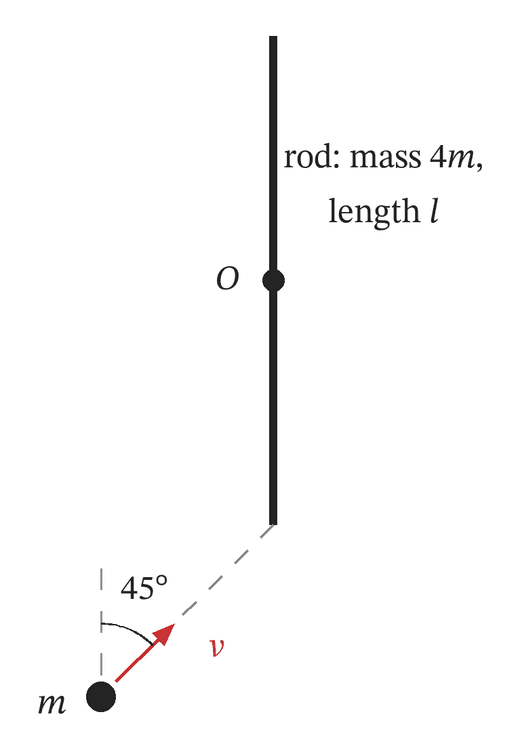
Consider a uniform rod of mass and length pivoted about its centre. A mass moving with velocity making angle to the rod's long axis collides with one end of the rod and sticks to it. The angular speed of the rod mass system just after the collision is
- 1291 mark
Question 129
A uniform sphere of mass 500 g rolls without slipping on a plane horizontal surface with its centre moving at a speed of 5.00 cm/s. Its kinetic energy is
- 1301 mark
Question 130
A particle of mass is fixed to one end of a light spring having force constant and unstretched length . The other end is fixed. The system is given an angular speed about the fixed end of the spring such that it rotates in a circle in gravity free space. The stretch in the spring is
- 1311 mark
Question 131
Find the torque about the origin when a force of N acts on a particle whose position vector is m
- 1321 mark
Question 132
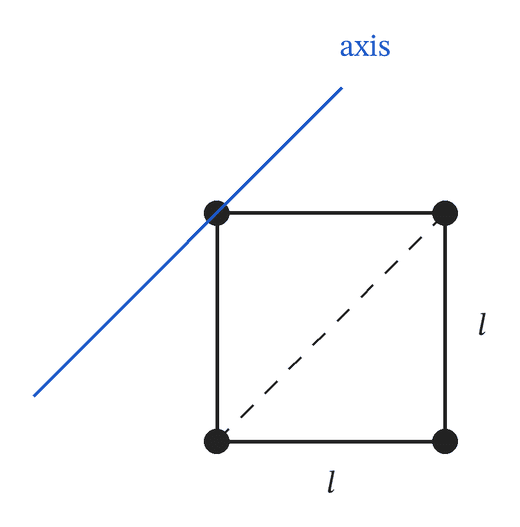
Four point masses, each of mass , are fixed at the corners of a square of side . The square is rotating with angular frequency , about an axis passing through one of the corners of the square and parallel to its diagonal, as shown in the given figure. The angular momentum of the square about this axis is
- 1331 mark
Question 133
A satellite in an elliptical orbit around a planet . It is observed that the velocity of the satellite when it is farthest from the planet is 6 times less than that when it is closest to the planet. The ratio of distances between the satellite and the planet at closest and farthest points is
- 1341 mark
Question 134
Consider two uniform discs of the same thickness and different radii and made of the same material. If the ratio of their moments of inertia and , respectively, about their axes is , then the value of is
- 1351 mark
Question 135
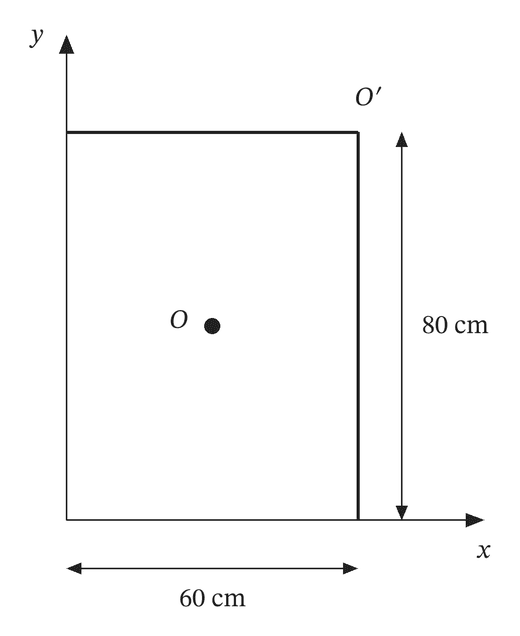
For a uniform rectangular sheet shown in the given figure, the ratio of moments of inertia about the axes perpendicular to the sheet and passing through (the centre of mass) and (corner point) is
- 1361 mark
Question 136
Two uniform circular discs are rotating independently in the same direction around their common axis passing through their centres. The moment of inertia and angular velocity of the first disc are and respectively while those for the second one are and respectively. At some instant, they get stuck together and start rotating as a single system about their common axis with some angular speed. The kinetic energy of the combined system is
- 1371 mark
Question 137
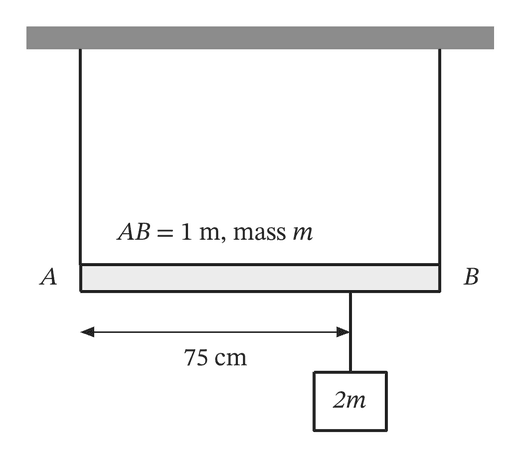
Shown in the figure, is rigid and uniform one meter long rod held in horizontal position by two strings tied to its end and attached to the ceiling. The rod is of mass '' and have another weight of mass hung at a distance of 75 cm from . The tension in the string at is
- 1381 mark
Question 138
From a circular ring of mass '' and radius '', an arc corresponding to a 90° sector is removed. The moment of inertia of the remaining part of the ring about and axis passing through the centre of the ring and perpendicular to the plane of the ring is '' times . Then the value of '' is
- 1391 mark
Question 139
A thin circular ring of mass and radius is rotating about its axis with an angular speed . Two particles having mass each are now attached at diametrically opposite points. The angular speed of the ring will become
- 1401 mark
Question 140
Consider a uniform wire of mass and length . It is bent into a semicircle. Its moment of inertia about a line perpendicular to the plane of the wire passing through the centre is
- 1411 mark
Question 141
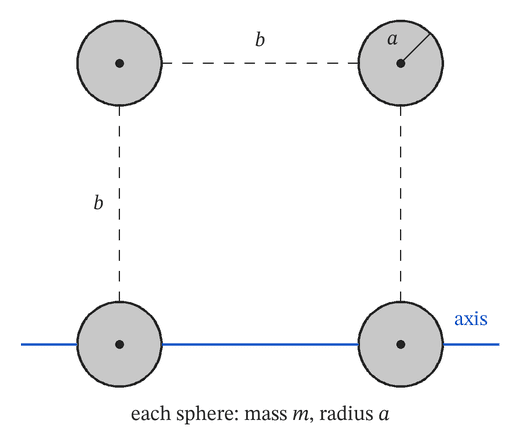
Four identical solid spheres each of mass '' and radius '' are placed with their centres on the four corners of a square of side ''. The moment of inertia of the system about one side of square where the axis of rotation is parallel to the plane of the square is
- 1421 mark
Question 142
A particle is moving with uniform speed along the circumference of a circle of radius under the action of a central fictitious force which is inversely proportional to . Its time period of revolution will be given by
- 1431 mark
Question 143
Moment of inertia (M.I.) of four bodies, having same mass and radius, are reported as:
= M.I. of thin circular ring about its diameter,
= M.I. of circular disc about an axis perpendicular to the disc and going through the centre,
= M.I. of solid cylinder about its axis and
= M.I. of solid sphere about its diameter. Then,
- 1441 mark
Question 144
A block of 200 g mass moves with a uniform speed in a horizontal circular groove, with vertical side walls of radius 20 cm. If the block takes 40 s to complete one round, the normal force by the side walls of the groove is
- 1451 mark
Question 145
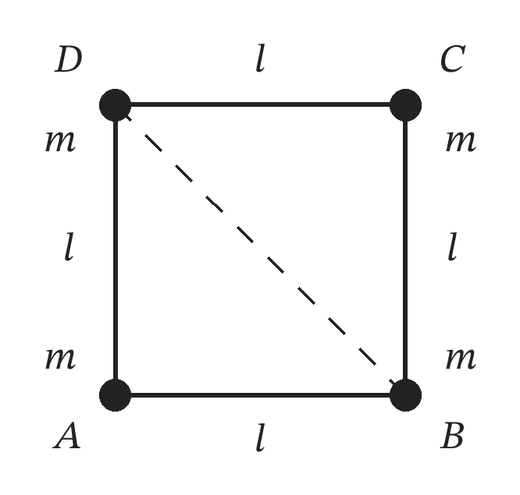
Four equal masses, each are placed at the corners of a square of length () as shown in the given figure. The moment of inertia of the system about an axis passing through and parallel to would be
- 1461 mark
Question 146
A body rolls down an inclined plane without slipping. The kinetic energy of rotation is 50% of its translational kinetic energy. The body is
- 1471 mark
Question 147
Moment of inertia of a square plate of side about the axis passing through one of the corner and perpendicular to the plane of square plate is given by
- 1481 mark
Question 148
The ratio of radius of gyration of a solid sphere of mass and radius about its own axis to the radius of gyration of the thin hollow sphere of the same mass and radius about its axis is
(A) 5 : 3
(B) 2 : 5
(C) 5 : 2
(D) 3 : 5
- 1491 mark
Question 149
The angular acceleration of a body moving along the circumference of a circle is
- 1501 mark
Question 150
A flywheel is accelerated uniformly from rest and rotates through 5 rad in the first second. The angle rotated by the flywheel in the next second will be
- 1511 mark
Question 151
An object of mass 8 kg is hanging from one end of a uniform rod () of mass 2 kg and length 1 m pivoted at its end on a vertical wall as shown in the given figure. It is supported by a cable such that the system is in equilibrium. The tension in the cable is (take )

- 1521 mark
Question 152
Assertion: A judo fighter in order to throw his opponent on to the mat tries to initially bend his opponent and then rotate him around his hip.
Reason: As the mass of the opponent is brought closer to the fighter's hip, the force required to throw the opponent is reduced.
- 1531 mark
Question 153
Assertion: The speed of whirlwind in a tornado is alarmingly high.
Reason: If no external torque acts on a body, its angular velocity remains conserved.
- 1541 mark
Question 154
The moment of inertia of a uniform thin rod about a perpendicular axis passing through one end is . The same rod is bent into a ring and its moment of inertia about a diameter is . If is , then the value of will be ______
- 1551 mark
Question 155
A solid sphere of mass 1 kg rolls without slipping on a plane surface. Its kinetic energy is J. The speed of the centre of mass of the sphere is ______ .
- 1561 mark
Question 156
A solid sphere , as shown in the figure is rotating about an axis . If the radius of the sphere is 5 cm, then its radius of gyration about will be cm. The value of is ______.