
A student sits on a stool that can turn freely about a vertical axis. The student holds a bicycle wheel above their head with its axle vertical, as shown. The wheel spins at , anticlockwise as seen from above, and its moment of inertia about its axle is . The student, the stool and the wheel (not counting the wheel's spin) have a moment of inertia of about the stool's axis. At first the stool is at rest. (Hypothetical data.)
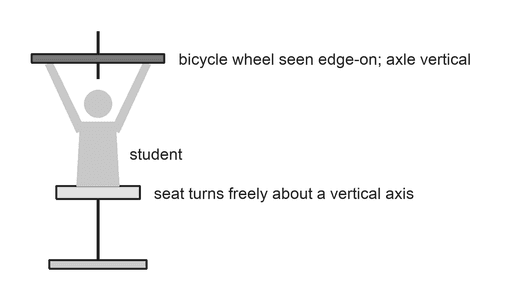
The wheel keeps spinning at about its own axle throughout. Ignore friction in the stool's bearing.
(a) The student turns the wheel upside down, so that its axle is again vertical. Find the angular velocity of the stool afterwards and its sense of rotation.
(b) Find the angular velocity of the stool if the student had instead turned the axle only until it was horizontal.
(c) In (a) the stool gains kinetic energy although no external torque acts about its axis. Where does this energy come from?