
Question 603 marksMedium
What is a rigid body? Explain the conditions for the equilibrium of rigid bodies.
Confirming your payment
Sign up now and get 250 free tokens.
Rotational Motion - Moment of Inertia and Torque · Question 60 of 67
What is a rigid body? Explain the conditions for the equilibrium of rigid bodies.
Solution:
Concept: A body is in equilibrium when it has no linear acceleration and no angular acceleration. A net force produces linear acceleration (), and a net torque produces angular acceleration ().
Step 1 — Define a rigid body. A rigid body is a body in which the distance between any two of its particles stays the same, whatever forces act on it. Real bodies deform a little, but many can be treated as rigid.
Step 2 — First condition: translational equilibrium. The vector sum of all the external forces on the body must be zero:
Then the centre of mass has no acceleration; it stays at rest or moves with constant velocity.
Step 3 — Second condition: rotational equilibrium. The vector sum of the torques of all the external forces about any point must be zero:
Then the body has no angular acceleration. This is the principle of moments: the total clockwise moment equals the total anticlockwise moment.
Step 4 — Illustrate with a balanced rod. The figure shows a rod pivoted at , with at distance on one side and at distance on the other.
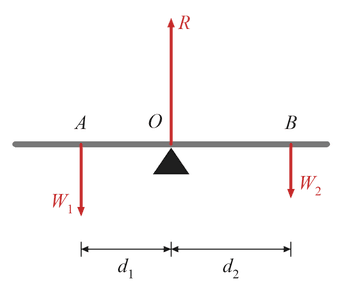
The reaction at the pivot balances the weights, (first condition; the rod's own weight, acting at its centre , is taken as negligible). Taking moments about , the rod does not turn when (second condition).
Therefore, a rigid body is one whose particles keep fixed distances from each other, and it is in equilibrium when the net external force on it is zero and the net external torque about any point is zero.