
Question 593 marksMedium
Derive an expression for the kinetic energy of a rotating body and hence define moment of inertia. What is the physical significance of moment of inertia?
Confirming your payment
Sign up now and get 250 free tokens.
Rotational Motion - Moment of Inertia and Torque · Question 59 of 67
Derive an expression for the kinetic energy of a rotating body and hence define moment of inertia. What is the physical significance of moment of inertia?
Solution:
Concept: All the particles of a rigid body turning about a fixed axis have the same angular velocity . A particle at distance from the axis moves in a circle with speed .
Step 1 — Set up the body. The figure shows a body turning about an axis through , perpendicular to the page, with particles , , , … at distances , , , … and speeds , , ….
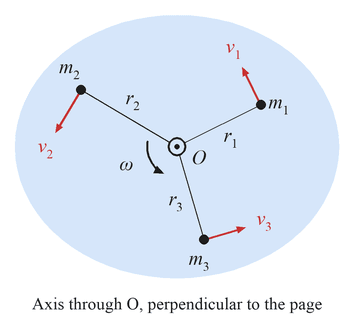
Step 2 — Write the kinetic energy of each particle. The particle has kinetic energy:
Step 3 — Add for all particles. The kinetic energy of the body is the sum; is common:
Here is the moment of inertia of the body about the axis.
Step 4 — Define moment of inertia. If , then , so . The moment of inertia of a body about an axis is twice its kinetic energy of rotation when it turns with unit angular velocity about that axis; it equals .
Step 5 — Give its physical significance. Comparing with the linear formula, , shows that plays the part in rotation that mass plays in linear motion. It is the measure of rotational inertia: the larger is, the harder it is to start, stop or change the rotation of the body (). Unlike mass, it depends on the axis and on the distribution of mass about it.
Therefore, ; the moment of inertia is twice the rotational kinetic energy at unit angular velocity, and it measures the body's rotational inertia.