
Question 51 markMCQMedium
A solid cylinder of mass and radius rolls down an inclined plane of height without slipping, starting from rest. The speed of its centre of mass when it reaches the bottom is
Confirming your payment
Sign up now and get 250 free tokens.
Rotational Motion - Moment of Inertia and Torque · Question 5 of 67
A solid cylinder of mass and radius rolls down an inclined plane of height without slipping, starting from rest. The speed of its centre of mass when it reaches the bottom is
(A)
(B)
(C)
(D)
Answer: (B)
Concept: When a body rolls without slipping, friction does no work, so the loss of potential energy ( = height of the incline, the height through which the centre of mass falls) equals the gain in kinetic energy, translational plus rotational. Rolling without slipping means .
Step 1 — Write the kinetic energy at the bottom. The figure shows the rolling cylinder.
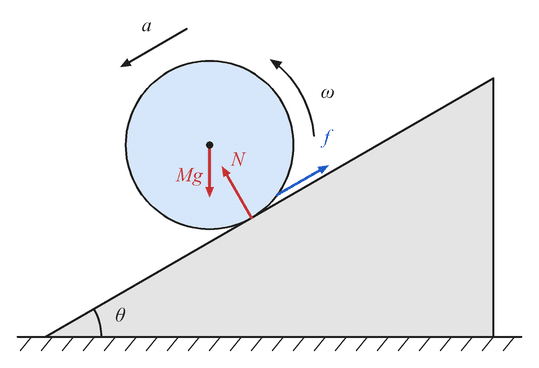
A solid cylinder has . Its kinetic energy is:
Step 2 — Use conservation of energy. The cylinder starts from rest, so all of this kinetic energy comes from the loss of potential energy, and we set the two equal:
Therefore, the speed at the bottom is , option (B).