
Opening your dashboard
Class 11 Physics Chapter 11 Rotational Motion - Moment of Inertia and Torque: Competency-Based Questions (CBQ)
52 questions on Chapter 11, each worked through on its own page with the AI tutor. Class 11 Physics, ICSE 2026-27.
52 questions
1–4 marks · Mixed difficulty
- 14 marks
Question 1
Competency: Application
A village hand pump has a handle pivoted at O, as shown. The pump rod is joined to the handle at A, from O, and hangs vertically. A person pushes vertically down on the handle at H, from O on the other side. To lift the plunger and the water above it, the pump rod must be pulled upward with a steady force of . Take . (Hypothetical data.)
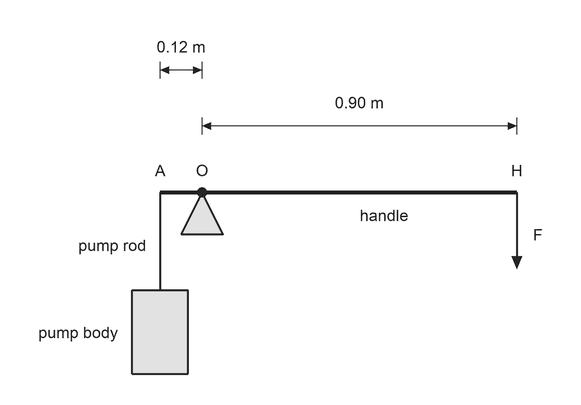
(a) Neglecting the weight of the handle, find the downward force the person must apply at H when the handle is horizontal and turning slowly at a steady rate (so that it is in equilibrium).
(b) Find the force that the pivot exerts on the handle in (a), and state its direction.
(c) The handle actually has a mass of , and its centre of gravity is from O, on the same side as H. Find the force now needed at H.
- 21 mark
Question 2
Competency: Analysis & Evaluation
A plumber tries to loosen a tight nut with a spanner. Instead of pushing at right angles to the spanner, the plumber pulls very hard on the end of the handle, along the line of the handle, which passes through the centre of the nut.
Assertion (A): However hard the plumber pulls in this way, the pull has no turning effect on the nut.
Reason (R): The moment of a force about an axis is zero when the line of action of the force passes through the axis.
- 31 mark
Question 3
Competency: Application
A tower crane on a building site has a horizontal beam resting on the top O of its tower, as shown. On one side of O, a counterweight hangs from O, and the counter-jib (the short arm of the beam) has a mass of with its centre of gravity from O. On the other side, the jib has a mass of with its centre of gravity from O, and the trolley carries a load of at a distance from O. (Hypothetical data.)
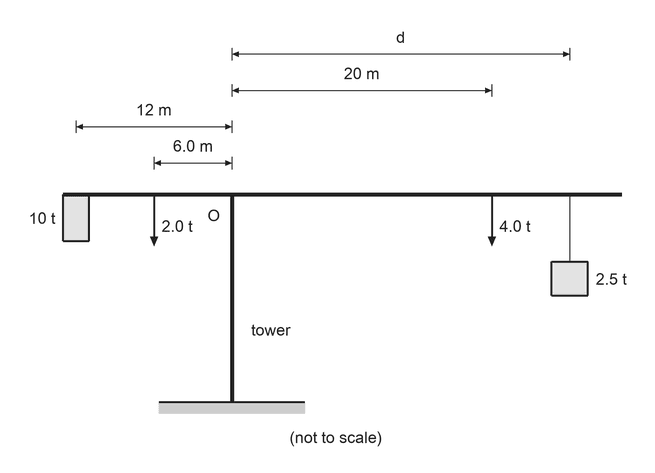
So as not to bend the tower, the operator places the load where the total moment of all these weights about O is zero. The distance is
- 44 marks
Question 4
Competency: Analysis & Evaluation
A steel almirah of mass stands on a floor. It is tall and deep, and its centre of gravity G is at its centre. A student pushes horizontally on one side face, at a height above the floor, to slide the almirah across the floor, as shown. The coefficient of static friction between the almirah and the floor is . Take . (Hypothetical data.)
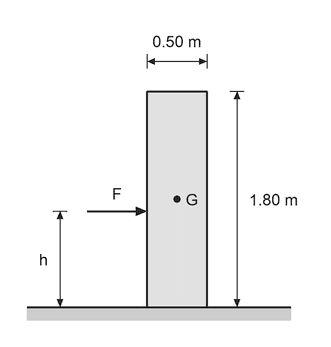
(a) Find the smallest push that will make the almirah start to slide, assuming it does not tip over first.
(b) Find the greatest height at which the student can push so that the almirah starts to slide without tipping over.
(c) Another student pushes at shoulder height, . Explain what happens as this student slowly increases the push from zero, and find the push at which it happens.
- 51 mark
Question 5
Competency: Analysis & Evaluation
A gardener lifts the handles of a loaded wheelbarrow until its legs just leave the ground, and holds it still. The wheel rests on the ground, and the centre of gravity of the wheelbarrow and its load lies between the wheel and the gardener's hands.
Assertion (A): The upward force the gardener applies at the handles is less than the total weight of the wheelbarrow and its load.
Reason (R): For the wheelbarrow to stay at rest, the upward forces on it must add up to its total weight.
- 61 mark
Question 6
Competency: Application
A wall shelf rests on L-shaped steel brackets. Each bracket is held to a vertical wall by a single screw at T near its top; at B, below T, the bracket simply presses against the wall. One bracket carries a load of whose line of action is from the wall, as shown. If the screw pulled out, the bracket would turn about B. (Hypothetical data.)
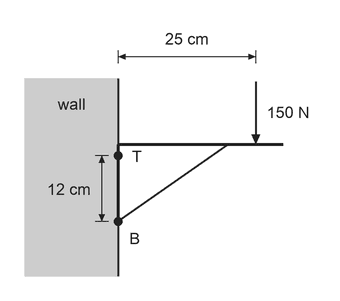
Neglecting the weight of the bracket, the horizontal pull that the screw must exert on the bracket is about
- 74 marks
Question 7
Competency: Application
At a mela, a giant wheel of radius starts from rest and speeds up uniformly for , until it reaches its working speed of one revolution per minute. (Hypothetical data.)
(a) Find the angular acceleration of the wheel while it speeds up, and the speed of a cabin on its rim at the working speed.
(b) A cabin is at the lowest point, by the loading platform, when the wheel starts. How far round the wheel (in degrees) has this cabin moved when the wheel reaches its working speed, and how far has it travelled along its circular path?
(c) At the end of the ride, the operator wants the wheel to stop with a chosen cabin exactly at the platform. The operator starts a uniform retardation when that cabin is before the platform, measured round the wheel. Find the time the wheel takes to stop and the angular retardation needed.
- 81 mark
Question 8
Competency: Application
A rider on an exercise bike stops pedalling. The bike's flywheel, turning at , then slows down uniformly and stops in . (Hypothetical data.) How many revolutions does the flywheel make in the last before it stops?
- 91 mark
Question 9
Competency: Analysis & Evaluation
The pendulum of a wall clock swings to and fro about its pivot. At each end of its swing it is at rest for an instant before swinging back.
Assertion (A): At each end of the swing, where the pendulum is momentarily at rest, its angular acceleration is also zero.
Reason (R): Angular acceleration is the rate of change of angular velocity.
- 103 marks
Question 10
Competency: Analysis & Evaluation
A sports-science club models a gymnast of mass swinging round a horizontal bar, with the hands gripping the bar. For each part of the gymnast's body, the table gives its mass and the distance of its centre of mass from the bar in two body positions. Treat each part as a particle at that distance. (Hypothetical data.)
Part of the body Mass (kg) Distance from the bar, body straight (m) Distance from the bar, body tucked (m) Arms 6 0.30 0.30 Head 5 0.65 0.65 Trunk 30 1.00 1.00 Thighs 12 1.45 0.95 Lower legs and feet 7 1.90 0.85 (a) Find the gymnast's moment of inertia about the bar with the body straight.
(b) Find the gymnast's radius of gyration about the bar with the body straight, and say what it means.
(c) Find the gymnast's moment of inertia about the bar with the body tucked. For the same torque about the bar, how many times larger is the gymnast's angular acceleration when tucked than when straight?
- 111 mark
Question 11
Competency: Analysis & Evaluation
A workshop has two uniform rods of the same length, , and the same thickness: one of steel and one of aluminium. The steel rod is about three times as heavy. (Hypothetical data.)
Assertion (A): The two rods have the same radius of gyration about an axis through one end, perpendicular to the rod.
Reason (R): The radius of gyration of a body about a given axis is proportional to its mass.
- 124 marks
Question 12
Competency: Application
Each of the four motors of a camera drone turns a two-blade propeller. Model a propeller as a thin uniform rod of mass and length , turning about an axis through its centre perpendicular to its length, and ignore the motor's own rotating parts. While the drone hovers, each propeller turns steadily at , and its motor supplies a torque of , which just balances the drag torque of the air on the propeller. The drag torque is proportional to the square of the angular speed. (Hypothetical data.)
(a) Find the moment of inertia of a propeller about its axis.
(b) Find the power each motor delivers to its propeller while the drone hovers.
(c) To climb, the controller suddenly raises the motor torque to . Find the angular acceleration of the propeller just after the change.
(d) Explain why the angular acceleration does not stay at this value, and find the new steady speed of the propeller in rpm.
- 131 mark
Question 13
Competency: Analysis & Evaluation
A flywheel on a test bench is spinning clockwise when a motor starts to apply a constant anticlockwise torque to it. Friction is negligible.
Assertion (A): As long as a constant net torque acts on a wheel, its angular speed keeps increasing.
Reason (R): A net torque on a body turning about a fixed axis gives it an angular acceleration in the direction of the torque.
- 144 marks
Question 14
Competency: Analysis & Evaluation
A lazy Susan (a revolving tray) on a dining table is a uniform disc of mass and radius . It turns on a frictionless bearing about a vertical axis through its centre O. A battery toy car of mass runs on a circular track of radius fixed on the tray, as shown in the top view. At first the tray and the car are at rest. The car is switched on and soon runs anticlockwise (seen from above) at a steady relative to the tray. Treat the car as a particle and ignore the spin of its wheels. (Hypothetical data.)
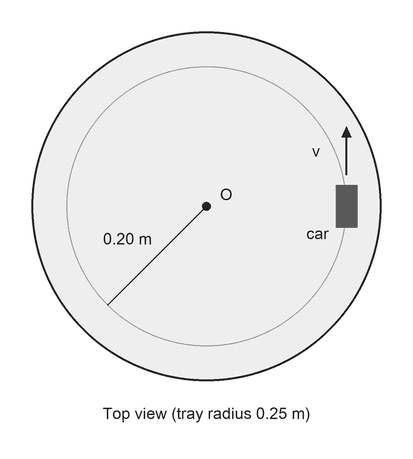
(a) Explain why the tray starts to turn, and in which direction.
(b) Find the angular velocity of the tray, and the speed of the car relative to the table, while the car runs steadily.
(c) Through what angle has the tray turned, relative to the table, by the time the car has gone once round the track from its starting point on the track?
(d) The car's motor is then stopped and its wheels lock, so the car comes to rest on the track. What happens to the tray? Explain.
- 151 mark
Question 15
Competency: Analysis & Evaluation
A wheel-balancing machine at a tyre shop spins a car wheel about a horizontal axle. At the end of a test, a brake applies a steady torque to the wheel along the axle, in the direction opposite to the wheel's angular momentum, until the wheel stops.
Assertion (A): While the brake acts, the wheel's angular momentum decreases in magnitude but keeps the same direction.
Reason (R): In a short time , a torque changes the angular momentum of a body by , in the direction of the torque.
- 164 marks
Question 16
Competency: Application
A roadside sugarcane-juice vendor turns a hand-operated crusher. Its large cast-iron wheel, turned by a handle, has a moment of inertia of about its axle. While a cane is crushed at a steady , the rollers oppose the motion with a torque of , and the vendor's push on the handle gives an equal and opposite torque. Neglect friction in the bearings. (Hypothetical data.)
(a) Find the work the vendor does in one revolution, and the power the vendor supplies.
(b) Find the kinetic energy stored in the wheel at .
(c) A hard joint (node) in the cane raises the opposing torque to for a quarter of a revolution, while the vendor keeps applying the usual . Find the speed of the wheel, in rpm, at the end of that quarter revolution, and explain how the heavy wheel helps the vendor.
- 171 mark
Question 17
Competency: Application
A carpenter uses a cordless screwdriver-drill powered by an , battery, which stores of energy. Driving one screw into hardwood needs 15 turns against an average opposing torque of . Only of the battery's energy reaches the screw as useful work. (Hypothetical data.) About how many such screws can be driven on one full charge?
- 181 mark
Question 18
Competency: Analysis & Evaluation
In a factory, a motor starts a heavy turntable from rest by applying a constant torque to it. Friction is negligible.
Assertion (A): The power delivered by the motor increases in direct proportion to the time since it started.
Reason (R): The power delivered by a torque to a body turning with angular velocity is .
- 194 marks
Question 19
Competency: Application
At a toll plaza, a boom barrier has a uniform aluminium boom long and of mass , pivoted at O, from its short end. A counterweight is fixed at the short end, with its centre from O, as shown. Treat the boom as a thin rod and the counterweight as a particle, and take . (Hypothetical data.)
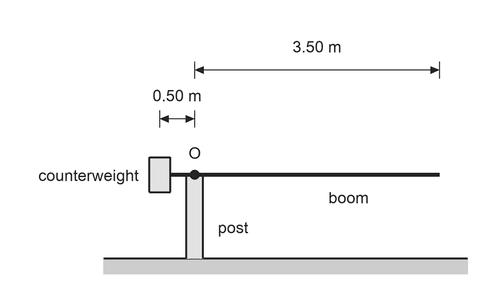
(a) What mass must the counterweight have for the boom to be balanced when it is horizontal (the total moment of the weights about O is zero)?
(b) Using the theorem of parallel axes, find the moment of inertia of the boom and counterweight about the horizontal axis through O, perpendicular to the boom. For a thin uniform rod of mass and length , about a perpendicular axis through its centre.
(c) To open the barrier, a motor applies a constant torque of about O. Neglecting friction, explain why the angular acceleration stays the same as the boom rises, and find the time the boom takes to swing from horizontal to vertical.
- 201 mark
Question 20
Competency: Analysis & Evaluation
A cricket coach notices that a bat is easiest to twirl (to set turning quickly) about an axis through its balance point, compared with any parallel axis through another point of the bat.
Assertion (A): Of all axes parallel to a given direction, a body has its least moment of inertia about the one through its centre of mass.
Reason (R): By the theorem of parallel axes, , where is the distance between the two axes, and can never be negative.
- 214 marks
Question 21
Competency: Analysis & Evaluation
A weightlifting barbell has a bar of mass and length , loaded with two plates of each. Treat the bar as a uniform solid cylinder of radius , and each plate as a thin uniform disc of radius whose centre is on the bar, from the bar's centre C. Axis 1 is the bar's own long axis; axis 2 passes through C, perpendicular to the bar, as shown. (Hypothetical data.)
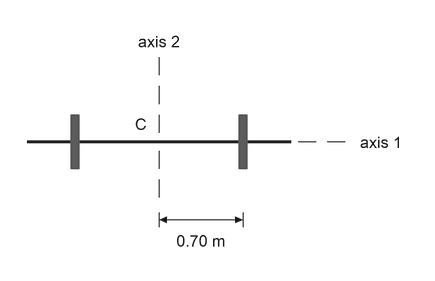
(a) Find the moment of inertia of the loaded barbell about axis 1.
(b) Find its moment of inertia about axis 2. (A thin disc of mass and radius has about a diameter; treat the bar as a thin rod for this axis.)
(c) In a lift, the lifter's wrists turn the bar about axis 1 with an angular acceleration of . Find the torque needed if the plates turn with the bar. On competition barbells the plates sit on sleeves that turn freely on the bar, so the plates need not turn with it. Find the torque needed then, and explain why the sleeves are made to turn.
- 221 mark
Question 22
Competency: Application
For a school band show, a baton twirler compares two props of the same mass, : a baton, modelled as a thin uniform rod long, and a flat uniform disc in diameter. Each is spun about an axis through its centre: the baton about an axis perpendicular to its length, and the disc about an axis perpendicular to its face. (Hypothetical data.) The ratio of their moments of inertia, , is
- 234 marks
Question 23
Competency: Analysis & Evaluation
A car of total mass , including its four wheels, travels at on a level road, and its wheels roll without slipping. Each wheel (with its tyre) has a mass of , a radius of and a radius of gyration of about its axle. (Hypothetical data.)
(a) Find the angular speed of each wheel and the total rotational kinetic energy of the four wheels.
(b) What percentage of the car's total kinetic energy is stored in the spinning of its wheels?
(c) The owner fits alloy wheels of mass each, with the same radius and radius of gyration. Ignoring all losses, find how much less kinetic energy the engine must supply to bring the car from rest to , and explain why a kilogram saved in the wheels counts for more than a kilogram saved in the body of the car.
- 241 mark
Question 24
Competency: Application
Workers move a heavy stone slab by resting it on two identical round logs lying on level ground and pushing it, as shown. The logs roll without slipping both on the ground and under the slab. (Hypothetical data.)
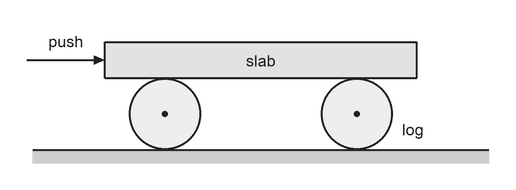
When the slab has moved forward , how far forward has each log moved?
- 251 mark
Question 25
Competency: Analysis & Evaluation
A solid ball is released from rest on a rough ramp and rolls down it without slipping. Ignore air resistance and rolling resistance.
Assertion (A): The total mechanical energy of the ball (its kinetic energy plus its gravitational potential energy) stays constant as it rolls down, even though friction acts on it.
Reason (R): For a solid ball rolling without slipping, its rotational kinetic energy is two-fifths of its translational kinetic energy at every instant.
- 263 marks
Question 26
A uniform solid cylinder of mass and radius rests on a long plank that lies on a smooth floor. Starting from rest, the plank is pulled so that it moves to the right with a constant acceleration of , and the cylinder rolls on the plank without slipping, as shown. (Hypothetical data.)
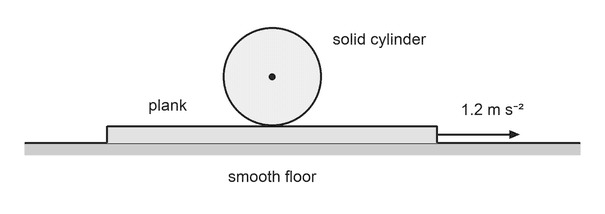
(a) Find the acceleration of the centre of the cylinder relative to the floor.
(b) Find the friction force that the plank exerts on the cylinder.
(c) Find the angular acceleration of the cylinder and state its sense.
- 274 marks
Question 27
A bowling ball, a uniform solid sphere of mass and radius , is released on a level lane with a speed of and no spin. At first it skids. The coefficient of kinetic friction between the ball and the lane is . Take . (Hypothetical data.)
(a) Find the speed of the ball when it starts to roll without slipping.
(b) How long after release does this happen, and how far has the ball travelled by then?
(c) How much kinetic energy is lost while the ball skids?
- 283 marks
Question 28
Calculate the magnitude and direction of total linear acceleration of a particle moving in a circle of radius 0.4 m having an instantaneous angular velocity of 2 rad s⁻¹ and angular acceleration 5 rad s⁻².
- 293 marks
Question 29
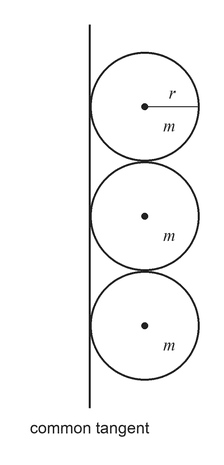
Three identical rings of masses each and radius are kept in contact as shown in the given figure. Find the moment of inertia of the system about a common tangent.
- 303 marks
Question 30
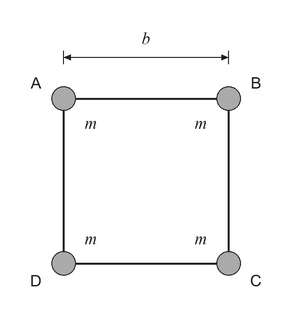
Four spheres , , , , each of mass and diameter are placed with their centres at the four corners of a square of side . What is the moment of inertia of the system about any side of the square?
- 313 marks
Question 31
Calculate the moment of inertia of a cylinder of length 2 m, radius 5 cm and density kg/m³ about (i) the axis of the cylinder and (ii) and axis passing through the centre and perpendicular to its length.
- 323 marks
Question 32
Show that the radii of gyration of a circular disc and circular ring of the same radius about a tangential axis are in the ratio .
- 333 marks
Question 33
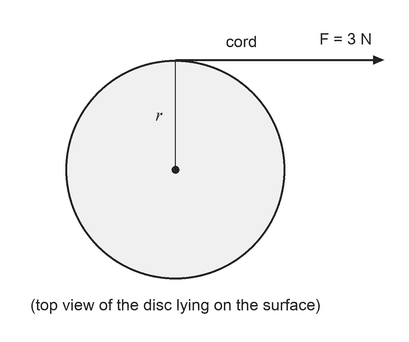
A uniform disc of mass of 0.50 kg and radius 0.20 m lies on one side initially at rest on a frictionless horizontal surface. A constant force of 3 N is then applied tangentially at its perimeter using a lightweight cord wrapped around its edge as shown in the given figure. What is the (i) angular acceleration, (ii) angular velocity and (iii) angular displacement after 2 s?
- 343 marks
Question 34
A constant torque of 20 N m is exerted on a pivoted wheel for 10 seconds. During which time the angular velocity of the wheel changes from 0 to 100 rpm? When the external torque is removed, it is stopped by friction in 100 s. Find (i) the M.I. of the wheel and (ii) the frictional torque.
- 353 marks
Question 35
A flywheel of radius 10 cm is mounted so as to rotate about a horizontal axis through its centre. A string of negligible mass wrapped round its circumference carries a mass of 200 g attached to its free end, when let fall the mass descends through 100 cm is 5 s. Calculate the angular acceleration and the moment of inertia of the flywheel.
- 363 marks
Question 36
A particle of mass moves along a circular path of radius with velocity . What is its instantaneous angular momentum about a point on the plane of the orbit at a distance from the centre of the axis of rotation?
- 373 marks
Question 37
Find the angular momentum of a satellite of mass moving round the Earth of mass if its orbital radius is , assuming it to be circular. Express it in terms of , , and , where is the universal gravitational constant.
- 383 marks
Question 38
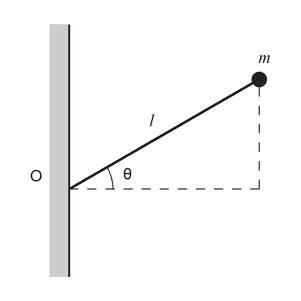
A ball of mass is attached to light weight rod of length and held as shown in the given figure. Initially, it is at rest. If the ball starts to fall, what is its angular momentum as a function of time about the point . Assume that there is no air resistance.
- 393 marks
Question 39
Two masses and are connected by a rigid rod of length and negligible mass. The system rotates about an axis passing through the centre of mass of the system and perpendicular to the length of the rod. Show that the angular momentum of the system is where .
- 404 marks
Question 40
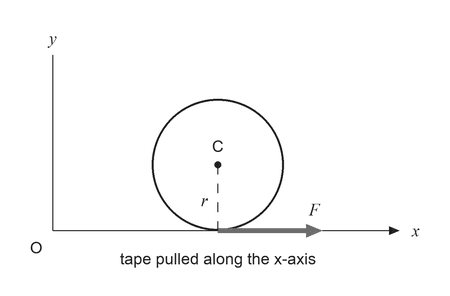
A disc of mass and radius is pulled, with a constant force by a lightweight tape wound around its circumference, along a frictionless table. What is the torque acting on the disc (i) about the centre of mass and (ii) about the origin ? What is the angular momentum (i) about the centre of mass and (ii) about the origin ?
- 413 marks
Question 41
If the Earth suddenly contracts by 1/2 of its present radius, by how much would the day be decreased?
- 423 marks
Question 42
A heavy circular disc is revolving in a horizontal plane about the centre which is fixed. An insect of mass th that of the disc walks from the centre along a radius and then flies away. Show that the final angular velocity is times the original angular velocity of the disc.
- 433 marks
Question 43
A bucket of mass 8 kg is supported by a light rope wound around a solid wooden cylinder of mass 12 kg and radius 20 cm free to rotate about its axis. A man holding the free end of the rope, with the bucket and the cylinder at rest initially, lets go the bucket freely downwards in a well 50 m deep. Neglecting friction, obtain the speed of the bucket and the angular speed of the cylinder just before the bucket enters water.
- 443 marks
Question 44
A metre scale of mass 100 g is suspended freely at its end. It is pulled aside and swung about a horizontal axis with an angular velocity 5 rad/s. Calculate the height to which the centre of mass of the scale rises above its lowest position, assuming that there is no friction and air resistance.
- 453 marks
Question 45
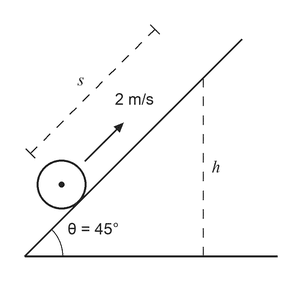
A disc rolls up an inclined plane of angle 45° as shown in the given figure. The centre of mass of the disc has a translational speed of 2 m/s at the bottom of the plane. What is the distance through which the disc travels up the plane?
- 463 marks
Question 46
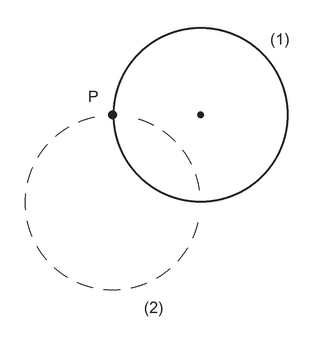
A uniform disc of radius and mass is free to rotate on a frictionless pivot through point on its rim as shown in the given figure. The disc is at rest and is released from the position (1). (i) What is the speed of the centre of mass when the disc reaches the position (2)? (ii) Also find the speed of the lowest point on the disc in the dashed position.
- 473 marks
Question 47
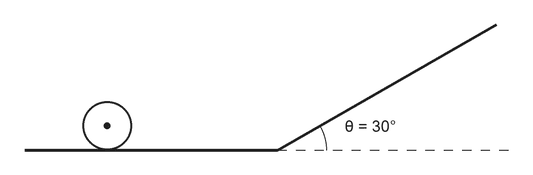
A uniform solid sphere rolls on a horizontal surface with a linear speed of 10 m/s as shown in the given figure. It then rolls up a plane inclined at 30° to horizontal. What is the height upto which the sphere rises? Assume that the surface is frictionless. Also calculate the distance travelled by the sphere on the inclined plane.
- 483 marks
Question 48
A wheel of moment of inertia rotates about a vertical frictionless axle with an angular velocity . A second wheel of moment of inertia and initially at rest drops onto the first wheel. The two wheels attain a common angular velocity of . (Assume that the two surfaces frictionless.) (a) What is the value of ? (b) What is the ratio of the initial to the final rotational energy?
- 494 marks
Question 49
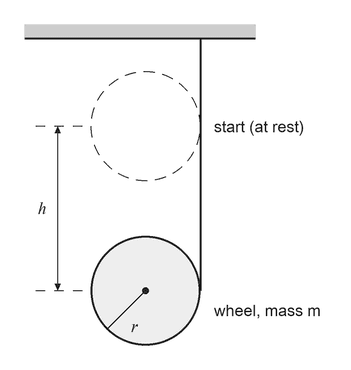
One end of a string is tied to a rigid support attached to roof and the other end is wound around a uniform wheel of radius and mass as shown in the given figure. The string is kept vertical and the wheel is released from rest. As the wheel descends, show that (i) the tension in the string is one-third the weight of the wheel, (ii) the magnitude of the acceleration of the centre of mass is and (iii) the speed of the centre of mass is .
- 503 marks
Question 50
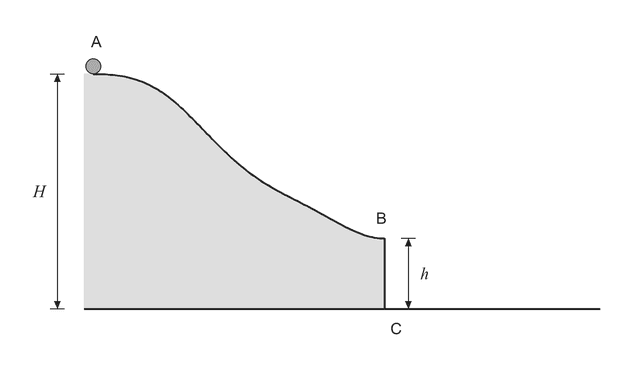
In the given figure, m and m. A rigid uniform sphere starts from the point from rest and rolls down the track without slipping and reaches the horizontal right hand end . What is the distance to the right of the point at which the sphere strikes the horizontal base line?
- 513 marks
Question 51
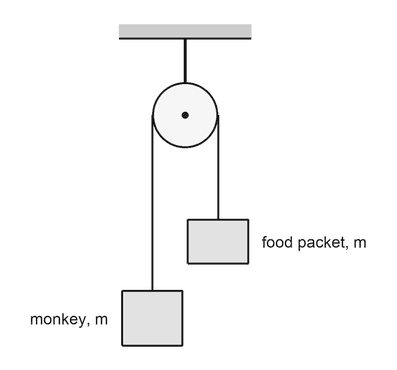
A lightweight cord is passed over a light, frictionless pulley to one end of which is attached a food packet of mass and to the other end, a monkey of mass clings. To catch the food packet the monkey climbs the rope. What is the net torque of the whole system about the pulley as axis? Will the monkey reach the food packet?
- 523 marks
Question 52
The Earth has a mass of kg and a radius m. Calculate the amount of work done if its rotation were to be slowed down so that the duration of the day becomes 30 hours instead of 25 hours.