
Competency: Analysis & Evaluation
A weightlifting barbell has a bar of mass and length , loaded with two plates of each. Treat the bar as a uniform solid cylinder of radius , and each plate as a thin uniform disc of radius whose centre is on the bar, from the bar's centre C. Axis 1 is the bar's own long axis; axis 2 passes through C, perpendicular to the bar, as shown. (Hypothetical data.)
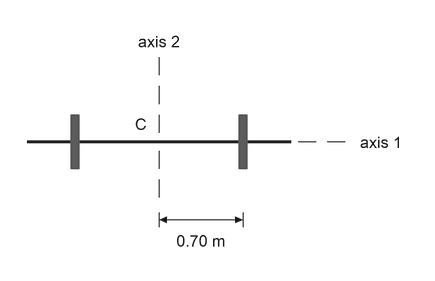
(a) Find the moment of inertia of the loaded barbell about axis 1.
(b) Find its moment of inertia about axis 2. (A thin disc of mass and radius has about a diameter; treat the bar as a thin rod for this axis.)
(c) In a lift, the lifter's wrists turn the bar about axis 1 with an angular acceleration of . Find the torque needed if the plates turn with the bar. On competition barbells the plates sit on sleeves that turn freely on the bar, so the plates need not turn with it. Find the torque needed then, and explain why the sleeves are made to turn.