Answer: (B) M+2mωM
Concept: When no external torque acts about the axis, angular momentum is conserved: I1ω1=I2ω2. Attaching the masses gently means they bring no torque of their own about the axis.
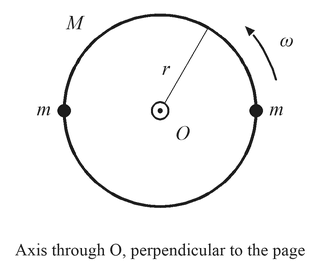
Step 1 — Picture the set-up. The figure shows the ring turning about the axis through its centre, perpendicular to its plane, with the two masses at the ends of a diameter.
Step 2 — Write the moments of inertia. At first, I1=Mr2. Each added mass is at distance r from the axis, so afterwards:
I2=Mr2+2mr2
I2=(M+2m)r2
Step 3 — Apply conservation of angular momentum. We set I1ω=I2ω2:
Mr2ω=(M+2m)r2ω2
ω2=M+2mωM
- (A) With this value the angular momentum afterwards would be (M+2m)r2×M+2mω(M−2m)=(M−2m)r2ω, less than the starting Mr2ω, although no external torque acts; the form M+2mM−2m belongs to the elastic-collision velocity formula, which does not apply here.
- (C) This counts only one of the two attached masses.
- (D) This is the ratio turned upside down; it would make the ring speed up, although its moment of inertia has increased.
Therefore, the ring now rotates with angular velocity M+2mωM, option (B).