
Question 675 marksMedium
Write down expressions for the M.I. of (a) a disc and (b) a ring
(i) about an axis passing through its centre and perpendicular to its plane,
(ii) about its diameter and
(iii) about a tangent in the plane of the body
Confirming your payment
Sign up now and get 250 free tokens.
Rotational Motion - Moment of Inertia and Torque · Question 67 of 67
Write down expressions for the M.I. of (a) a disc and (b) a ring
(i) about an axis passing through its centre and perpendicular to its plane,
(ii) about its diameter and
(iii) about a tangent in the plane of the body
Solution:
Concept: For a thin uniform disc or ring of mass and radius , the moment of inertia about the central perpendicular axis comes from . The perpendicular axes theorem () then gives the value about a diameter, and the parallel axes theorem () gives the value about a tangent.
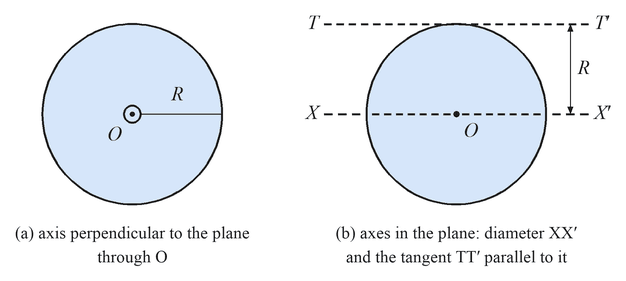
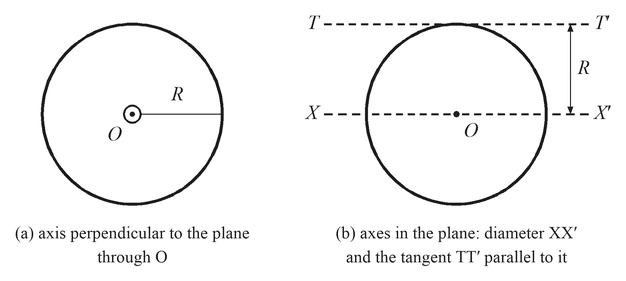
Step 1 — Name the axes. The figures show the axes: through the centre perpendicular to the plane (marked at ), the diameter , and the tangent in the plane, parallel to and a distance from it.
Step 2 — Ring about the central perpendicular axis. All the mass of a thin ring is at the distance from this axis:
Step 3 — Disc about the central perpendicular axis. A disc is made of thin rings of radius and width , each of mass at distance . Adding their moments of inertia:
Step 4 — About a diameter. Two perpendicular diameters in the plane have equal moments of inertia by symmetry, each, and by the perpendicular axes theorem their sum is the central perpendicular value. So is half of it:
Step 5 — About a tangent in the plane. The tangent is parallel to the diameter , a distance away, so we add :
Therefore, (a) for a disc: (i) , (ii) , (iii) ; (b) for a ring: (i) , (ii) , (iii) .