
Opening your dashboard
Class 11 Chemistry Chapter 12: Some p-Block Elements Solutions
111 textbook questions with step-by-step answers, free to read, for ISC 2026-27.
Get talked through Ch 12, not just shown the answer
Reading a finished solution is not the same as being able to do it. The AI tutor takes one question at a time and works it with you, in your own words, until you can.
- Ask it out loud, in your own words
- It gives you the next step, not the answer
- Stuck on part (ii)? Start there
111 questions with solutions
1–5 marks · Mixed difficulty
The first 45 solutions are on this page. This chapter is a long one, so the rest open on their own page to keep this one quick to load.
- 11 mark
Question 1
The element which exists in liquid state for a wide range of temperature and can be used for measuring high temperature is
Solve with AIAnswer
(A) B
(B) Al
- Correct
(C) Ga
(D) In
Answer: (C) Ga
Key idea: A liquid used in a thermometer for high temperatures must stay liquid over a very wide range: it should melt near room temperature and boil only at a very high temperature. The useful number is the liquid range = boiling point − melting point.
Step 1 — Recall the melting and boiling points of gallium. Gallium melts at 303 K (about 30 °C, so it melts in the hand) and boils at 2676 K (about 2400 °C).
Step 2 — Work out the liquid range of gallium. We subtract the melting point from the boiling point.
Step 3 — Compare with the other elements. Gallium has the widest liquid range of the four and it is already liquid just above room temperature, so gallium in a quartz tube is used in thermometers for high temperatures.
Why the other options are wrong:
- (A) Boron melts only at about 2350 K and boils at about 4200 K (current values; the textbook table gives 2453 K and 3923 K); it is a hard solid at ordinary temperatures, and its liquid range, about 1850 K, is narrower than that of gallium.
- (B) Aluminium melts at 933 K and boils at 2740 K, a liquid range of 1807 K; it is solid until 933 K, so it cannot be used as a thermometer liquid.
- (D) Indium melts at 430 K and boils at 2353 K, a liquid range of 1923 K, which is narrower than that of gallium.
Therefore, gallium (Ga) is the element.
- 21 mark
Question 2
Which of the following is a Lewis acid?
Solve with AIAnswer
- Correct
(A)
(B)
(C)
(D)
Answer: (A)
Key idea: A Lewis acid is a species that can accept a pair of electrons. Covalent group 13 halides are typical Lewis acids because the central atom has only six electrons in its valence shell (an incomplete octet).
Step 1 — Count the electrons round aluminium in . Aluminium has 3 valence electrons and shares one with each of the three chlorine atoms. So there are only 3 bond pairs round Al, and 3 pairs make 6 electrons.
Step 2 — See how it accepts a pair. With an empty orbital and only six electrons, aluminium readily takes a lone pair from a donor, for example from a chloride ion.
Step 3 — Link to its use. This electron-pair accepting power is why anhydrous is used as the Lewis-acid catalyst in Friedel–Crafts reactions.
Why the other options are wrong:
- (B) is an ionic chloride with no electron-deficient central atom, so it is not counted as a Lewis acid in the way is; its Mg²⁺ ion only attracts lone pairs weakly, for example from water.
- (C) is also an ionic solid made of Ca²⁺ and Cl⁻ ions; the large Ca²⁺ ion has an even weaker pull on lone pairs than Mg²⁺.
- (D) is ionic too, and the very large Ba²⁺ ion has the weakest pull on electron pairs of these group 2 ions.
Therefore, is the Lewis acid.
- 31 mark
Question 3
The geometry of a complex species can be understood from the knowledge of type of hybridisation of orbitals of central atom. The hybridisation of orbitals of central atom in and the geometry of the complex are respectively
Solve with AIAnswer
- Correct
(A) , tetrahedral
(B) , square planar
(C) , octahedral
(D) , square planar
Answer: (A) , tetrahedral
Key idea: The hybridisation of a central atom is fixed by the number of electron pairs (bond pairs + lone pairs) round it: 4 pairs → → tetrahedral; 6 pairs → → octahedral. Boron is in period 2, so it has only the 2s and 2p orbitals and no d orbitals.
Step 1 — Count the electron pairs round boron. In boron is bonded to four OH groups. Boron brings 3 electrons, the extra negative charge brings 1 more, and each OH supplies 1 electron to its bond, so there are 4 bond pairs and no lone pair.
Step 2 — Find the hybridisation. Four electron pairs use one 2s and three 2p orbitals of boron, so boron is hybridised.
Step 3 — Find the shape. Four orbitals point to the corners of a regular tetrahedron (angle about 109.5°), so the ion is tetrahedral, like .
Why the other options are wrong:
- (B) Four pairs always point to the corners of a tetrahedron; a square planar shape needs hybridisation, which uses a d orbital.
- (C) needs two d orbitals and six electron pairs; boron has no d orbitals and here has only four pairs.
- (D) needs an inner d orbital, which boron (period 2) does not have.
Therefore, boron is hybridised and is tetrahedral.
- 41 mark
Question 4
Which of the following oxides is acidic in nature?
Solve with AIAnswer
- Correct
(A)
(B)
(C)
(D)
Answer: (A)
Key idea: Down group 13 the metallic character increases, so the oxides change from acidic to amphoteric to basic: is acidic, and are amphoteric, and and are basic.
Step 1 — Recall the nature of boron. Boron is a non-metal, and oxides of non-metals are acidic.
Step 2 — Show that behaves as an acid. It dissolves in water to give boric acid, and it reacts with bases to give borates.
Why the other options are wrong:
- (B) is amphoteric: it dissolves both in acids and in alkalis, so it is not simply acidic.
- (C) is also amphoteric, like aluminium oxide.
- (D) is basic: indium is a metal and its oxide reacts with acids only.
Therefore, is the acidic oxide.
- 51 mark
Question 5
The exhibition of highest co-ordination number depends on the availability of vacant orbitals in the central atom. Which of the following elements is not likely to act as central atom in ?
Solve with AIAnswer
- Correct
(A) B
(B) Al
(C) Ga
(D) In
Answer: (A) B
Key idea: To bond to six fluoride ions, the central atom must hold six atoms round it. In the textbook (valence-bond) model this needs six orbitals (), that is, empty d orbitals. Boron, in period 2, has only one 2s and three 2p orbitals, so its maximum covalency is 4; the heavier group 13 elements are larger atoms with d orbitals available and can reach 6.
Step 1 — Count the orbitals boron can use. Boron's valence shell (n = 2) has just four orbitals, so it can form at most four bonds, as in .
Step 2 — Compare with what needs. Six M–F bonds need six orbitals, so boron cannot form .
Step 3 — Check the other elements. Aluminium, gallium and indium are much larger than boron, so six fluoride ions fit round them; in this model they also have vacant d orbitals in their valence shells, so they can form six bonds.
Why the other options are wrong:
- (B) Aluminium forms ; it is present in the mineral cryolite, .
- (C) Gallium is large enough to hold six fluoride ions (and in the ISC description has vacant 4d orbitals), so it forms six-coordinate fluoro complexes such as .
- (D) Indium is larger still (and in the ISC description has vacant 5d orbitals), so it likewise forms .
Note: Using vacant d orbitals () is the older textbook (ISC) model. Calculations since the late 1980s show that d orbitals take very little part in ions such as , whose Al–F bonds are largely ionic. The real reasons are size and the number of valence orbitals: aluminium, gallium and indium are large enough to hold six fluoride ions round them, whereas the very small boron atom, with only four valence orbitals (2s and 2p), cannot go beyond four.
Therefore, boron is not likely to act as the central atom in .
- 61 mark
Question 6
Boric acid is an acid because its molecule
Solve with AIAnswer
(A) contains replaceable H⁺ ion
(B) gives up a proton
- Correct
(C) accepts OH⁻ from water releasing proton
(D) combines with proton from water molecule
Answer: (C) It accepts OH⁻ from water, releasing a proton
Key idea: Boric acid, , is a weak monobasic Lewis acid. Boron in it has only six electrons, so it accepts a hydroxide ion (a lone pair) from a water molecule; the water molecule is left as H⁺, which makes the solution acidic.
Step 1 — See why boron can accept a pair. In boron forms three B–O bonds and has an empty 2p orbital, so it is electron deficient.
Step 2 — Write what happens in water. Boron takes the OH⁻ part of a water molecule, and the proton left over joins another water molecule.
Step 3 — Say where the acidity comes from. The H₃O⁺ ion formed comes from water, not from an O–H bond of boric acid. This is also why boric acid is monobasic: each molecule takes up only one OH⁻.
Why the other options are wrong:
- (A) The hydrogen atoms of boric acid are held in O–H bonds that do not ionise in water; the acid does not release its own H⁺ ions.
- (B) Boric acid does not give up a proton from its own molecule; the proton set free comes from the water molecule it reacts with.
- (D) A molecule that combines with a proton is acting as a base, not an acid.
Therefore, boric acid is an acid because it accepts OH⁻ from water, releasing a proton.
- 71 mark
Question 7
Ionisation enthalpy ( kJ mol⁻¹) for the elements of Group 13 follows the order.
Solve with AIAnswer
(A) B > Al > Ga > In > Tl
(B) B < Al < Ga < In < Tl
(C) B < Al > Ga < In > Tl
- Correct
(D) B > Al < Ga > In < Tl
Answer: (D) B > Al < Ga > In < Tl
Key idea: Down a group, ionisation enthalpy usually falls because the atoms grow larger. In group 13 the fall is broken twice: the 10 d electrons added before gallium, and the 14 f + 10 d electrons added before thallium, shield the nucleus poorly, so Ga and Tl hold their outer electron more tightly than expected.
Step 1 — Write the first ionisation enthalpies. The values (in kJ mol⁻¹) are B 801, Al 577, Ga 579, In 558 and Tl 589.
Step 2 — Compare B and Al. Aluminium is much larger than boron, so its outer electron is removed more easily; B (801) > Al (577).
Step 3 — Compare Al and Ga. Gallium has 18 more protons than aluminium, but the ten 3d electrons in between shield poorly, so gallium's value rises slightly; Al (577) < Ga (579).
Step 4 — Compare Ga, In and Tl. Indium is larger, so its value falls; Ga (579) > In (558). Thallium's 4f and 5d electrons shield very poorly (lanthanoid contraction), so its value rises again; In (558) < Tl (589).
Why the other options are wrong:
- (A) A steady fall ignores the rise from Al to Ga and from In to Tl caused by poor d and f shielding.
- (B) A steady rise is wrong from the very first step: boron (801) has a much higher value than aluminium (577).
- (C) Every sign is reversed; for example B (801) is greater than Al (577), and Al (577) is less than Ga (579).
Therefore, the order is B > Al < Ga > In < Tl.
- 81 mark
Question 8
In the structure of diborane
Solve with AIAnswer
(A) all hydrogen atoms lie in one plane and boron atoms lie in a plane perpendicular to this plane
- Correct
(B) 2 boron atoms and 4 terminal hydrogen atoms lie in the same plane and 2 bridging hydrogen atoms lie in the perpendicular plane
(C) 4 bridging hydrogen atoms and boron atoms lie in one plane and two terminal hydrogen atoms lie in a plane perpendicular to this plane
(D) all the atoms are in the same plane
Answer: (B) 2 boron atoms and 4 terminal hydrogen atoms in one plane; 2 bridging hydrogen atoms in the perpendicular plane
Key idea: In diborane, , each boron is hybridised. Each boron forms two ordinary B–H bonds to terminal hydrogen atoms, and the two borons are joined through two bridging hydrogen atoms, each held by a three-centre two-electron (B–H–B) bond.
Step 1 — Place the terminal atoms. The two boron atoms and the four terminal hydrogen atoms all lie in one plane (plane 1 in the figure).
Step 2 — Place the bridging atoms. The two bridging hydrogen atoms lie one above and one below plane 1, in plane 2, which contains both boron atoms and is at right angles to plane 1.
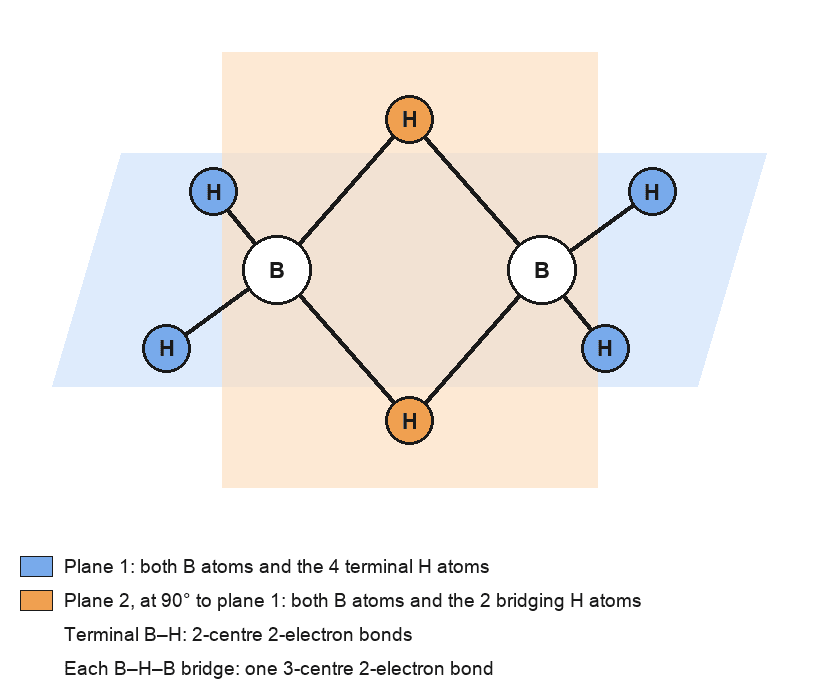
Step 3 — Count the atoms. This accounts for all 8 atoms: 2 B and 4 terminal H in plane 1, and the 2 bridging H in plane 2 (which also contains the two B atoms).
Why the other options are wrong:
- (A) The hydrogen atoms are not all in one plane: the two bridging hydrogen atoms lie above and below the plane of the four terminal ones.
- (C) Diborane has only two bridging hydrogen atoms and four terminal ones, not four bridging and two terminal.
- (D) The molecule is not flat, because the bridging hydrogen atoms stand out of the plane of the other six atoms.
Therefore, option (B) describes the structure of diborane.
- 91 mark
Question 9
A compound X of boron, reacts with on heating to give another compound Y which is called inorganic benzene. The compound X can be prepared by treating with lithium aluminium hydride. The compounds X and Y are represented by the formulas.
Solve with AIAnswer
- Correct
(A) ,
(B) ,
(C) ,
(D) ,
Answer: (A) ,
Key idea: Diborane is made by reducing boron trifluoride with lithium aluminium hydride. Heating diborane with ammonia gives borazine, , called inorganic benzene because it has a flat six-membered ring of alternating B and N atoms, like benzene.
Step 1 — Identify X. Reduction of by (in ether) gives diborane, so X is .
Step 2 — Identify Y. Diborane first forms an addition compound with ammonia; on heating this gives borazine and hydrogen. The overall change is shown below.
Step 3 — Match with the options. X is and Y is .
Why the other options are wrong:
- (B) is not formed from and ; a hydride reducing agent gives a boron hydride, not an oxide.
- (C) is the starting material that is reduced to X, not X itself.
- (D) The two formulas are the wrong way round: borazine, , is the product Y, not the starting compound X.
Therefore, X is and Y is .
- 101 mark
Question 10
The reason for small radius of Ga compared to Al is ________ .
(a) poor screening effect of d and f orbitals
(b) increase in nuclear charge
(c) presence of higher orbitals
(d) higher atomic number
Solve with AIWritten solution
Solution:
Key idea: Atomic radius depends on how strongly the outer electrons are pulled by the nucleus. Inner d and f electrons screen (shield) the nuclear charge poorly, so when they are added the effective nuclear charge on the outer electrons rises and the atom shrinks.
Step 1 — State the fact to be explained. The atomic radius of gallium (135 pm) is smaller than that of aluminium (143 pm), although gallium is below aluminium in the group.
Step 2 — Find what is added between Al and Ga. Aluminium has atomic number 13 and gallium has atomic number 31, so the nuclear charge rises by 18 units. Ten of the electrons added in between go into the inner 3d orbitals.
Step 3 — Explain the shrinking (options a and b). The 3d electrons screen the nucleus poorly, so the large increase in nuclear charge is not cancelled. The outer 4s and 4p electrons of gallium feel a larger effective nuclear charge and are pulled closer, so gallium is smaller than aluminium. Option (a) gives the poor screening, and option (b) gives the larger nuclear charge that is left unscreened; together they are the reason.
Step 4 — Reject options c and d. Higher orbitals (option c) would make the atom larger, not smaller. A higher atomic number (option d) on its own does not explain anything here: indium and thallium have still higher atomic numbers and are larger than gallium.
Note: the book accepts both poor screening and the increase in nuclear charge as answers, so this question is answered as a short-answer item. For gallium only the 3d electrons matter; the poor screening by f electrons is what makes thallium's size and ionisation enthalpy unusual.
Therefore, the correct options are (a) poor screening by the inner d electrons and (b) the increase in nuclear charge.
- 111 mark
Question 11
Which of the following statements are correct? Answer on the basis of figure given below
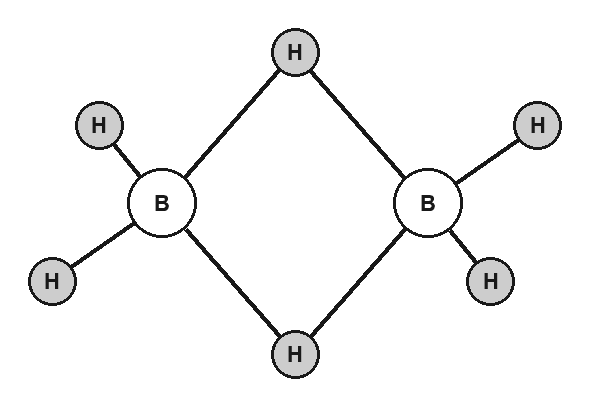
(a) The two bridged hydrogen atoms and the two boron atoms lie in one plane
(b) Out of six B–H bonds two bonds can be described in terms of 3 centre 2-electron bonds
(c) Out of six B–H bonds four B–H bonds can be described in terms of 3 centre 2 electron bonds
(d) The four terminal B–H bonds are two centre two electron regular bonds
Solve with AIWritten solution
Solution:
Key idea: The figure shows diborane, . Its 12 valence electrons (3 from each B and 1 from each H) form four ordinary two-centre two-electron (2c–2e) B–H bonds to the terminal hydrogen atoms and two three-centre two-electron (3c–2e) B–H–B bridges. Counting each bridge as one bond, the book speaks of "six B–H bonds": 4 terminal + 2 bridges.
Step 1 — Judge statement (a). The two bridging hydrogen atoms and the two boron atoms lie in one plane, and this plane is at right angles to the plane of the B atoms and the four terminal H atoms. So (a) is correct.
Step 2 — Count the electrons. Each boron atom brings 3 valence electrons and each hydrogen atom brings 1.
Twelve electrons make 6 pairs. Four pairs make the four terminal B–H bonds, and the remaining two pairs must hold the two bridges, one pair per bridge.
Step 3 — Judge statements (b) and (c). Each bridge is one bond in which a single pair of electrons holds three atoms (B, H and B), a 3c–2e or "banana" bond. Of the six bonds, therefore, two are 3c–2e bonds, so (b) is correct and (c), which says four, is wrong.
Step 4 — Judge statement (d). Each terminal B–H bond is a normal bond in which two electrons are shared between two atoms, so (d) is correct.
Note: the book accepts three of the four statements (all except the one about four 3c–2e bonds), so this question is answered as a short-answer item. The four B–H contacts in the bridges are not four separate bonds: they make up the two 3c–2e bonds.
Therefore, statements (a), (b) and (d) are correct.
- 121 mark
Question 12
Which one of the following is the correct statement?
Solve with AIAnswer
(A) Boric acid is a protonic acid
(B) Beryllium exhibits coordination number of six
- Correct
(C) Chlorides of both beryllium and aluminium have bridged structures in solid phase
(D) · is known as ‘inorganic benzene’
Answer: (C) Chlorides of both beryllium and aluminium have bridged structures in the solid phase
Key idea: Beryllium and aluminium show a diagonal relationship: both form covalent, electron-deficient chlorides, and in both the metal atoms make up their electron shortage by sharing lone pairs of chlorine atoms that bridge two metal atoms.
Step 1 — Describe solid beryllium chloride. In solid each Be atom is joined to four Cl atoms, and each Cl bridges two Be atoms, giving long chains.
Step 2 — Describe aluminium chloride. Aluminium chloride forms the Cl-bridged dimer in the vapour and in non-polar solvents, and in the solid each Al is surrounded by Cl atoms that bridge neighbouring Al atoms. So both chlorides have bridged structures.
Why the other options are wrong:
- (A) Boric acid is not a protonic acid: it does not release its own H⁺ but accepts OH⁻ from water (it is a Lewis acid).
- (B) Beryllium is a very small period 2 atom with only four valence orbitals (2s and 2p), so its highest coordination number is four, as in .
- (D) · is the addition compound of diborane and ammonia, ; inorganic benzene is borazine, , formed when this compound is heated.
Therefore, statement (C) is correct.
- 131 mark
Question 13
Heating an aqueous solution of aluminium chloride to dryness will give
Solve with AIAnswer
(A)
- Correct
(B)
(C)
(D)
Answer: (B)
Key idea: Aluminium chloride is a salt of a weak base and a strong acid and is strongly hydrolysed by water. When the solution is heated, the hydrogen chloride formed escapes, so the hydrolysis goes to completion.
Step 1 — Write the hydrolysis. In hot water aluminium chloride reacts with water to give aluminium hydroxide and hydrogen chloride.
Step 2 — Follow the heating to dryness. The HCl gas is driven off, so the reaction keeps moving forward. When the residue is heated strongly, the hydroxide loses water.
Step 3 — Name the final residue. What is left after heating to dryness is aluminium oxide.
Why the other options are wrong:
- (A) A basic chloride such as may form part-way, but on heating to dryness it loses its chlorine as HCl too.
- (C) is anhydrous aluminium chloride (the dimer); it cannot be obtained from water because the chloride is hydrolysed.
- (D) For the same reason anhydrous cannot be made by heating its aqueous solution; it is made by dry methods instead.
Therefore, heating the solution to dryness gives .
- 141 mark
Question 14
Aluminium chloride exists as dimer, in solid state as well as in solution of non-polar solvents such as benzene. When dissolved in water, it gives
Solve with AIAnswer
(A)
- Correct
(B)
(C)
(D)
Answer: (B)
Key idea: Water has a very high dielectric constant and its molecules donate lone pairs strongly. When aluminium chloride dissolves in water, the Cl bridges break, and each small, highly charged Al³⁺ ion is surrounded by six water molecules, giving the hexaaqua ion.
Step 1 — Write what happens to the dimer. The dimer breaks up and the aluminium is hydrated.
Step 2 — Check the equation. Each side has 2 Al, 6 Cl, 24 H and 12 O atoms, and the charges balance: 2 × (+3) + 6 × (−1) = 0.
Step 3 — Write it per Al. For each aluminium atom we get one ion and three Cl⁻ ions, which is option (B).
Why the other options are wrong:
- (A) A hydroxo complex such as forms only in alkali; with 3HCl is not what aluminium chloride gives in water.
- (C) Writing the ion as Al³⁺ is a shortened form; in water the small, highly charged Al³⁺ ion is always held by six water molecules, so (B) shows what is actually present.
- (D) Aluminium oxide is obtained only when the solution is heated to dryness, not simply on dissolving.
Note: the stem's description is the book's; strictly, solid aluminium chloride has a layer lattice with six-coordinate Al, and the dimer is found in the vapour, the melt and non-polar solvents.
Therefore, in water it gives .
- 151 mark
Question 15
Alum helps in purifying water by
Solve with AIAnswer
(A) forming Si complex with clay particles
(B) Sulphate part which combines with the dirt and removes it
- Correct
(C) coagulating the mud particles
(D) making mud water soluble
Answer: (C) Coagulating the mud particles
Key idea: Muddy water is a colloid: the fine clay particles carry negative charges, so they repel one another and stay suspended. Ions of high positive charge neutralise these charges and make the particles clump together and settle (coagulation).
Step 1 — Find the active ion in alum. Potash alum is . In water it gives Al³⁺ ions, which carry a high positive charge.
Step 2 — Explain the cleaning. The Al³⁺ ions (and the aluminium hydroxide formed by their hydrolysis) neutralise the negative charges on the clay particles. The particles then stick together into larger lumps that settle at the bottom, and the clear water above can be drawn off.
Why the other options are wrong:
- (A) Alum contains no silicon and forms no silicon complex; it works by neutralising the charges of the particles.
- (B) The sulphate ions are not the active part: the negatively charged clay particles are coagulated by the positive Al³⁺ ions.
- (D) Alum does the opposite: it makes the suspended mud settle out of the water; it does not dissolve it.
Therefore, alum purifies water by coagulating the mud particles.
- 161 mark
Question 16
The stability of +1 oxidation state increases in the sequence:
Solve with AIAnswer
(A) Tl < In < Ga < Al
(B) In < Tl < Ga < Al
(C) Ga < In < Al < Tl
- Correct
(D) Al < Ga < In < Tl
Answer: (D) Al < Ga < In < Tl
Key idea: Group 13 elements have the outer configuration . Down the group the pair is held more and more tightly and takes part in bonding less and less (the inert pair effect). So the +1 state, in which only the p electron is used, becomes more stable down the group.
Step 1 — Apply the inert pair effect. The reluctance of the electrons to bond grows from Al to Ga to In to Tl, so the stability of the +1 state increases in the same order.
Step 2 — Check with facts. Aluminium shows essentially only +3, while for thallium +1 is the more stable state (Tl⁺ salts are stable, and Tl³⁺ is an oxidising agent).
Why the other options are wrong:
- (A) This is the reverse order: it would make +1 most stable for aluminium, which in fact shows only +3.
- (B) It places thallium below gallium, but thallium shows the strongest inert pair effect in the group.
- (C) It places aluminium above indium, though +1 is least stable for aluminium.
Therefore, the stability of the +1 state increases as Al < Ga < In < Tl.
- 171 mark
Question 17
can be converted to anhydrous by heating
Solve with AIAnswer
(A) with NaCl in solid state
- Correct
(B) a mixture of and carbon in dry gas
(C) with gas
(D) with HCl gas
Answer: (B) A mixture of and carbon in dry gas
Key idea: Aluminium oxide is very stable, so chlorine alone cannot take the aluminium away from oxygen. Carbon removes the oxygen as carbon monoxide, and this drives the reaction. Everything must be dry, because water hydrolyses aluminium chloride.
Step 1 — Write the reaction. A hot mixture of alumina and coke reacts with dry chlorine.
Step 2 — Explain why it works. The carbon combines with the oxygen of the oxide, and the chlorine combines with the aluminium. As no water is present or formed, the product is anhydrous , which sublimes away from the hot mixture.
Why the other options are wrong:
- (A) Solid sodium chloride does not react with aluminium oxide; nothing removes the oxygen.
- (C) Chlorine alone cannot remove the oxygen from the very stable ; carbon is needed to take it away as CO.
- (D) With HCl the oxygen would leave as water, and water hydrolyses aluminium chloride, so anhydrous is not obtained this way.
Therefore, heating a mixture of and carbon in dry chlorine gives anhydrous .
- 181 mark
Question 18
Which of the following is the electron deficient molecule?
Solve with AIAnswer
(A)
- Correct
(B)
(C)
(D)
Answer: (B)
Key idea: A molecule is electron deficient when it has too few valence electrons to give an ordinary two-electron bond to every pair of linked atoms.
Step 1 — Count the electrons in diborane. Each boron has 3 valence electrons and each hydrogen 1.
Step 2 — Compare with the bonds needed. Twelve electrons make only 6 pairs, but diborane has 8 B–H links (4 terminal and 4 in the bridges). There are not enough pairs, so two pairs each hold three atoms (B–H–B, 3-centre 2-electron bonds). Diborane is electron deficient.
Why the other options are wrong:
- (A) Ethane has electrons, exactly 7 pairs for its 7 bonds (one C–C and six C–H), so it is electron precise.
- (C) Silane has 4 + 4 = 8 electrons, exactly 4 pairs for its four Si–H bonds, so it is electron precise.
- (D) Phosphine has 5 + 3 = 8 electrons: three bond pairs and one lone pair on phosphorus, so it is electron rich, not deficient.
Therefore, is the electron deficient molecule.
- 191 mark
Question 19
Which one of the following compounds is not a protonic acid?
Solve with AIAnswer
(A)
- Correct
(B)
(C)
(D)
Answer: (B)
Key idea: A protonic (Brønsted) acid gives H⁺ ions from its own O–H groups. Boric acid instead accepts OH⁻ from water, so it is a Lewis acid, not a protonic acid.
Step 1 — Recognise each formula. is sulphuric acid, ; is phosphoric acid, ; is sulphurous acid, ; is boric acid, .
Step 2 — Find the one that does not release its own proton. Boric acid is acidic only because boron accepts an OH⁻ ion from water, setting free H⁺ from the water.
Why the other options are wrong:
- (A) Sulphuric acid ionises its own O–H groups and gives H⁺ ions, so it is a protonic acid.
- (C) Phosphoric acid also releases protons from its O–H groups, in three steps.
- (D) Sulphurous acid also releases protons from its O–H groups.
Therefore, is not a protonic acid.
- 201 mark
Question 20
In borax bead test which compound is formed?
Solve with AIAnswer
(A) Ortho-borate
- Correct
(B) Meta-borate
(C) Double oxide
(D) Tetra-borate
Answer: (B) Meta-borate
Key idea: In the borax bead test, borax is heated in a platinum loop until it forms a clear glassy bead of sodium metaborate and boric anhydride. The in the bead combines with a metal oxide to give a coloured metaborate of that metal.
Step 1 — Form the bead. On heating, borax loses its water and then forms sodium metaborate and boric anhydride.
Step 2 — React the bead with a metal oxide. For example, a copper salt gives copper(II) oxide in the flame, which forms blue copper(II) metaborate with the boric anhydride.
Step 3 — Name the product type. The coloured compound in the bead, such as , is a metaborate.
Why the other options are wrong:
- (A) Orthoborates contain the ion; the bead compounds contain the metaborate unit .
- (C) The metal oxide does not stay as a separate oxide or a double oxide; it combines with to form a salt.
- (D) Borax itself is the tetraborate, ; it breaks down on heating, and the coloured compounds formed are metaborates.
Therefore, a metaborate is formed in the borax bead test.
- 211 mark
Question 21
Among the following electron deficient compound is:
Solve with AIAnswer
- Correct
(A)
(B)
(C)
(D)
Answer: (A)
Key idea: A compound is electron deficient when its central atom has fewer than eight electrons in its valence shell.
Step 1 — Count the electrons round boron in . Boron has 3 valence electrons and forms three B–Cl bonds, so it has only 3 bond pairs.
Step 2 — Conclude. Six electrons is two short of an octet, so is electron deficient and acts as a Lewis acid (it accepts a lone pair, for example from ).
Why the other options are wrong:
- (B) In carbon forms four bonds and has 8 electrons, a complete octet.
- (C) In phosphorus forms five bonds and has 10 electrons, an expanded octet, so it is not electron deficient.
- (D) In phosphorus has three bond pairs and one lone pair, 8 electrons in all.
Therefore, is the electron deficient compound.
- 221 mark
Question 22
Among boron trifluoride, stannic chloride and stannous chloride, Lewis acid is represented by
(a) only stannic chloride
(b) boron trifluoride and stannic chloride
(c) boron trifluoride and stannous chloride
(d) only boron trifluoride
Solve with AIWritten solution
Solution:
Key idea: A Lewis acid accepts a pair of electrons into an empty orbital. Boron trifluoride, stannic chloride () and stannous chloride () can all do this.
Step 1 — Judge boron trifluoride. Boron in has only six valence electrons and an empty 2p orbital, so it accepts a lone pair, for example from ammonia or from F⁻.
Step 2 — Judge stannic chloride. Tin is a large atom and carries a large partial positive charge in , so it has room for two more groups and accepts two chloride ions to form the hexachloridostannate ion. is also used as a Lewis-acid catalyst.
In the ISC (textbook) description the extra electron pairs go into vacant 5d orbitals of tin; calculations since the late 1980s show that the d orbitals take little part, and explain the extra bonds by the large size and high positive charge of tin.
Step 3 — Judge stannous chloride. In tin has two bond pairs and one lone pair, only six electrons, so it can accept one more pair.
Step 4 — Judge the options. All three compounds are Lewis acids. Options (a) and (d) say "only" one compound, so they are wrong. Options (b) and (c) each name two compounds that really are Lewis acids, so both are correct statements, although neither names all three.
Note: the book's key names boron trifluoride and stannous chloride, but boron trifluoride and stannic chloride is equally correct, because stannic chloride is a well-known Lewis acid; so this question is answered as a short-answer item.
Therefore, options (b) and (c) are both correct; in fact all three compounds are Lewis acids.
- 231 mark
Question 23
Which of the following compounds has a 3-centre bond?
Solve with AIAnswer
- Correct
(A) Diborane
(B) Carbon dioxide
(C) Boron trifluoride
(D) Ammonia
Answer: (A) Diborane
Key idea: A three-centre two-electron (3c–2e) bond is a bond in which one pair of electrons holds three atoms together. Such bonds are found in electron-deficient molecules that do not have enough electrons for ordinary two-centre bonds.
Step 1 — Look at diborane. Diborane, , has only 12 valence electrons for 8 B–H links. Its two B–H–B bridges are each held by one electron pair spread over the B, H and B atoms, so diborane has two 3c–2e bonds.
Why the other options are wrong:
- (B) Carbon dioxide, O=C=O, has two ordinary C=O double bonds, each made of a σ bond and a π bond between two atoms.
- (C) Boron trifluoride has three ordinary two-centre B–F σ bonds; its extra π back-bonding is spread over all four atoms, not a B–H–B type bridge.
- (D) Ammonia has three ordinary two-centre N–H bonds and a lone pair on nitrogen.
Therefore, diborane has 3-centre bonds.
- 241 mark
Question 24
Which of the following statements about is not correct?
Solve with AIAnswer
- Correct
(A) It is a strong tribasic acid.
(B) It is prepared by acidifying an aqueous solution of borax.
(C) It has a layer structure in which planar units are joined by hydrogen bonds.
(D) It does not act as proton donor but acts as a Lewis acid by accepting a lone pair of electrons.
Answer: (A) It is a strong tribasic acid — this statement is not correct
Key idea: Boric acid, or , is a weak monobasic acid. It does not release its own protons; it accepts one OH⁻ ion from water.
Step 1 — Test statement (A). Each boric acid molecule takes up only one OH⁻ ion, so it is monobasic, not tribasic.
Step 2 — Judge its strength. The equilibrium lies far to the left (its is about 9.2), so boric acid is a very weak acid. Statement (A) is wrong on both counts.
Why the other options are wrong (each is a correct statement):
- (B) This is how boric acid is made: borax solution is acidified, for example with hydrochloric acid (), and boric acid crystallises out.
- (C) In the crystal, flat units are linked by hydrogen bonds into layers; this is why boric acid forms soft, slippery flakes.
- (D) Boric acid is a Lewis acid: boron accepts the lone pair of a hydroxide ion from water.
Therefore, the statement "It is a strong tribasic acid" is not correct.
- 251 mark
Question 25
An example of a double salt is
Solve with AIAnswer
(A) Bleaching powder
(B)
(C) Hypo
- Correct
(D) Potash Alum
Answer: (D) Potash Alum
Key idea: A double salt is formed when two simple salts crystallise together in a fixed ratio; in water it gives all the ions of both salts. A complex salt, by contrast, keeps its complex ion in solution.
Step 1 — Write the formula of potash alum. Potash alum is potassium sulphate and aluminium sulphate crystallised together with water.
Step 2 — Check its behaviour in water. It dissolves to give K⁺, Al³⁺ and ions, the ions of the two simple salts, so it is a double salt.
Why the other options are wrong:
- (A) Bleaching powder, , is a mixed salt: one metal ion with two different anions; it is not two salts crystallised together.
- (B) is a complex salt; in water it gives K⁺ and the complex ion , with practically no free Fe²⁺ or CN⁻ ions.
- (C) Hypo is sodium thiosulphate, , a simple salt with water of crystallisation.
Therefore, potash alum is a double salt.
- 261 mark
Question 26
Catenation, i.e., linking of similar atoms depends on size and electronic configuration of atoms. The tendency of catenation in Group 14 elements follows the order:
Solve with AIAnswer
(A) C > Si > Ge > Sn
- Correct
(B) C >> Si > Ge ≈ Sn
(C) Si > C > Sn > Ge
(D) Ge > Sn > Si > C
Answer: (B) C >> Si > Ge ≈ Sn
Key idea: An element can form long chains of its own atoms only if the bond between two of its atoms is strong. The E–E bond gets weaker down group 14 as the atoms get larger, so catenation falls sharply after carbon.
Step 1 — Compare the bond enthalpies. The E–E bond enthalpies are about C–C 348, Si–Si 297, Ge–Ge 260 and Sn–Sn 240 kJ mol⁻¹.
Step 2 — Explain the big gap after carbon. Carbon is small, and its C–C bond is strong; it also forms strong multiple bonds, so carbon forms countless chains and rings. Silicon forms only short chains in its hydrides (silanes up to about ; long Si–Si chains are known mainly in polysilanes carrying organic groups), so carbon's tendency is far greater (C >> Si).
Step 3 — Compare Ge and Sn. Germanium and tin show very little catenation, and the two are about equal (Ge ≈ Sn); lead shows hardly any.
Why the other options are wrong:
- (A) It gets the order of the first members right, but it misses the two features that describe the trend: carbon's tendency is far greater than silicon's, and germanium and tin are about equal; option (B) states both.
- (C) Silicon cannot come before carbon, because the Si–Si bond (297 kJ mol⁻¹) is weaker than the C–C bond (348 kJ mol⁻¹).
- (D) This is nearly the reverse order; carbon shows the greatest catenation, not the least.
Therefore, the order is C >> Si > Ge ≈ Sn.
- 271 mark
Question 27
Silicon has a strong tendency to form polymers like silicones. The chain length of silicone polymer can be controlled by adding
Solve with AIAnswer
(A)
(B)
- Correct
(C)
(D)
Answer: (C)
Key idea: Silicones are made by hydrolysing methylchlorosilanes (Me = methyl, ) and letting the Si–OH groups condense into Si–O–Si links. Each Si–Cl bond becomes one Si–OH group, that is one point where the chain can grow. A compound with only one Si–Cl bond can join a chain at one end only, so it stops the chain there.
Step 1 — See how the chain grows. Dimethyldichlorosilane is hydrolysed to a diol, which has two OH groups and so can link at both ends.
Step 2 — See what does. Trimethylchlorosilane gives , with only one OH group. When it condenses onto the end of a chain, that end becomes , which has no OH left, so the chain cannot grow further there.
Step 3 — Control the length. The more is added to the mixture, the sooner the chains are capped, so the shorter the chains. In this way the chain length is controlled.
Why the other options are wrong:
- (A) gives three OH groups per silicon, so it links chains together into a cross-linked network instead of capping them.
- (B) gives two OH groups per silicon; it is the monomer that makes the chain grow, not the one that stops it.
- (D) has no Si–Cl bond, so it is not hydrolysed, forms no Si–OH group and cannot join the chain at all.
Therefore, is added to control the chain length.
- 281 mark
Question 28
Quartz is extensively used as a piezoelectric material, it contains ________ .
Solve with AIAnswer
(A) Pb
- Correct
(B) Si
(C) Ti
(D) Sn
Answer: (B) Si
Key idea: Quartz is a crystalline form of silica, silicon dioxide, . A piezoelectric crystal develops an electric voltage when it is squeezed, and vibrates when a voltage is applied; this is why quartz crystals keep time in clocks and watches.
Step 1 — Write the formula of quartz. Quartz is , made of silicon and oxygen only.
Step 2 — Pick the element from the options. Of the four elements given, quartz contains only silicon.
Why the other options are wrong:
- (A) Lead is present in some other piezoelectric materials (for example lead zirconate titanate), but quartz itself contains no lead.
- (C) Titanium is also found in some synthetic piezoelectric ceramics, but not in quartz, which is pure .
- (D) Tin is not a constituent of quartz.
Therefore, quartz contains silicon (Si).
- 291 mark
Question 29
The most commonly used reducing agent is:
Solve with AIAnswer
(A)
(B)
(C)
- Correct
(D)
Answer: (D)
Key idea: A reducing agent gives away electrons and is itself oxidised. For tin, the +4 state is more stable than the +2 state, so tin(II) compounds readily change to tin(IV): .
Step 1 — See why reduces. Tin in is in the less stable +2 state and easily loses two electrons to reach +4. For example, it reduces iron(III) chloride to iron(II) chloride.
Step 2 — Note its use. Stannous chloride is widely used in the laboratory as a reducing agent, for example to reduce mercury(II) chloride and iron(III) salts.
Why the other options are wrong:
- (A) Aluminium in is already in its only common state, +3, and cannot be oxidised further, so is not a reducing agent (it is a Lewis acid).
- (B) For lead the +2 state is the more stable one (inert pair effect), so does not readily change to lead(IV) and is not a useful reducing agent.
- (C) Tin in is already in the +4 state, so it cannot give away more electrons.
Therefore, is the commonly used reducing agent.
- 301 mark
Question 30
Dry ice is
Solve with AIAnswer
(A) solid
(B) solid
- Correct
(C) solid
(D) solid
Answer: (C) Solid
Key idea: Dry ice is solid carbon dioxide. It is called "dry" because at atmospheric pressure it does not melt into a liquid: it changes straight into gas (sublimes) at about −78 °C.
Step 1 — Recall how dry ice is made. Carbon dioxide gas is liquefied under pressure and then allowed to expand quickly; the cooling turns part of it into a snow-like solid, which is pressed into blocks.
Step 2 — Recall its use. Because it leaves no liquid behind, dry ice is used as a refrigerant for ice-cream and frozen food.
Why the other options are wrong:
- (A) Ammonia is a refrigerant gas, but solid ammonia is not called dry ice.
- (B) Solid sulphur dioxide is not called dry ice.
- (D) Nitrogen is used as liquid nitrogen for cooling; dry ice is not solid nitrogen.
Therefore, dry ice is solid .
- 311 mark
Question 31
Cement, the important building material is a mixture of oxides of several elements. Besides calcium, iron and sulphur, oxides of elements of which of the group(s) are present in the mixture?
Solve with AIAnswer
(A) group 2
- Correct
(B) groups 2, 13 and 14
(C) groups 2 and 13
(D) groups 2 and 14
Answer: (B) Groups 2, 13 and 14
Key idea: Portland cement is made by strongly heating limestone with clay, and adding a little gypsum. Its main oxides are lime (CaO), silica () and alumina (), with smaller amounts of iron oxide, magnesia (MgO) and sulphur trioxide (from gypsum).
Step 1 — List the elements other than Ca, Fe and S. Leaving out calcium, iron and sulphur, the oxides present are those of silicon, aluminium and magnesium.
Step 2 — Place them in groups. Magnesium is in group 2, aluminium is in group 13 and silicon is in group 14.
Why the other options are wrong:
- (A) It leaves out aluminium (group 13) and silicon (group 14); silica is in fact the largest part of cement after lime.
- (C) It leaves out silicon, though silica () is a major oxide in cement.
- (D) It leaves out aluminium, though alumina () from the clay is present.
Therefore, oxides of elements of groups 2, 13 and 14 are present.
- 321 mark
Question 32
The linear shape of is due to ________ .
(a) hybridisation of carbon
(b) hybridisation of carbon
(c) – bonding between carbon and oxygen
(d) hybridisation of carbon
Solve with AIWritten solution
Solution:
Key idea: The shape of a molecule is set by its σ bonds. In O=C=O carbon forms two σ bonds (one to each O) and two π bonds. Two σ bonds use two sp hybrid orbitals, which point in opposite directions (180°), so the molecule is linear.
Step 1 — Find the hybridisation of carbon. Carbon forms two σ bonds and has no lone pair, so it uses two hybrid orbitals: it is sp hybridised. The two sp orbitals lie at 180°, which makes O=C=O linear, so option (b) is correct.
Step 2 — See the part played by π bonding. Carbon is small, and its 2p orbitals overlap well with those of oxygen to form strong – bonds. Because of these double bonds, carbon needs only two σ bonds to complete its octet, so it stays sp hybridised and CO₂ exists as small linear molecules. The larger 3p orbitals of silicon overlap poorly with the 2p orbitals of oxygen, so silicon does not form stable – bonds with oxygen; in each Si forms four single Si–O bonds and a giant network results. In this sense option (c) is also a reason, as the book's key accepts.
Step 3 — Reject options a and d. hybridisation would give a tetrahedral arrangement and a trigonal one; neither gives a 180° molecule.
Note: the book accepts both sp hybridisation and – bonding as answers, so this question is answered as a short-answer item. Strictly, the 180° angle itself comes from the two σ bonds formed by sp orbitals; the – bonding explains why carbon uses only two σ bonds.
Therefore, the correct options are (b) sp hybridisation of carbon and (c) – bonding between carbon and oxygen.
- 331 mark
Question 33
is used during polymerisation of organosilicones because
(a) the chain length of organosilicone polymers can be controlled by adding
(b) blocks the end terminal of silicone polymer
(c) improves the quality and yield of the polymer
(d) acts as a catalyst during polymerisation
Solve with AIWritten solution
Solution:
Key idea: In making silicones, each Si–Cl bond of a methylchlorosilane is hydrolysed to Si–OH, and Si–OH groups condense to form Si–O–Si links. Trimethylchlorosilane, (Me = ), has only one Si–Cl bond, so it can form only one link.
Step 1 — Find what gives on hydrolysis. It gives trimethylsilanol, which has a single OH group.
Step 2 — Judge statement (b). When condenses with the OH at the end of a growing chain, that end becomes , which has no OH left. So blocks the end of the chain: (b) is correct.
Step 3 — Judge statement (a). Since every molecule caps one chain end, the amount added decides how long the chains can grow. So the chain length is controlled by adding it: (a) is correct.
Step 4 — Judge statements (c) and (d). is used up as it joins the chain ends, so it is a reactant, not a catalyst: (d) is wrong. Its purpose is to stop the chains at the wanted length; it is not added to improve quality or yield, so (c) is not the reason.
Note: the book accepts both "blocks the chain end" and "controls the chain length" as answers, so this question is answered as a short-answer item.
Therefore, the correct reasons are (a) and (b): blocks the chain ends and so controls the chain length.
- 341 mark
Question 34
Which of the following statements are correct?
(a) Fullerenes have dangling bonds
(b) Fullerenes are cage-like molecules
(c) Graphite is thermodynamically most stable allotrope of carbon
(d) Graphite is slippery and hard and therefore used as a dry lubricant in machines
Solve with AIWritten solution
Solution:
Key idea: Carbon has several allotropes: diamond, graphite and the fullerenes. Fullerenes such as are closed molecules; graphite is made of layers held by weak forces; and graphite is the most stable form under ordinary conditions.
Step 1 — Judge statement (a). In a fullerene every carbon atom is bonded to three other carbon atoms, and the closed cage has no edges, so there are no unused ("dangling") bonds. Statement (a) is wrong.
Step 2 — Judge statement (b). is a hollow, football-shaped cage made of 20 six-membered and 12 five-membered rings. Statement (b) is correct.
Step 3 — Judge statement (c). At ordinary temperature and pressure graphite has a lower Gibbs energy than diamond: the standard Gibbs energy of formation of graphite is zero and that of diamond is about +2.9 kJ mol⁻¹ (its standard enthalpy of formation is about +1.9 kJ mol⁻¹). So graphite is the thermodynamically most stable allotrope; diamond changes into it only extremely slowly. Statement (c) is correct.
Step 4 — Judge statement (d). Graphite is used as a dry lubricant because it is soft and slippery: its layers slide over one another. It is not hard, so statement (d) is wrong as written.
Note: the book accepts both the cage statement and the stability statement, so this question is answered as a short-answer item.
Therefore, statements (b) and (c) are correct.
- 351 mark
Question 35
Identify the correct resonance structures of carbon dioxide from the ones given below:
(a) O—C ≡ O
(b) O = C = O
(c) O ≡ C – O
(d) O – C ≡ O
Solve with AIWritten solution
Solution:
Key idea: A correct resonance structure keeps the atoms in the same places, gives every atom an octet, and shows the right formal charges. Formal charge = (valence electrons) − (lone-pair electrons) − (number of bonds).
Step 1 — Check structure (b), O=C=O. Each oxygen has 2 lone pairs and 2 bonds, and carbon has 4 bonds and no lone pair. The formal charges are all zero.
Structure (b) is correct (it is the main contributor).
Step 2 — Check structure (d), ⁻O–C≡O⁺. The singly bonded oxygen has 3 lone pairs and 1 bond, and the triply bonded oxygen has 1 lone pair and 3 bonds.
The charges shown, − on the singly bonded O and + on the triply bonded O, are right, so (d) is correct.
Step 3 — Check structure (c), ⁻O≡C–O⁺. It has the same bonds as (d), but the charges are swapped: the triply bonded oxygen should carry +1 and the singly bonded one −1. So (c) is wrong.
Step 4 — Check structure (a), O–C≡O. Its bonds are those of (d), but it shows no charges, although the oxygen atoms must carry −1 and +1. So (a) is wrong as written.
Note: the book accepts both O=C=O and ⁻O–C≡O⁺, so this question is answered as a short-answer item. The third contributor, ⁺O≡C–O⁻, is the mirror image of (d).
Therefore, structures (b) and (d) are correct resonance structures of carbon dioxide.
- 361 mark
Question 36
Beryllium and aluminium exhibit many properties which are similar. But, the two elements differ in
Solve with AIAnswer
(A) forming covalent halides
(B) forming polymeric hydrides
- Correct
(C) exhibiting maximum covalency in compounds
(D) exhibiting amphoteric nature in their oxides
Answer: (C) Exhibiting maximum covalency in compounds
Key idea: Beryllium (group 2) and aluminium (group 13) are diagonally related: their ions have a similar charge-to-size ratio, so they behave alike in many ways. They differ where atomic size and the number of valence orbitals matter, because beryllium is in period 2 and aluminium in period 3.
Step 1 — Compare how many groups each atom can hold. Beryllium is very small and has only four valence orbitals (2s and three 2p), so it forms at most four bonds, as in . Aluminium is a larger, period 3 atom, so six fluoride ions fit round it, as in .
Step 2 — Conclude. The maximum covalency is 4 for beryllium but 6 for aluminium, so this is where they differ.
Note: Using vacant 3d orbitals is the older textbook (ISC) model of the covalency of six. Calculations since the late 1980s show that the 3d orbitals of aluminium take little part in bonding; the Al–F bonds are largely ionic, so the larger size of aluminium is the main reason.
Why the other options are wrong:
- (A) Both elements form covalent halides, such as and , because their small, highly charged ions polarise the halide ions strongly.
- (B) Both form polymeric hydrides, and , held together by hydrogen bridges.
- (D) Both oxides, BeO and , are amphoteric: each dissolves in acids and in alkalis.
Therefore, beryllium and aluminium differ in their maximum covalency.
- 371 mark
Question 37
Among the following substituted silanes, which one will give rise to cross linked silicone polymer on hydrolysis
Solve with AIAnswer
(A)
(B)
- Correct
(C)
(D)
Answer: (C)
Key idea: On hydrolysis each Si–Cl bond becomes an Si–OH group, and each Si–OH can make one Si–O–Si link. Two links per silicon give a chain; three links per silicon join chains to one another, giving a cross-linked (three-dimensional) polymer.
Step 1 — Hydrolyse . It gives a silanetriol with three OH groups on silicon.
Step 2 — Follow the condensation. Each silicon can now form three Si–O–Si links. Two of them build a chain, and the third joins it to a neighbouring chain, so a cross-linked network forms.
Why the other options are wrong:
- (A) has no Si–Cl bond, so it is not hydrolysed and cannot form a polymer.
- (B) gives two OH groups per silicon, so it forms straight chains (or rings), not a cross-linked network.
- (D) gives only one OH group, so it can only cap the end of a chain.
Therefore, gives a cross-linked silicone polymer.
- 381 mark
Question 38
The stability of dihalides of Si, Ge, Sn and Pb increase steadily in the sequence
Solve with AIAnswer
(A)
(B)
(C)
- Correct
(D)
Answer: (D)
Key idea: Group 14 elements have the outer configuration . Down the group the pair takes part in bonding less and less (the inert pair effect), so the +2 state, in which only the two p electrons are used, becomes steadily more stable.
Step 1 — Apply the inert pair effect. The +2 state becomes more stable in the order Si < Ge < Sn < Pb, so the dihalides become more stable in the same order.
Step 2 — Check with facts. Silicon dihalides are not stable compounds under ordinary conditions, germanium(II) halides are easily oxidised, tin(II) chloride is a stable compound but a reducing agent, and lead(II) halides are the stable halides of lead.
Why the other options are wrong:
- (A) This is the reverse order; it would make the silicon dihalide the most stable, while it is the least stable.
- (B) It puts germanium below silicon, but +2 is more stable for germanium than for silicon.
- (C) It puts lead below tin, but lead shows the strongest inert pair effect, so is the most stable.
Therefore, the stability increases as .
- 391 mark
Question 39
A metal, M forms chlorides in its +2 and +4 oxidation states. Which of the following statements about these chlorides is correct?
Solve with AIAnswer
- Correct
(A) is more ionic than
(B) is more easily hydrolysed than
(C) is more volatile than
(D) is more soluble in anhydrous ethanol than
Answer: (A) is more ionic than
Key idea: By Fajans' rules, the higher the charge on a cation, the more it polarises the anion and the more covalent the bond. An ion polarises chloride ions far more than an ion, so is covalent and is more ionic. Tin and lead are examples of such metals.
Step 1 — Compare the bonding. In the metal is in the lower oxidation state, so it polarises chloride less and the chloride is more ionic. For example, is a solid, while is a covalent liquid.
Step 2 — Use the bonding to judge the other properties. Covalent consists of separate molecules, so it is more volatile, is hydrolysed more easily (for example fumes in moist air) and tends to dissolve better in less polar solvents.
Why the other options are wrong:
- (B) The covalent tetrachloride is the one more easily hydrolysed: the M(IV) atom carries a large partial positive charge and is large enough to take a water molecule as an extra neighbour, so water attacks it readily (the ISC (textbook) description has the lone pair of water entering vacant d orbitals; calculations since the late 1980s show that the d orbitals take little part).
- (C) The tetrachloride is the more volatile: is a liquid that boils at about 114 °C, while is a solid.
- (D) Solubility in a less polar solvent such as anhydrous ethanol favours the more covalent chloride, , so this statement does not follow from the change in bonding.
Therefore, is more ionic than .
- 401 mark
Question 40
In silicon dioxide
Solve with AIAnswer
(A) there are double bonds between silicon and oxygen atoms
(B) silicon atom is bonded to two oxygen atoms
(C) each silicon atom is surrounded by two oxygen atoms and each oxygen atom is bonded to two silicon atoms
- Correct
(D) each silicon atom is surrounded by four oxygen atoms and each oxygen atom is bonded to two silicon atoms
Answer: (D) Each silicon atom is surrounded by four oxygen atoms and each oxygen atom is bonded to two silicon atoms
Key idea: Silicon is too large to form strong – double bonds with oxygen. So instead of small O=Si=O molecules, silica is a giant network of tetrahedra in which every oxygen is shared between two silicon atoms.
Step 1 — Describe the bonding round silicon. Each silicon atom forms four single Si–O bonds, to four oxygen atoms at the corners of a tetrahedron.
Step 2 — Describe the bonding round oxygen. Each oxygen atom is bonded to two silicon atoms (Si–O–Si), linking the tetrahedra into a three-dimensional network.
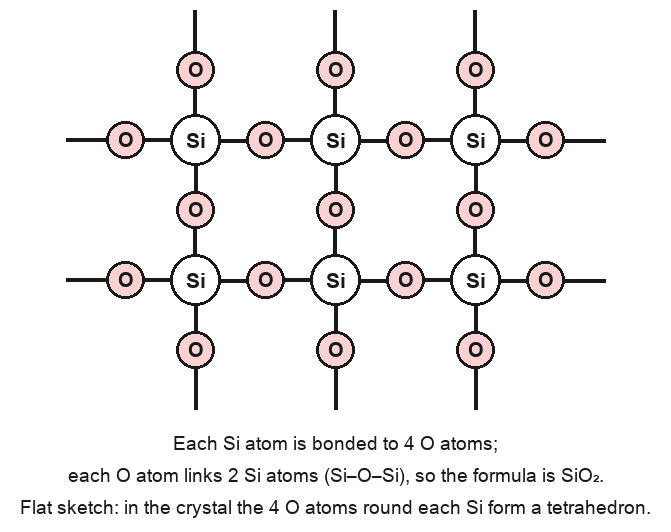
Step 3 — Check the formula. Each silicon has 4 oxygen neighbours, but each oxygen is shared by 2 silicons, so each silicon owns 4 ÷ 2 = 2 oxygen atoms. This gives the formula .
Why the other options are wrong:
- (A) There are no Si=O double bonds in silica; silicon forms only single Si–O bonds to four different oxygen atoms.
- (B) "Bonded to two oxygen atoms" describes a molecule like CO₂; in silica each silicon is bonded to four oxygen atoms.
- (C) The second half is right (each O bonds to two Si), but each silicon is surrounded by four oxygen atoms, not two.
Therefore, in silicon dioxide each Si is surrounded by four O atoms and each O is bonded to two Si atoms.
- 411 mark
Question 41
Graphite is a soft solid lubricant extremely difficult to melt. The reason for this anomalous behaviour is that graphite
Solve with AIAnswer
(A) is an allotropic form of diamond
(B) has molecules of variable molecular masses like polymers
- Correct
(C) has carbon atoms arranged in large plates of rings of strongly bound carbon atoms with weak interplate bonds
(D) is a non-crystalline substance
Answer: (C) It has carbon atoms arranged in large plates of rings of strongly bound carbon atoms with weak interplate bonds
Key idea: Graphite has a layer structure. Inside each layer every carbon atom is hybridised and joined by strong covalent bonds to three others, forming flat sheets of hexagonal rings (C–C 141.5 pm). The layers are 340 pm apart (textbook value; precise measurements give about 335 pm) and are held together only by weak van der Waals forces.
Step 1 — Explain the softness. The forces between the layers are weak, so the layers slide over one another easily. This makes graphite soft and slippery, and so a good lubricant.
Step 2 — Explain the very high melting point. To melt graphite, the strong covalent C–C bonds within the layers must be broken, and this needs a very large amount of energy. So graphite is extremely difficult to melt.

Why the other options are wrong:
- (A) Graphite and diamond are both allotropes of carbon, but this fact does not explain why graphite is soft yet hard to melt.
- (B) Graphite is not a mixture of molecules of different masses; each layer is one giant covalent sheet.
- (D) Graphite is crystalline: its atoms are arranged in a regular pattern of layers.
Therefore, the reason is that graphite has strongly bonded layers of carbon rings held together by weak forces.
- 421 mark
Question 42
Glass is a
Solve with AIAnswer
- Correct
(A) super-cooled liquid
(B) gel
(C) polymeric mixture
(D) micro-crystalline solid
Answer: (A) Super-cooled liquid
Key idea: Glass is made by cooling molten silicates quickly. The particles do not have time to arrange themselves into a regular crystal lattice, so glass keeps the disordered arrangement of a liquid but becomes rigid. For this reason the book describes glass as a super-cooled liquid.
Step 1 — Describe what happens on cooling. As the melt cools, it becomes more and more viscous until it is rigid; it never crystallises.
Step 2 — Note the result. Glass has no sharp melting point: on heating it softens gradually over a range of temperature, as expected for a material with a liquid-like, disordered arrangement.
Why the other options are wrong:
- (B) A gel is a colloid in which a liquid is held in a solid network (for example jelly); glass contains no liquid trapped in this way.
- (C) Glass is not a mixture of separate polymer molecules; it is a continuous, disordered network of silicate units.
- (D) Glass has no crystals at all, not even tiny ones; its particles are arranged irregularly.
Note: today glass is usually described as an amorphous (non-crystalline) solid; at room temperature it is rigid and does not flow. "Super-cooled liquid" is the book's traditional name for the same disordered structure.
Therefore, glass is described as a super-cooled liquid.
- 431 mark
Question 43
For making good quality mirrors, plates of float glass are used. These are obtained by floating molten glass over a liquid metal which does not solidify before glass. The metal used can be
Solve with AIAnswer
- Correct
(A) tin
(B) sodium
(C) magnesium
(D) mercury
Answer: (A) tin
Key idea: In the float-glass process, molten glass is poured onto a bath of molten metal. The metal must be denser than glass (so the glass floats), must stay liquid from about 600 °C up to about 1100 °C without boiling, and must not react with the glass.
Step 1 — Check tin. Tin melts at 232 °C and boils only at about 2600 °C, so it is liquid at every temperature used. Molten tin (density about 6.5 g cm⁻³) is much denser than glass (about 2.5 g cm⁻³), and it does not react with glass. Glass floating on it cools into a perfectly flat, smooth sheet.
Step 2 — Conclude. Tin is the metal used in the float-glass process.
Why the other options are wrong:
- (B) Sodium boils at about 883 °C, below the temperature of molten glass, it is less dense than glass, and it is very reactive.
- (C) Magnesium is less dense than glass and is a reactive metal that would react with the hot glass; it is not used.
- (D) Mercury is dense, but it boils at 357 °C, far below the temperature of molten glass, so it would boil away (and its vapour is poisonous).
Note: the book's answer, mercury, is a slip; the float-glass process uses molten tin.
Therefore, the metal used is tin.
- 441 mark
Question 44
The straight chain polymer is formed by
Solve with AIAnswer
(A) hydrolysis of followed by condensation polymerisation
(B) hydrolysis of by addition polymerisation
- Correct
(C) hydrolysis of followed by condensation polymerisation
(D) hydrolysis of followed by condensation polymerisation
Answer: (C) Hydrolysis of followed by condensation polymerisation
Key idea: A straight-chain silicone needs each silicon to form exactly two Si–O–Si links, one on each side. On hydrolysis each Si–Cl bond becomes one Si–OH group, so the starting compound must have two Si–Cl bonds.
Step 1 — Hydrolyse dimethyldichlorosilane. It gives dimethylsilanediol, with two OH groups.
Step 2 — Condense the diol. Neighbouring molecules lose water between their OH groups, building a long chain . This is condensation polymerisation, because a small molecule (water) is removed at each link.
Why the other options are wrong:
- (A) gives three OH groups per silicon, so its polymer is cross-linked, not a straight chain.
- (B) has no Si–Cl bond and is not hydrolysed; silicones are not made by addition polymerisation.
- (D) gives only one OH group, so it can form only the dimer or cap a chain end.
Therefore, the straight-chain polymer is formed from .
- 451 mark
Question 45
Which one of the following statements about the zeolites is false?
Solve with AIAnswer
(A) They are used as cation exchangers
(B) They have open structure which enables them to take up small molecules
(C) Zeolites are aluminosilicates having three dimensional network
- Correct
(D) Some of the units are replaced by and ions in zeolites
Answer: (D) The statement about and units is false
Key idea: Zeolites are aluminosilicates with an open three-dimensional framework of tetrahedra. Some tetrahedra are replaced by tetrahedra; each such swap gives the framework one extra negative charge, which is balanced by cations such as Na⁺ or Ca²⁺ held in the open channels.
Step 1 — Test statement (D). In zeolites aluminium replaces silicon only in tetrahedral units. Octahedral units are not part of the zeolite framework (octahedral aluminium is found in clay minerals instead). So statement (D) is false.
Step 2 — Check the other statements. Statements (A), (B) and (C) all describe zeolites correctly, as shown below.
Why the other options are wrong (each is a true statement):
- (A) The loosely held cations in the channels can be swapped for others, so zeolites are used as cation exchangers, for example to soften hard water.
- (B) Their open framework has cavities of fixed size that take up small molecules, which is why zeolites act as molecular sieves and catalysts (ZSM-5 converts alcohols to petrol).
- (C) Zeolites are indeed aluminosilicates with a three-dimensional network of linked tetrahedra.
Note: the book's answer marks the statement about the three-dimensional aluminosilicate network as false, but that statement is true; the false statement is the one about units.
Therefore, statement (D) is the false one.
- 461 mark
Question 46
Glass reacts with HF to produce
- 471 mark
Question 47
In graphite, electrons are
- 481 mark
Question 48
Which of the following types of forces bind together the carbon atoms in diamond?
- 491 mark
Question 49
Water gas is produced by
- 501 mark
Question 50
Glass is a
(a) Liquid
(b) Solid
(c) Supercooled liquid
(d) Transparent organic polymer
- 511 mark
Question 51
The substance used as a smoke screen in warfare is
- 521 mark
Question 52
Trimethylamine molecule is ______ in shape, while shape of trisilylamine is ______.
- 531 mark
Question 53
The compound having the highest bond energy among diatomic molecules is ______.
- 541 mark
Question 54
is ______ in nature.
- 551 mark
Question 55
Silicones are also referred to as ______ polymers because they have very high ______.
- 561 mark
Question 56
One recently discovered allotrope, , is known as ______.
- 571 mark
Question 57
The C—C bond length in diamond is ______ while in graphite it is ______.
- 581 mark
Question 58
______ is produced by action of conc. on potassium ferrocyanide.
- 591 mark
Question 59
Dehydration of formic acid gives ______.
- 601 mark
Question 60
Out of CO and , ______ forms complexes.
- 611 mark
Question 61
The basic building unit of silicates is ______.
- 621 mark
Question 62
Trihalides of boron are ______ compounds and act as Lewis ______.
- 631 mark
Question 63
In borax bead test, copper forms a ______ coloured bead in oxidising flame and a ______ coloured bead in reducing flame.
- 641 mark
Question 64
The two boron atoms in diborane are bridged together through two ______ atoms by ______ bonding.
- 651 mark
Question 65
Orthoboric acid is a ______ basic acid.
- 661 mark
Question 66
The two types of bonds present in diborane are ______ and ______.
- 671 mark
Question 67
An alloy of copper and aluminium which has beautiful golden yellow colour is called ______.
- 681 mark
Question 68
The structure of is ______ while that of is ______.
- 691 mark
Question 69
acts as a ______ agent.
- 701 mark
Question 70
In diborane, the two boron atoms are linked together by two ______ bonds.
- 711 mark
Question 71
has a ______ structure.
- 721 mark
Question 72
is ______ in nature.
- 731 mark
Question 73
Boron shows diagonal relationship with ______.
- 741 mark
Question 74
The electronic configurations of group 14 elements are of the type ______.
- 751 mark
Question 75
The ability of an element to form long chains or rings by linking its atoms is called ______.
- 761 mark
Question 76
In group 14, the stability of +4 oxidation state ______ while that of +2 state ______ on moving down the group. It is due to ______ effect.
- 771 mark
Question 77
We cannot prepare anhydrous by heating hydrated aluminium chloride, . Explain.
- 781 mark
Question 78
Why boron forms electron deficient compound?
- 791 mark
Question 79
Why boron and aluminium tend to form covalent compounds?
- 801 mark
Question 80
Why does not boron form ions?
- 811 mark
Question 81
Why trihalides of Group 13 elements fume in the moist air?
- 821 mark
Question 82
Molten aluminium bromide is a poor conductor of electricity. Explain.
- 831 mark
Question 83
For the preparation of from marble, dil. HCl is preferred to dil. .
- 841 mark
Question 84
does not support combustion but a burning Mg ribbon continues to burn in it. Explain.
- 851 mark
Question 85
Complete the following reaction equation,
- 861 mark
Question 86
is known whereas not. Give possible reasons.
- 871 mark
Question 87
What are silicones?
- 881 mark
Question 88
Diamond is covalent, yet it has high melting point. Why?
- 892 marks
Question 89
When is treated with water, it hydrolyses and forms only whereas in acidified aqueous solution forms ion. Explain what is the hybridisation of boron and aluminium in these species?
- 902 marks
Question 90
Anhydrous is covalent but hydrated is ionic in nature. Explain.
- 912 marks
Question 91
back bonding occurs in the halides of boron but not in those of aluminium. Explain.
- 922 marks
Question 92
What are the difficulties that we face in getting Al metal by the electrolysis of pure fused ?
OR
What is the purpose of adding cryolite () to in the extraction of Al from ?
- 932 marks
Question 93
Explain the formation of different bonds in adduct.
- 942 marks
Question 94
Explain the following with proper reasoning.
(i) Graphite is a conductor but diamond is not a conductor.
(ii) Alkanes are more stable than silanes.
- 952 marks
Question 95
Compounds of carbon are covalent but those of lead are generally ionic. Explain the difference.
- 962 marks
Question 96
C and Si are almost tetra-covalent but Ge, Sn and Pb show divalency. Explain.
- 972 marks
Question 97
Among the elements of group 14 name
(i) the most electropositive element
(ii) most metallic element
(iii) the element having the highest tendency to form bonds.
- 982 marks
Question 98
Solid is called dry ice. Why?
- 992 marks
Question 99
does not act as a Lewis acid while acts as Lewis acid. Explain.
- 1002 marks
Question 100
Trimethylamine, has pyramidal geometry while trisilicylamine, has planar trigonal geometry. Explain the difference.
- 1015 marks
Question 101
Explain why exists as a dimer, or while exists as a monomer.
OR
Explain the formation of dimeric structure of in benzene (inert solvent) and in the vapour state.
OR
Explain why all Al – Cl bonds in are not equivalent.
- 1025 marks
Question 102
Which of the following boron halides is not hydrolysed by water? , and . Give reason for your answer.
- 1035 marks
Question 103
Explain the following giving appropriate reason.
(i) is a stronger Lewis acid as compared to though F is more electronegative than Br?
(ii) Boron compounds are electron-deficient.
(iii) +1 Ga undergoes disproportionation in aqueous solution
(iv) Unlike , is more stable with respect to disproportionation.
(v) InCl undergoes disproportionation but TlCl does not.
(vi) In (III) is more stable than In (I) in aqueous solution.
(vii) ion is more stable than ion in aqueous solution
- 1045 marks
Question 104
Explain the following, giving appropriate reason for your answer.
(i) Aluminium prefers to form covalent bond, but is soluble in water. Explain why?
(ii) Bond order of B–F bond in not equal to 1 but 1.33. Explain.
(iii) is a colourless gas, is a colourless liquid while is a white fusible solid. Explain why?
(iv) Al is passive to conc. ?
(v) Damp produces foul odour?
(vi) Anhydrous fumes in air.
(vii) Boron forms only covalent compounds.
(viii) Aluminium is the most electropositive and strongest reducing agent among elements of group 13.
(ix) is not basic but acidic.
- 1055 marks
Question 105
Explain the structure/geometry of the following ions on the basis of hybridisation.
(i) Borotetrahydride ()
(ii) Borotetrafluoride ()
(iii) Aluminium hexafluoride ion ()
- 1065 marks
Question 106
Explain the following, giving appropriate reason for your answer.
(i) Elemental silicon does not form graphite-like structure as carbon does.
(ii) Diamond is extremely hard while graphite is very soft.
(iii) (a) is more stable than (b) is less stable than but is more stable than .
(iv) is a gas while is a solid of high melting point.
(v) Structure of is similar to that of diamond but different from that of graphite.
- 1075 marks
Question 107
can form ion while cannot form ion. Explain.
- 1085 marks
Question 108
has monomeric (discrete) linear structure but has polymeric three-dimensional structure. Explain
OR
Explain why C = O bonds are present in molecule but Si = O bonds are not present in .
OR
Explain why the structure of is O = C = O but that is not O = Si = O.
- 1095 marks
Question 109
Carbon atom is tetra covalent in spite of the fact that there are only two unpaired electrons in it. Explain.
- 1105 marks
Question 110
Trisilicylamine, is a weaker base than trimethylamine, . Explain.
- 1115 marks
Question 111
ion is more readily reduced to ion but ion is much less readily reduced to ion in aqueous solution. Explain the difference.
What Class 11 Chemistry Ch 12 covers
The sections of the chapter, in the order the book takes them. Every question above comes from one of these.
- 01General Characteristics of Group 13 Elements
- 02Anomalous Behaviour of Boron
- 03Important Compounds of Boron: Borax, Boric Acid and Diborane
- 04Aluminium: Reactions, Amphoteric Nature and Alums
- 05Uses of Group 13 Elements and their Compounds
- 06General Characteristics of Group 14 Elements
More ways to study this chapter
The same chapter asked three other ways. Practise it, revise it, and see what the board has set on Ch 12 before.
Class 11 Chemistry Ch 12 questions students ask
How many questions are there in Class 11 Chemistry Ch 12?
111 questions. Every one is solved step by step on this page.
Are these Class 11 Chemistry solutions free?
Yes. Every question and its full working is free to read, with no account needed.
Can I download the Class 11 Chemistry Ch 12 solutions as a PDF?
There is no PDF to download. Every solution is on this page instead, which means it is searchable, always the current syllabus, and readable on a phone. Use your browser's print option if you want it on paper.