
Question 942 marksMedium
Explain the following with proper reasoning.
(i) Graphite is a conductor but diamond is not a conductor.
(ii) Alkanes are more stable than silanes.
Confirming your payment
Sign up now and get 250 free tokens.
Some p-Block Elements · Question 94 of 111
Explain the following with proper reasoning.
(i) Graphite is a conductor but diamond is not a conductor.
(ii) Alkanes are more stable than silanes.
Solution:
Key idea: (i) A solid conducts electricity only if some of its electrons are free to move. (ii) The stability of a hydride depends mainly on how strong its bonds are; stronger bonds mean a more stable compound.
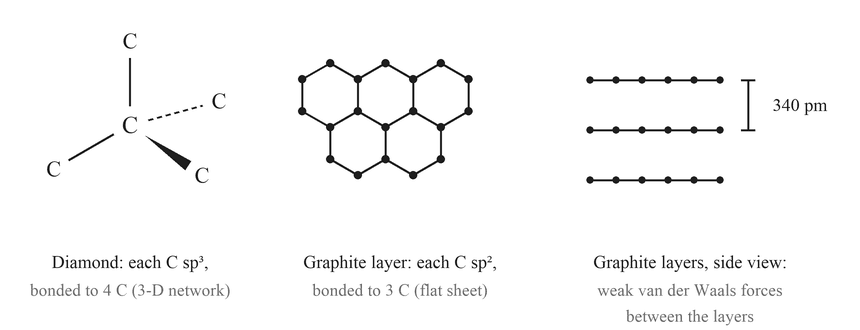
Step 1 — (i) Look at the bonding in diamond. In diamond each carbon atom is sp³ hybridised and is joined by strong σ bonds to four other carbon atoms in a rigid three-dimensional network (C–C 154 pm). All four valence electrons of every carbon atom are held in these localised bonds, so no electron is free to move, and diamond is an insulator.
Step 2 — (i) Look at the bonding in graphite. In graphite each carbon atom is sp² hybridised and is joined to only three other carbon atoms in flat hexagonal layers (C–C 141.5 pm). The fourth electron of each carbon atom is in an unhybridised p orbital, at right angles to the layer. These p orbitals overlap all over the layer, so these electrons are delocalised over the whole sheet and can move along the layers when a voltage is applied. So graphite conducts electricity (along the layers), as the figure shows.
Step 3 — (ii) Compare the bonds in alkanes and silanes. Carbon is a small atom, so the C–C bond (about 350 kJ mol⁻¹) and the C–H bond (about 414 kJ mol⁻¹) are strong. Silicon is larger, so the Si–Si bond (about 226 kJ mol⁻¹) and the Si–H bond (about 318 kJ mol⁻¹) are much weaker.
Step 4 — (ii) Explain the difference in reactivity. Besides having weaker bonds, silicon is less electronegative than hydrogen, so the Si–H bond is polarised , and the larger silicon atom (with its vacant 3d orbitals, in the ISC description) is easily attacked by water, oxygen and other reagents. So silanes are very reactive: silane itself and the lower silanes catch fire on contact with air, while alkanes are stable in air at room temperature.
Note: Vacant 3d orbitals are the older textbook (ISC) model. Calculations since the late 1980s show that an attacking water or oxygen molecule uses the empty σ* orbitals of the polar Si–H bonds, and the larger silicon atom leaves room for it to approach.
Note: The figure shows the textbook graphite layer spacing of 340 pm; precise measurements give about 335 pm.
Therefore, (i) graphite conducts because each sp² carbon has one delocalised electron free to move along the layers, while in diamond all four electrons are in localised sp³ bonds; (ii) alkanes are more stable than silanes because C–C and C–H bonds are much stronger than Si–Si and Si–H bonds, and silicon is easily attacked.