
Question 932 marksMedium
Explain the formation of different bonds in adduct.
Confirming your payment
Sign up now and get 250 free tokens.
Some p-Block Elements · Question 93 of 111
Explain the formation of different bonds in adduct.
Solution:
Key idea: Ammonia, , is a Lewis base (its nitrogen atom has a lone pair) and boron trifluoride, , is a Lewis acid (its boron atom has only six electrons and an empty orbital). When they meet, the lone pair of nitrogen is donated to boron, forming a coordinate bond.
Step 1 — Describe the bonds in ammonia. In nitrogen is sp³ hybridised. Three sp³ orbitals overlap with the 1s orbitals of three hydrogen atoms, giving three N–H σ bonds; the fourth sp³ orbital holds the lone pair.
Step 2 — Describe the bonds in boron trifluoride. In boron is sp² hybridised. Its three sp² orbitals overlap with p orbitals of three fluorine atoms, giving three B–F σ bonds (polar covalent) in a planar triangle. One 2p orbital of boron stays empty.
Step 3 — Describe the coordinate bond. The lone pair on nitrogen is donated into the empty orbital of boron, forming an N → B coordinate (dative) σ bond. The arrow points from the donor (N) to the acceptor (B).
Step 4 — Describe the change in shape. On accepting the pair, boron now has four electron pairs, so its hybridisation changes from sp² to sp³ and the part becomes pyramidal; nitrogen stays sp³. So the adduct has a tetrahedral arrangement around both N and B, as the figure shows. Boron now has a complete octet, so the pπ–pπ back bonding of free is lost and the B–F bonds become a little longer.
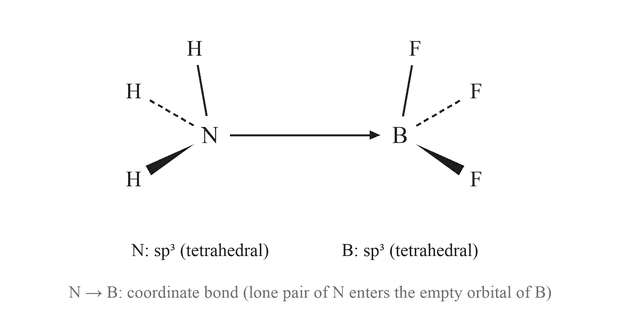
Therefore, the adduct contains three N–H σ bonds, three B–F σ bonds and one N → B coordinate bond formed by donation of the nitrogen lone pair into the empty orbital of boron, with both N and B sp³ hybridised (tetrahedral).