
Opening your dashboard
Class 11 Chemistry Chapter 12 Some p-Block Elements: Competency-Based Questions (CBQ)
40 questions on Chapter 12, each worked through on its own page with the AI tutor. Class 11 Chemistry, ICSE 2026-27.
40 questions
1–5 marks · Mixed difficulty
- 14 marks
Question 1
Competency: Application
Thallium(I) sulphate was once widely used as a rat poison, but its use is now banned or strictly limited in many countries because it is also extremely poisonous to people. Thallium (Z = 81) is the heaviest element of Group 13. Its ion has an ionic radius of 150 pm, close to that of the potassium ion, (138 pm), so the body takes up through the same routes that carry into cells.
(a) Write the electronic configuration of thallium, and state which electron is lost when it forms the ion.
(b) Aluminium forms only in its compounds, but thallium forms far more readily than . Explain why.
(c) Thallium(I) hydroxide, TlOH, is a strong base that is very soluble in water, like KOH, whereas aluminium hydroxide is insoluble and amphoteric. Explain this difference in terms of the charge and size of the cations (ionic radius of = 53.5 pm).
- 21 mark
Question 2
Competency: Analysis & Evaluation
Gallium is a silvery metal that melts at 29.8 °C, so a piece held in a warm hand slowly turns into a liquid, while aluminium, just above it in Group 13, melts only at 660 °C. The metallic radius of gallium (135 pm) is slightly smaller than that of aluminium (143 pm).
Assertion (A): Gallium has a far lower melting point than aluminium.
Reason (R): A gallium atom is smaller than an aluminium atom.
- 34 marks
Question 3
Competency: Application
Boron carbide, , is one of the hardest materials known, and plates of it are used in bullet-proof vests and tank armour. It is not attacked by water, even when hot. Aluminium carbide, , behaves very differently: it reacts with cold water to give aluminium hydroxide and methane. A student adds 2.88 g of aluminium carbide to excess water. (Hypothetical data.) (B = 10.8, C = 12, Al = 27; molar volume at S.T.P. (0 °C, 1 atm) = 22.4 L mol⁻¹)
(a) Explain, in terms of bonding, why boron carbide is very hard and unreactive towards water, whereas aluminium carbide is readily attacked by water.
(b) Calculate the percentage by mass of boron in boron carbide.
(c) Write a balanced equation for the reaction of aluminium carbide with water, and calculate the volume of methane, at S.T.P., given by the student's sample.
- 41 mark
Question 4
Competency: Application
In a school demonstration, a piece of aluminium foil (cleaned to remove its oxide film) and a lump of crystalline boron are dropped into separate beakers of dilute hydrochloric acid. The aluminium fizzes and dissolves, giving off hydrogen, but the boron is not attacked at all. The sum of the first three ionisation enthalpies is about 6890 kJ mol⁻¹ for boron and about 5140 kJ mol⁻¹ for aluminium. Which statement best explains why boron does not react with the acid?
- 54 marks
Question 5
Competency: Application
In the 1950s, boron hydrides were tested as high-energy fuels for jet engines and rockets. Diborane burns in oxygen to give boron(III) oxide and water. The standard enthalpies of formation are: , +36 kJ mol⁻¹; , −1273 kJ mol⁻¹; , −286 kJ mol⁻¹. The enthalpy of combustion of methane is −890 kJ mol⁻¹. (B = 10.8, C = 12, H = 1)
(a) Write the balanced equation for the combustion of diborane.
(b) Calculate the enthalpy of combustion of diborane, and compare the heat released per gram of diborane with that released per gram of methane.
(c) In spite of its high energy, diborane was never adopted as a fuel. Suggest two chemical reasons why.
- 61 mark
Question 6
Competency: Analysis & Evaluation
Many carrom players sprinkle fine boric acid powder on the board so that the striker and the coins glide smoothly. Boric acid, , forms soft, white, flaky crystals that feel slippery between the fingers.
Assertion (A): Boric acid crystals are soft and slippery, and they split easily into thin flakes.
Reason (R): In solid boric acid, flat units are joined by hydrogen bonds into layers, and neighbouring layers are held together only by weak forces, so they slide over one another easily.
- 71 mark
Question 7
Competency: Application
A pharmacy prepares a mild boric acid lotion for washing the eyes by dissolving 6.18 g of boric acid, , in water to make 1.00 L of solution. (Hypothetical data.) The acid dissociation constant of boric acid in water is mol L⁻¹, and for a weak acid that gives one ion per molecule, . (H = 1, B = 10.8, O = 16) What is the pH of the lotion?
- 84 marks
Question 8
Competency: Application
Anhydrous aluminium chloride sublimes at about 180 °C. A research student finds the molar mass of its vapour at three temperatures from the measured density of the vapour. (Hypothetical data.) The results are shown in the table.
Temperature (K) 473 873 1173 Molar mass of the vapour (g mol⁻¹) 267 178 133.5 (Al = 27, Cl = 35.5)
(a) Show that at 473 K the vapour consists of molecules, and at 1173 K of molecules.
(b) At 873 K the vapour is an equilibrium mixture, . Calculate the fraction of the molecules that have dissociated, and the percentage of the molecules in the vapour that are .
(c) Describe how two units are held together in , and suggest why the dimer breaks up on strong heating.
- 91 mark
Question 9
Competency: Analysis & Evaluation
Concentrated nitric acid is often carried by road in tankers made of aluminium alloy, although dilute hydrochloric acid dissolves aluminium readily. The standard reduction potential of the couple is −1.66 V, and that of the couple is 0.00 V.
Assertion (A): Aluminium tanks can be used to carry concentrated nitric acid.
Reason (R): Aluminium is less reactive than hydrogen, so acids are unable to oxidise aluminium.
- 101 mark
Question 10
Competency: Application
An antacid tablet contains 0.312 g of aluminium hydroxide as its only active ingredient. (Hypothetical data.) In the stomach, the aluminium hydroxide reacts with hydrochloric acid, whose concentration is taken here as 0.100 mol L⁻¹. What volume of this stomach acid can one tablet neutralise completely? (H = 1, O = 16, Al = 27)
- 114 marks
Question 11
Competency: Application
Mercury clinical thermometers are being phased out in many countries, and many fever thermometers now contain a liquid alloy called galinstan instead. Galinstan is 68.5 % gallium, 21.5 % indium and 10.0 % tin by mass, and it stays liquid down to about −19 °C. (Ga = 69.7, In = 114.8, Sn = 118.7)
(a) Give one reason, based on the properties of the two liquids, why a broken galinstan thermometer is much less dangerous than a broken mercury thermometer.
(b) Calculate the percentage of each metal in galinstan by number of atoms (mole percentage).
(c) Galinstan and pure gallium must never be stored in aluminium containers. Explain why.
- 124 marks
Question 12
Competency: Application
Older chemical-foam fire extinguishers hold two separate solutions: aluminium sulphate in an inner polythene bottle, and sodium hydrogencarbonate with a foaming agent in the outer steel body. When the extinguisher is turned upside down, the solutions mix and react to give carbon dioxide, aluminium hydroxide and sodium sulphate; the gas, trapped in a sticky foam, smothers the fire. One extinguisher holds 171 g of aluminium sulphate and an excess of sodium hydrogencarbonate. (Hypothetical data.) (H = 1, C = 12, O = 16, Na = 23, Al = 27, S = 32; molar volume at S.T.P. (0 °C, 1 atm) = 22.4 L mol⁻¹)
(a) Write the balanced equation for the reaction.
(b) Calculate the volume of carbon dioxide, at S.T.P., that the extinguisher can produce, and the least mass of sodium hydrogencarbonate it must contain.
(c) Explain why the aluminium sulphate solution is kept in a polythene bottle and not in contact with the steel body.
- 134 marks
Question 13
Competency: Application
Lead-free solders used in electronics are mostly tin. Ordinary white tin is a shiny, malleable metal (density 7.31 g cm⁻³), but below 13.2 °C it can slowly change into grey tin, a brittle grey powder (density 5.77 g cm⁻³) that has the same crystal structure as diamond, silicon and germanium. This change, called ‘tin pest’, makes tin objects swell and crumble if they are kept very cold for a long time.
(a) What does the crystal structure of grey tin tell you about the bonding in it? Use this to explain why grey tin is brittle while white tin is malleable.
(b) Calculate the volume of 1.00 g of each form of tin, and the percentage increase in volume when white tin changes into grey tin.
(c) Lead, the element below tin in Group 14, has no such non-metallic form. Explain why, in terms of the trend in properties down the group.
- 141 mark
Question 14
Competency: Analysis & Evaluation
When dark brown lead(IV) oxide, , is warmed with concentrated hydrochloric acid in a fume cupboard, a greenish-yellow gas is given off and white lead(II) chloride is formed.
Assertion (A): Lead(IV) oxide oxidises concentrated hydrochloric acid to chlorine.
Reason (R): Because of the inert pair effect, lead is more stable in the +2 oxidation state than in the +4 state, so lead(IV) readily gains two electrons.
- 151 mark
Question 15
Competency: Application
A gas supplier stores methane, , in ordinary steel cylinders at room temperature for years. Stannane, , the corresponding hydride of tin, has to be kept cold, because at room temperature it slowly decomposes into tin and hydrogen. Average bond enthalpies are: C–H 414, Si–H 318, Ge–H 288 and Sn–H 251 kJ mol⁻¹. Which statement best explains the difference in stability?
- 161 mark
Question 16
Competency: Analysis & Evaluation
Graphite is used to make electrodes and the carbon brushes of electric motors. In graphite, the C–C bonds within a layer are 141.5 pm long, and the layers are 340 pm apart.
Assertion (A): A single crystal of graphite conducts electricity equally well in all directions.
Reason (R): In graphite, the delocalised π electrons can move freely within each layer, but the layers are held together only by weak van der Waals forces.
- 171 mark
Question 17
Competency: Analysis & Evaluation
Diamond is used to tip the drills that cut through rock, while graphite is soft enough to leave a mark on paper. The C–C bonds within a layer of graphite are 141.5 pm long, whereas the C–C bonds in diamond are 154 pm long.
Assertion (A): Diamond is very much harder than graphite.
Reason (R): The C–C bonds within a layer of graphite are shorter than the C–C bonds in diamond.
- 181 mark
Question 18
Competency: Application
A jeweller's diamond tester touches a stone with a heated metal tip and measures how quickly the heat is carried away. Diamond carries heat away about five times faster than copper does, yet diamond is an electrical insulator. Which statement best explains why diamond is such a good conductor of heat?
- 194 marks
Question 19
Competency: Application
On cold winter nights in north India, people sometimes keep a charcoal brazier (angithi) burning inside a closed room, and every winter there are news reports of deaths caused by it. A room measures 4.0 m × 3.0 m × 2.5 m. (Hypothetical data.) During one night the air in it, at 27 °C and 1.00 atm, comes to contain 0.040 % carbon monoxide by volume. (R = 0.0821 L atm K⁻¹ mol⁻¹; C = 12, O = 16; 1 m³ = 1000 L)
(a) Explain, with balanced equations, how burning charcoal produces carbon monoxide in a closed room.
(b) Calculate the mass of carbon monoxide in the room, and the mass of charcoal (taken as pure carbon) that was burnt to form it.
(c) Explain why carbon monoxide is so dangerous, and state two safety measures.
- 201 mark
Question 20
Competency: Analysis & Evaluation
Soda water is made by dissolving carbon dioxide in water under pressure. A freshly opened bottle of soda water has a pH of about 4.
Assertion (A): Soda water is slightly acidic.
Reason (R): Carbon dioxide reacts completely with water to form carbonic acid, which is a strong acid.
- 211 mark
Question 21
Competency: Application
In a glass factory, sand (silica) is melted with soda ash, , at about 1500 °C. The silica, an acidic oxide, reacts with the sodium carbonate to form sodium silicate, and carbon dioxide escapes. In one batch, 1.20 tonnes of pure silica react completely. (Hypothetical data.) What mass of carbon dioxide is released by this reaction? (C = 12, O = 16, Na = 23, Si = 28)
- 223 marks
Question 22
Competency: Application
A freshly applied silicone sealant round a bathroom sink smells of vinegar, and it slowly sets into a rubbery, water-repellent solid. The sealant contains long silicone chains whose ends carry Si–OH groups, mixed with a cross-linking agent, methyltriacetoxysilane, . Moisture from the air hydrolyses each group to an Si–OH group, and the Si–OH groups then join together, losing water, to form Si–O–Si links. A tube of sealant contains 2.20 g of the cross-linking agent. (Hypothetical data.) (H = 1, C = 12, O = 16, Si = 28)
(a) Write the balanced equation for the complete hydrolysis of methyltriacetoxysilane, and use it to explain the smell of vinegar.
(b) Calculate the mass of acetic acid released when all the cross-linking agent in the tube is hydrolysed.
(c) Explain why a cross-linking agent with three hydrolysable groups on one silicon atom makes the sealant set into a solid instead of staying a thick liquid.
- 231 mark
Question 23
Competency: Analysis & Evaluation
Flexible silicone baking moulds and silicone oven gloves are sold in most kitchen shops, and their labels say they can be used up to about 230 °C. The Si–O bond enthalpy is about 452 kJ mol⁻¹, compared with about 348 kJ mol⁻¹ for a C–C bond.
Assertion (A): Silicone baking moulds cannot safely be used in a home oven at 200 °C, because silicones soften and decompose below about 150 °C.
Reason (R): The backbone of a silicone is a chain of alternating silicon and oxygen atoms joined by strong Si–O bonds, with organic groups such as methyl attached to the silicon atoms.
- 243 marks
Question 24
Competency: Application
One idea for removing carbon dioxide from the air is ‘enhanced weathering’: crushed olivine rock, , is spread on fields or beaches, where it slowly reacts with carbon dioxide (dissolved in rain water) to form magnesium carbonate and silica. Olivine weathers far faster than quartz, , which hardly reacts at all. A farmer spreads 1.00 kg of crushed olivine on a field. (Hypothetical data.) (C = 12, O = 16, Mg = 24, Si = 28)
(a) Write the overall balanced equation for the reaction of olivine with carbon dioxide.
(b) Calculate the greatest mass of carbon dioxide that the 1.00 kg of olivine can remove by this reaction.
(c) Explain, in terms of the silicate structures of olivine and quartz, why olivine is attacked much more easily than quartz.
- 251 mark
Question 25
Competency: Application
Building workers are told to wear gloves and boots when handling wet concrete, because wet cement can cause serious skin burns if it stays on the skin. The main compounds in Portland cement are the calcium silicates and , with a little gypsum, , added to slow down setting. Which statement correctly explains the burns?
- 264 marks
Question 26
In thermite welding of railway tracks, a mixture of aluminium powder and iron(III) oxide is ignited, and the molten iron produced fills the gap between two rails. A welding crew needs 3.36 kg of iron for one joint. (Hypothetical data.) Standard enthalpies of formation: , −1676 kJ mol⁻¹; , −824 kJ mol⁻¹ (Fe = 56, Al = 27, O = 16).
(a) Write the balanced equation for the thermite reaction.
(b) Calculate the enthalpy change of the reaction per mole of .
(c) Calculate the masses of aluminium and iron(III) oxide needed for this joint.
(d) Calculate the heat released when this charge reacts.
- 274 marks
Question 27
The figure shows one layer of graphite seen from above and the stacking of the layers seen from the side. Each C–C bond in a layer is 141.5 pm long and the layers are 340 pm apart.
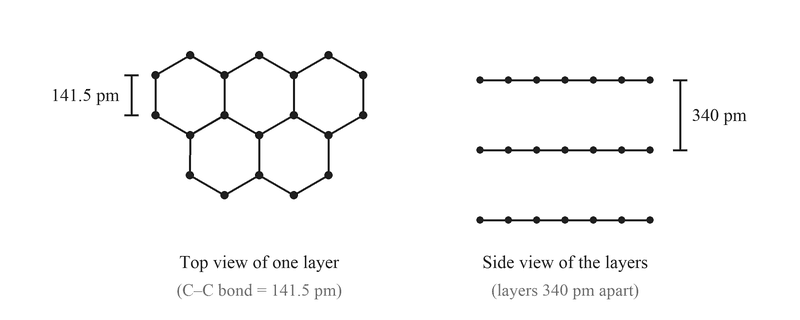
(C = 12; N_A = 6.022 × 10²³ mol⁻¹; area of a regular hexagon of side a = (3√3/2)a²)
(a) How many carbon atoms belong to one hexagon of the layer?
(b) Calculate the area of the layer that belongs to one carbon atom.
(c) Calculate the volume of graphite that belongs to one carbon atom.
(d) Hence calculate the density of graphite in g cm⁻³.
- 284 marks
Question 28
Dimethylsilicone (polydimethylsiloxane), used in silicone oils and water-repellent sprays, is made in three stages: silicon is heated with chloromethane, , at about 573 K with copper as a catalyst to give ; this is hydrolysed; and the hydrolysis product condenses into long chains. (Hypothetical data.) A batch starts with 56.0 g of silicon. Assume that only is formed in the first stage and that every stage is complete. (Si = 28, C = 12, H = 1, O = 16)
(a) Write the equation for the first stage.
(b) Write the equation for the hydrolysis.
(c) Write the equation for the condensation of n molecules of the hydrolysis product.
(d) Calculate the mass of dimethylsilicone formed.
- 294 marks
Question 29
Zeolite A, used in detergents to soften water, has the formula . (Hypothetical data.) A sample of hard water contains 80.0 mg of ions per litre. (Na = 23, Al = 27, Si = 28, O = 16, H = 1, Ca = 40)
(a) Calculate the molar mass of zeolite A.
(b) Find the charge on the framework and explain why Na⁺ ions are present.
(c) Calculate the greatest mass of ions that 1.00 g of zeolite A can take up if all its Na⁺ ions are exchanged.
(d) Hence find the volume of this hard water that 1.00 g of zeolite A can soften completely.
- 301 mark
Question 30
Competency: Analysis
In a school laboratory, tin(II) chloride solution is kept as a reducing agent. The laboratory assistant makes it by dissolving tin(II) chloride in dilute hydrochloric acid and drops a few granules of tin metal into the stock bottle. A second bottle, made in the same way but without any tin, slowly loses its reducing power over a few weeks of use, because oxygen from the air oxidises the tin(II) ions in it. The standard reduction potentials at 25 °C are:
Couple (V) −0.14 +0.15 Which statement best explains why the granules of tin keep the stock solution useful?
- 311 mark
Question 31
Competency: Application
In a village water-treatment unit, muddy pond water is pumped into a 5000 L settling tank, and potash alum, (molar mass 948 g mol⁻¹), is added at a dose of 23.7 mg per litre. In the water, the aluminium ions form a sticky, jelly-like precipitate of aluminium hydroxide that traps the fine clay particles and settles to the bottom; the hydrogen ions formed are used up by the hydrogencarbonate ions naturally present in the water. (Hypothetical data.) (H = 1, O = 16, Al = 27)
What is the greatest mass of aluminium hydroxide that the alum added to the full tank can form?
- 321 mark
Question 32
Competency: Analysis
A solution of borax, , of concentration 0.0100 mol L⁻¹ has a pH of about 9.2 at 25 °C, and laboratories use it as a standard solution for checking pH meters. When a student adds a few drops of dilute hydrochloric acid, or of dilute sodium hydroxide solution, to 100 mL of it, the pH changes only slightly. (For boric acid, = 9.24.)
Assertion (A): A borax solution resists a change in its pH when a small amount of acid or alkali is added to it.
Reason (R): In water, borax gives boric acid and borate ions, , in equal amounts, so the solution contains a weak acid together with its conjugate base.
- 331 mark
Question 33
Competency: Evaluation
The standard Gibbs energy of formation of diamond is +2.9 kJ mol⁻¹ at 25 °C and 1 bar, while that of graphite is zero, because graphite is taken as the reference form of carbon. Yet diamonds set in jewellery many centuries ago are still diamonds today.
Assertion (A): At room temperature and ordinary pressure, a diamond does not change into graphite, even over hundreds of years.
Reason (R): Diamond is the thermodynamically most stable allotrope of carbon at 25 °C and 1 bar.
- 342 marks
Question 34
Competency: Analysis
Emeralds are a green variety of the mineral beryl, , in which the metal ions are and . X-ray studies show that the silicate part of beryl is not an endless chain or sheet, but a separate (discrete) anion made of tetrahedra joined to one another through shared oxygen atoms.
(a) Find the charge on the silicate anion, and the number of oxygen atoms that each tetrahedron shares with its neighbours.
(b) Hence suggest the shape of the silicate anion, and name this type of silicate.
- 352 marks
Question 35
Competency: Analysis
When gallium metal is heated with gallium(III) chloride, a white crystalline solid is formed whose analysis gives the empirical formula . The solid is diamagnetic, which means it has no unpaired electrons (a substance with one or more unpaired electrons is paramagnetic). Spectroscopic studies show that the solid contains tetrahedral ions. (For gallium, Z = 31.)
(a) Write the electronic configuration of a ion, and show that a solid made of and ions would be paramagnetic.
(b) Write a formula for the compound that fits all the facts, give the oxidation state of each gallium atom in it, and write a balanced equation for its formation.
- 362 marks
Question 36
Competency: Evaluation
Small sachets of silica gel are packed with medicines and electronic goods to keep them dry. A student weighs two sachets, each holding 5.00 g of freshly dried silica gel, after keeping them on open shelves for a week. (Hypothetical data.)
Sachet Where it was kept Mass of the gel after a week (g) P Mumbai, a humid monsoon week 6.60 Q Delhi, a dry winter week 5.75 When sachet P is then heated at 150 °C for 2 hours, the mass of the gel falls back to 5.00 g, and it can be reused many times. The student concludes: “Silica gel dries the air because the silica reacts chemically with water to form silicic acid, .” Use the data to evaluate this conclusion, and give the correct explanation. (H = 1, O = 16, Si = 28)
- 373 marks
Question 37
Competency: Creativity
A company makes a silicone oil for use as a lubricant. Its molecules are straight chains with a trimethylsilyl group at each end:
The oil is made by hydrolysing a mixture of dimethyldichlorosilane, , and trimethylchlorosilane, , and letting the hydrolysis products condense. The chemist wants molecules whose average molar mass is 3122 g mol⁻¹. (H = 1, C = 12, O = 16, Si = 28)
(a) Explain why trimethylchlorosilane always ends up at the ends of the chains and never inside them.
(b) Find the value of n in the desired oil, and hence the molar ratio of to that the chemist should use.
(c) Predict the value of n and the average molar mass if the ratio worked out in (b) is halved, and state how this changes the thickness (viscosity) of the oil.
- 383 marks
Question 38
Competency: Application
In parts of Bihar and West Bengal, many soils are low in boron, and crops such as cauliflower then grow hollow, brownish stems. Boron is one of the trace elements that plants need for healthy growth, and they take it up from the soil water mainly as boric acid. A farmer with 2.5 hectares of cauliflower is advised to apply borax, , so as to supply 1.0 kg of boron per hectare. (H = 1, B = 10.8, O = 16, Na = 23)
(a) Write a balanced equation to show how borax dissolved in the soil water gives boric acid.
(b) Calculate the mass of borax that the farmer needs for the whole field.
(c) The adviser warns the farmer not to add “a little extra to be safe”. Explain why.
- 394 marks
Question 39
Competency: Analysis
Most of the world's boron minerals are mined in Turkey and the United States. In one process for making borax, the finely powdered mineral colemanite is boiled with sodium carbonate solution, and calcium carbonate is precipitated:
The hot mixture is filtered, and the filtrate is cooled, when crystals of borax, , separate. The liquid left behind still contains sodium metaborate, so carbon dioxide is bubbled through it to change the metaborate into more borax, with sodium carbonate as the other product. A plant processes 1.00 tonne of a colemanite concentrate that contains 60.0 % by mass. (Hypothetical data.) (H = 1, B = 10.8, C = 12, O = 16, Na = 23, Ca = 40)
(a) Show that the first reaction puts only two-thirds of the boron into borax, and write a balanced equation for the reaction of carbon dioxide with sodium metaborate.
(b) Calculate the greatest mass of borax crystals that the plant can obtain (i) from the first reaction alone and (ii) when the carbon dioxide step is also used.
(c) Explain why the boiled mixture is filtered while it is still hot, before it is cooled.
- 405 marks
Question 40
Competency: Evaluation
Some small industries make their own fuel gas from coke. When air is blown through a bed of red-hot coke, producer gas is formed; when steam is blown through the bed instead, water gas is formed. The water-gas reaction absorbs heat, so the coke bed slowly cools, and in practice the plant blows steam and air through the bed in turn, the air blast burning some coke to heat the bed again. The tables give simplified compositions of the two gases and some standard enthalpies of formation. (Hypothetical data.) (Molar volume at S.T.P. (0 °C, 1 atm) = 22.4 L mol⁻¹; 1 m³ = 1000 L; C = 12)
Gas CO (% by volume) (% by volume) (% by volume) Producer gas 34.7 0 65.3 Water gas 50.0 50.0 0 Substance CO (g) (g) (g) (kJ mol⁻¹) −110.5 −393.5 −241.8 (a) Write balanced equations for the formation of producer gas and of water gas from carbon, and calculate for each. Which of the two reactions is endothermic?
(b) Calculate the heat released when 1.00 m³ (at S.T.P.) of each gas burns completely, with the water formed as vapour, and explain why producer gas is the poorer fuel.
(c) A student claims: “Making water gas gets extra fuel energy out of water.” Calculate the least mass of coke that must be burnt to carbon dioxide to supply the heat needed to turn 12.0 kg of coke into water gas, and use your answers to evaluate the claim.