
Question 401 markMCQEasy
In silicon dioxide
Confirming your payment
Sign up now and get 250 free tokens.
Some p-Block Elements · Question 40 of 111
In silicon dioxide
(A) there are double bonds between silicon and oxygen atoms
(B) silicon atom is bonded to two oxygen atoms
(C) each silicon atom is surrounded by two oxygen atoms and each oxygen atom is bonded to two silicon atoms
(D) each silicon atom is surrounded by four oxygen atoms and each oxygen atom is bonded to two silicon atoms
Answer: (D) Each silicon atom is surrounded by four oxygen atoms and each oxygen atom is bonded to two silicon atoms
Key idea: Silicon is too large to form strong – double bonds with oxygen. So instead of small O=Si=O molecules, silica is a giant network of tetrahedra in which every oxygen is shared between two silicon atoms.
Step 1 — Describe the bonding round silicon. Each silicon atom forms four single Si–O bonds, to four oxygen atoms at the corners of a tetrahedron.
Step 2 — Describe the bonding round oxygen. Each oxygen atom is bonded to two silicon atoms (Si–O–Si), linking the tetrahedra into a three-dimensional network.
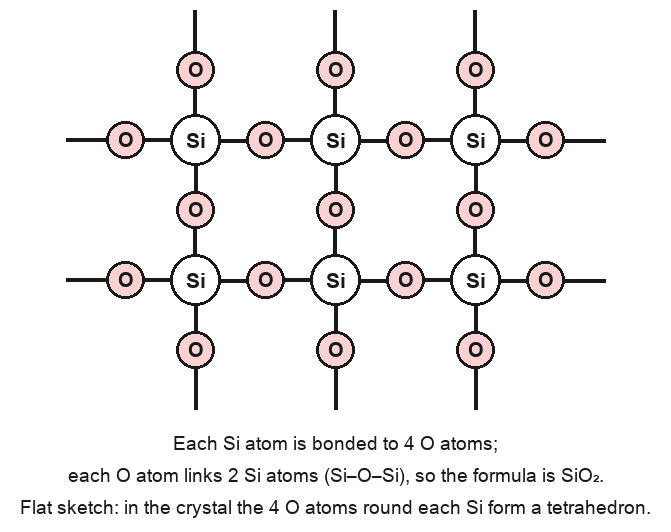
Step 3 — Check the formula. Each silicon has 4 oxygen neighbours, but each oxygen is shared by 2 silicons, so each silicon owns 4 ÷ 2 = 2 oxygen atoms. This gives the formula .
Why the other options are wrong:
Therefore, in silicon dioxide each Si is surrounded by four O atoms and each O is bonded to two Si atoms.