
Question 1055 marksMedium
Explain the structure/geometry of the following ions on the basis of hybridisation.
(i) Borotetrahydride ()
(ii) Borotetrafluoride ()
(iii) Aluminium hexafluoride ion ()
Confirming your payment
Sign up now and get 250 free tokens.
Some p-Block Elements · Question 105 of 111
Explain the structure/geometry of the following ions on the basis of hybridisation.
(i) Borotetrahydride ()
(ii) Borotetrafluoride ()
(iii) Aluminium hexafluoride ion ()
Solution:
Key idea: The number of electron pairs around the central atom fixes its hybridisation and the shape: four pairs → sp³ → tetrahedral (109.5°); six pairs → sp³d² → octahedral (90°). In each of these ions the central atom has no lone pair, so the shape is the regular one.
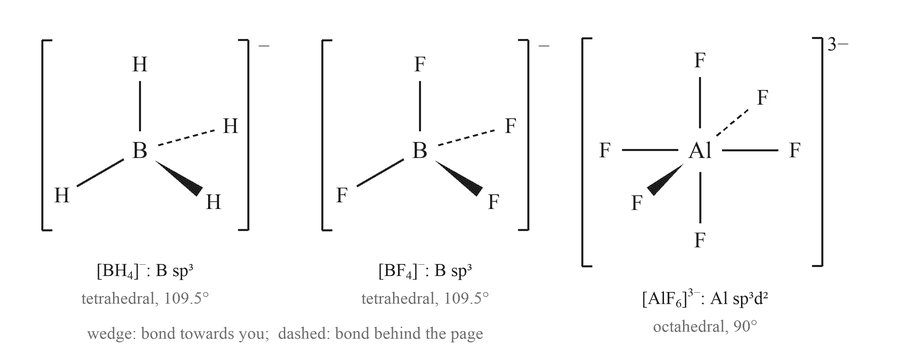
Step 1 — (i) Work out the structure of . Boron () has three valence electrons. In the excited state one 2s electron moves to a 2p orbital (), and one 2s and three 2p orbitals mix to give four sp³ hybrid orbitals: three hold one electron each and one is empty. Three of them form B–H bonds with hydrogen atoms, and the empty one accepts the electron pair of a hydride ion (). Once formed, all four B–H bonds are identical.
So boron is sp³ hybridised and is tetrahedral, with H–B–H angles of 109.5°.
Step 2 — (ii) Work out the structure of . In the same way, boron in forms three B–F bonds and has an empty orbital. It accepts a lone pair from a fluoride ion, so boron now has four bond pairs in four sp³ hybrid orbitals:
So boron is sp³ hybridised and is tetrahedral (F–B–F angles 109.5°).
Step 3 — (iii) Work out the structure of . Aluminium () belongs to period 3 and is a much larger atom than boron, so six fluoride ions fit round it; in the ISC description it uses its vacant 3d orbitals. In the 3s, 3p and 3d orbitals are empty; one 3s, three 3p and two 3d orbitals mix to give six equivalent sp³d² hybrid orbitals. Each accepts a lone pair from a fluoride ion, giving six Al–F bonds:
Six pairs point to the corners of an octahedron, so is octahedral, with F–Al–F angles of 90°. This ion is present in cryolite, .
Step 4 — Compare the three shapes. The figure shows the two tetrahedral boron ions beside the octahedral aluminium ion. Boron cannot form a six-coordinate ion such as because, being in period 2, it is a very small atom with only four valence orbitals (and no d orbitals).
Note: Using 3d orbitals (sp³d²) is the older textbook (ISC) model. Calculations since the late 1980s show that the 3d orbitals of aluminium take little part in bonding: the Al–F bonds in are largely ionic, and the octahedral shape follows simply from six electron pairs round the larger aluminium ion.
Therefore, and are tetrahedral (boron sp³, bond angles 109.5°), while is octahedral (aluminium sp³d², bond angles 90°).