Solution:
Key idea: Carbon is small, so it forms strong pπ–pπ multiple bonds (as in graphite and CO2); silicon is larger, its 3p orbitals overlap poorly sideways, so it forms only single σ bonds in three-dimensional networks. The stability of oxidation states down group 14 is controlled by the inert pair effect.
Step 1 — (i) Explain why silicon has no graphite-like form. Graphite is built from flat layers in which each carbon is sp² hybridised and the fourth electron forms delocalised pπ–pπ bonds over the layer. Silicon atoms are much larger, so the Si–Si distance is long and the 3p orbitals overlap only weakly sideways; Si=Si π bonds are very weak. So silicon does not form stable sp² layers held by pπ–pπ bonding. It forms only single σ bonds, with each silicon sp³ hybridised and bonded to four others in a diamond-like three-dimensional network.
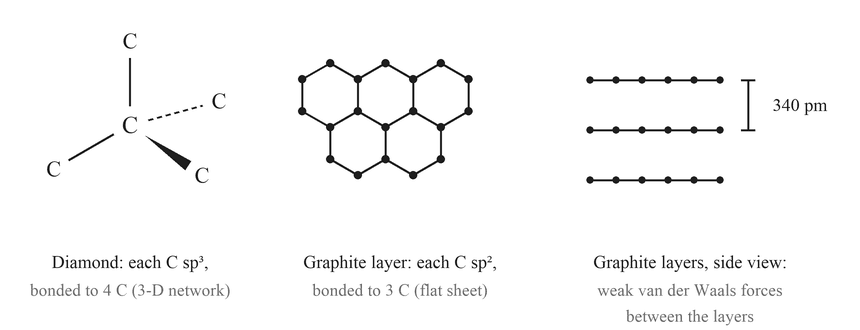
Step 2 — (ii) Explain why diamond is hard and graphite soft. In diamond every carbon is sp³ hybridised and bonded by strong covalent bonds (C–C 154 pm) to four others in a rigid three-dimensional network. To scratch or deform it, many strong covalent bonds must be broken, so diamond is extremely hard. In graphite the carbon atoms are strongly bonded only within flat hexagonal layers (C–C 141.5 pm); the layers are about 340 pm apart (textbook value; precise measurements give about 335 pm) and are held together by weak van der Waals forces. The layers easily slide over one another, so graphite is soft and slippery (it is used as a lubricant and in pencils). The figure compares the two structures.
Step 3 — (iii)(a) Explain why PbCl2 is more stable than PbCl4. Because of the inert pair effect, the 6s² electrons of lead are reluctant to take part in bonding, so +2 is the more stable oxidation state of lead. PbCl4 (lead in +4) is unstable and decomposes on gentle warming:
PbCl4→PbCl2+Cl2
Step 4 — (iii)(b) Compare tin and lead. The inert pair effect is weaker in tin than in lead. So for tin the +4 state is the more stable one: SnCl4 is stable, while SnCl2 is readily oxidised to SnCl4 (it is a good reducing agent). For lead the +2 state is the more stable one. Hence PbCl4 is less stable than SnCl4, but PbCl2 is more stable than SnCl2. For example, tin(II) chloride reduces iron(III) chloride:
SnCl2+2FeCl3→SnCl4+2FeCl2
Step 5 — (iv) Explain why CO2 is a gas and SiO2 a high-melting solid. Carbon forms strong pπ–pπ double bonds with oxygen, so one carbon atom satisfies its valency with just two oxygen atoms (O=C=O). CO2 therefore exists as small, discrete, linear, non-polar molecules held together only by weak van der Waals forces, so it is a gas at room temperature. Silicon does not form stable Si=O double bonds; each silicon forms four single Si–O bonds and each oxygen bridges two silicon atoms, giving a giant three-dimensional covalent network. To melt silica, strong Si–O covalent bonds must be broken, so it is a solid with a very high melting point (about 1700 °C).
Step 6 — (v) Compare the structure of SiO2 with diamond and graphite. In SiO2 each silicon atom is sp³ hybridised and is joined tetrahedrally to four oxygen atoms, and each oxygen joins two silicon atoms, so SiO4 tetrahedra share corners in all three directions. This is like diamond, where each sp³ carbon is joined tetrahedrally to four carbons in a three-dimensional network (one form of silica, cristobalite, is a diamond-like arrangement of Si atoms with an O between each pair). It differs from graphite, which is made of flat sp² layers held by weak forces; SiO2 has no layers and no delocalised electrons, so it is hard and does not conduct electricity.
Therefore, (i) silicon forms no graphite-like structure because its large atoms do not form stable pπ–pπ bonds; (ii) diamond is a rigid 3-D network while graphite has weakly held, sliding layers; (iii) the inert pair effect, stronger in Pb than in Sn, makes Pb(II) and Sn(IV) the more stable states; (iv) CO2 is made of small molecules but SiO2 is a giant covalent network; and (v) SiO2, like diamond, is a 3-D tetrahedral network, not a layered structure.
