Solution:
Key idea: Whether an oxide is a small molecule or a giant network depends on whether the element forms strong pπ–pπ double bonds with oxygen. Carbon (small, 2p orbitals) does; silicon (larger, 3p orbitals) does not, so it uses single Si–O bonds instead. The three alternatives of the question all rest on this one idea and are answered together.
Step 1 — Explain why carbon forms C=O double bonds. Carbon is a small atom, and its 2p orbitals are compact and of similar size to the 2p orbitals of oxygen. So the C–O distance is short and the p orbitals overlap well sideways, forming strong pπ–pπ bonds. One carbon atom therefore satisfies its valency of four with just two oxygen atoms, through two double bonds. Approximate bond enthalpies show why double bonds are preferred: one C=O bond (about 800 kJ mol⁻¹ in CO2) is stronger than two C–O single bonds.
2×E(C–O)≈2×360 kJ mol−1
2×E(C–O)≈720 kJ mol−1
Since 800 kJ mol⁻¹ is more than 720 kJ mol⁻¹, carbon gains more energy by forming double bonds.
Step 2 — Describe the structure of CO2. Carbon is sp hybridised, and the molecule is linear (O=C=O, bond angle 180°). Each CO2 molecule is complete in itself (monomeric, discrete), and the molecules attract one another only through weak van der Waals forces, so carbon dioxide is a gas.
Step 3 — Explain why silicon does not form Si=O double bonds. Silicon is a larger atom, and its 3p orbitals are larger and more diffuse than the 2p orbitals of oxygen. The Si–O distance is longer and the sideways overlap of 3p (Si) and 2p (O) orbitals is poor, so a Si=O π bond is weak. Approximate bond enthalpies show that two Si–O single bonds are much stronger than one Si=O double bond (about 640 kJ mol⁻¹).
2×E(Si–O)≈2×450 kJ mol−1
2×E(Si–O)≈900 kJ mol−1
Since 900 kJ mol⁻¹ is far more than 640 kJ mol⁻¹, silicon prefers four single bonds to four different oxygen atoms. This is why SiO2 is not O=Si=O.
Step 4 — Describe the structure of SiO2. Each silicon is sp³ hybridised and bonded to four oxygen atoms placed at the corners of a tetrahedron (SiO4 unit), and each oxygen is shared between two silicon atoms. The SiO4 tetrahedra share all their corners and build up a giant three-dimensional network, in which the ratio Si : O is 1 : 2. So SiO2 is a polymeric covalent solid with a very high melting point (about 1700 °C). The figure compares the two oxides.
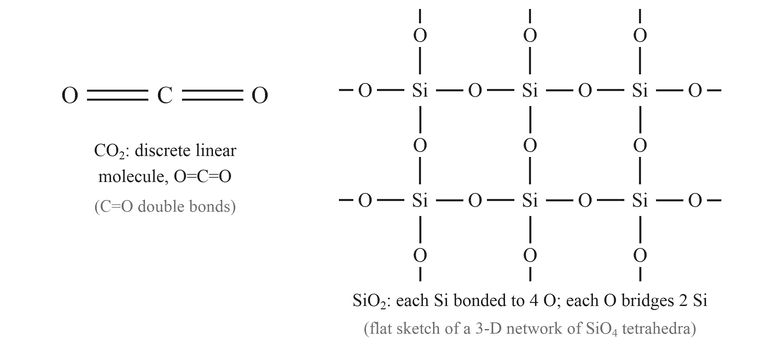
Therefore, CO2 is a discrete linear O=C=O molecule because small carbon forms strong pπ–pπ double bonds with oxygen, whereas silicon does not form stable pπ–pπ (Si=O) bonds (poor 3p–2p overlap) and instead forms four single Si–O bonds, each oxygen bridging two silicon atoms in a polymeric three-dimensional network.
