
Opening your dashboard
Class 11 Chemistry Chapter 12 Some p-Block Elements: Practice Questions
114 questions on Chapter 12, each worked through on its own page with the AI tutor. Class 11 Chemistry, ICSE 2026-27.
114 questions
1–4 marks · Mixed difficulty
- 11 mark
Question 1
The standard reduction potentials of some Group 13 couples are: , −1.66 V; , −0.55 V; , −0.34 V; , +1.25 V. Which of the following ions is the strongest oxidising agent in aqueous solution?
- 22 marks
Question 2
An element X has atomic number 31.
(a) Write the electronic configuration of X.
(b) State the group, period and block of X, and give the formula of its oxide in its usual oxidation state.
- 31 mark
Question 3
The table gives four properties of the Group 13 elements.
Element B Al Ga In Tl Atomic radius / pm 85 143 135 167 170 First ionisation enthalpy / kJ mol⁻¹ 801 578 579 558 589 Density / g cm⁻³ 2.34 2.70 5.91 7.31 11.85 Melting point / °C 2076 660 30 157 304 Which property increases at every step from boron to thallium?
- 43 marks
Question 4
A student analyses a white oxide of a Group 13 element M and finds that it has the formula and contains 47.1 % oxygen by mass. (Hypothetical data.)
(a) Calculate the atomic mass of M (O = 16).
(b) Identify M.
(c) State whether this oxide is acidic, basic or amphoteric.
- 53 marks
Question 5
The first three ionisation enthalpies of aluminium are 578, 1817 and 2745 kJ mol⁻¹, and the hydration enthalpy of the ion is about −4665 kJ mol⁻¹.
(a) Calculate the energy needed to convert one mole of gaseous Al atoms into gaseous ions.
(b) Explain why the third ionisation enthalpy is much larger than the first.
(c) In spite of this large energy, aluminium dissolves in dilute hydrochloric acid to give . Explain which energy term makes this possible.
- 61 mark
Question 6
Which of the following statements is true for boron but NOT for aluminium?
- 71 mark
Question 7
Pure crystalline boron is a poor conductor of electricity at room temperature. How does its electrical conductivity change when it is heated?
- 81 mark
Question 8
Boron shows a diagonal relationship with silicon. Which of the following statements is NOT true for both boron and silicon?
- 93 marks
Question 9
The ionic radii calculated for and are 27 pm and 53.5 pm. Boron trifluoride is a gas that boils at about −100 °C, while aluminium fluoride is a solid that sublimes only above 1250 °C.
(a) Calculate the charge-to-radius ratio of each ion (charge in units of the electronic charge, radius in pm).
(b) Use Fajans' rules to explain the difference in the nature of and .
- 103 marks
Question 10
Element X belongs to Group 13. It is a hard, black solid that melts above 2000 °C and is not attacked by dilute hydrochloric acid. Its oxide, , reacts with sodium hydroxide solution to form a salt but does not react as a base with dilute hydrochloric acid, and X forms a gaseous hydride, .
(a) Identify X.
(b) Write a balanced equation for the reaction of with sodium hydroxide.
(c) Explain, in terms of the size and ionisation enthalpy of X, why its oxide is acidic while the oxide of the next element of the group is amphoteric.
- 111 mark
Question 11
A 1.91 g sample of borax, , is heated strongly until its mass no longer changes; it forms a clear glassy mass of sodium metaborate and boric anhydride. What is the mass of the glassy residue? (Na = 23, B = 11, O = 16, H = 1)
- 123 marks
Question 12
A student dissolves 0.955 g of borax, , in water and titrates the solution with 0.100 mol L⁻¹ hydrochloric acid, using methyl red as the indicator. (Hypothetical data.)
(a) Write the balanced equation for the reaction, in which boric acid is formed.
(b) Calculate the volume of acid needed to reach the end point (Na = 23, B = 11, O = 16, H = 1).
(c) Explain why an indicator that changes colour in a slightly acidic range is used.
- 133 marks
Question 13
A student wants to find the purity of a sample of boric acid by titrating it with sodium hydroxide. The student dissolves 0.248 g of the sample in water, adds an excess of mannitol (a sugar alcohol with several OH groups) and titrates with 0.100 mol L⁻¹ NaOH using phenolphthalein. (Hypothetical data.)
(a) Explain why boric acid cannot be titrated accurately with NaOH without the mannitol.
(b) Explain how mannitol helps.
(c) Calculate the volume of NaOH needed if the sample is pure (H = 1, B = 11, O = 16).
- 143 marks
Question 14
In the laboratory, diborane is prepared by oxidising sodium borohydride with iodine in a dry ether solvent. A student uses 1.52 g of with enough iodine. (Hypothetical data.)
(a) Calculate the volume of diborane formed, measured at 273 K and 1 atm (Na = 23, B = 11, H = 1; molar volume 22.4 L).
(b) Using oxidation numbers, identify the element that is oxidised and the element that is reduced.
- 154 marks
Question 15
The figure shows the structure of the anion present in borax, with its overall charge.
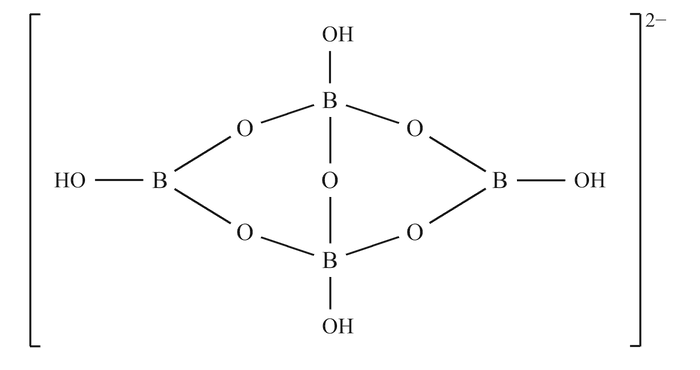
(a) How many boron atoms are bonded to three oxygen atoms, and how many to four? State the hybridisation of each kind of boron atom.
(b) Explain why the overall charge of 2− is carried by the boron atoms bonded to four oxygen atoms.
(c) The formula of borax is often written . Show that this is the same as .
(d) How many oxygen atoms in the anion bridge two boron atoms?
- 161 mark
Question 16
Aqueous ammonia is added slowly, until it is in excess, to a solution of aluminium chloride. What is observed?
- 171 mark
Question 17
A drain cleaner contains sodium hydroxide flakes and aluminium granules. When it is poured into water, the aluminium reacts with the alkali and the hydrogen given off helps to break up the blockage. A dose contains 1.35 g of aluminium. (Hypothetical data.) What volume of hydrogen, measured at 273 K and 1 atm, can it give when all the aluminium reacts? (Al = 27; molar volume 22.4 L)
- 183 marks
Question 18
Potash alum is .
(a) Calculate its molar mass (K = 39, Al = 27, S = 32, O = 16, H = 1).
(b) Calculate the percentage by mass of aluminium in it.
(c) Explain, with an equation, why an aqueous solution of potash alum turns blue litmus red.
- 192 marks
Question 19
Aluminium has a standard reduction potential of −1.66 V, yet aluminium cooking pots do not react with water. Explain why, and explain why cleaning aluminium pots with washing soda () solution is not advised.
- 203 marks
Question 20
Bauxite, , contains iron(III) oxide as its main impurity. In the Bayer process, the powdered ore is heated with concentrated sodium hydroxide solution, the undissolved "red mud" is filtered off, and pure aluminium hydroxide is then recovered from the filtrate.
(a) Write the equation for the dissolving of alumina in sodium hydroxide solution.
(b) Explain why iron(III) oxide stays behind in the red mud.
(c) Write equations for the precipitation of aluminium hydroxide when carbon dioxide is passed through the filtrate, and for the formation of pure alumina when this hydroxide is heated.
- 211 mark
Question 21
Benzene is converted into methylbenzene (toluene) by reaction with chloromethane in the Friedel–Crafts reaction. Which of the following is used as the catalyst?
- 221 mark
Question 22
Which of the following uses of Group 13 elements or their compounds is correctly explained by the reason given with it?
- 233 marks
Question 23
Natural boron has an atomic mass of 10.81 and is a mixture of two isotopes, boron-10 (isotopic mass 10.013 u) and boron-11 (isotopic mass 11.009 u). Only boron-10 absorbs slow neutrons strongly, which is why boron compounds are used to control nuclear reactors.
(a) Calculate the percentage of boron-10 in natural boron.
(b) Write the nuclear equation for a boron-10 nucleus that captures a neutron and splits into a lithium-7 nucleus and an alpha particle.
(c) Name one boron compound used for this purpose.
- 243 marks
Question 24
Copper conducts electricity better than aluminium, yet most overhead power lines use aluminium conductors, usually with a steel core for strength. Compare a copper wire and an aluminium wire of the same length and the same electrical resistance, using these data: resistivity of copper 1.68 × 10⁻⁸ Ω m and of aluminium 2.65 × 10⁻⁸ Ω m; density of copper 8.96 g cm⁻³ and of aluminium 2.70 g cm⁻³.
(a) How many times larger must the cross-sectional area of the aluminium wire be?
(b) Calculate the ratio of the mass of the aluminium wire to the mass of the copper wire.
(c) Give one chemical property of aluminium that also suits it to outdoor use.
- 251 mark
Question 25
The first ionisation enthalpies (in kJ mol⁻¹) of the group 14 elements are C 1086, Si 786, Ge 761, Sn 708 and Pb 715. Which statement best explains why the value for lead is slightly higher than the value for tin, instead of lower?
- 262 marks
Question 26
Silane, , catches fire as soon as it meets air, whereas methane, , burns only when it is lit. Write a balanced equation for the burning of silane and give two reasons why silane reacts with oxygen so much more readily than methane.
- 271 mark
Question 27
The melting points of silicon, germanium, tin and lead are 1687 K, 1211 K, 505 K and 600 K respectively. Which statement best explains the very large drop in melting point from germanium to tin?
- 283 marks
Question 28
Red lead, , is warmed with excess dilute nitric acid. (Hypothetical data.) A 6.85 g sample is used; part of it dissolves and a dark brown solid is left. (Pb = 207, O = 16)
(a) Show that red lead can be written as 2PbO·PbO₂ and give the oxidation state of each lead atom.
(b) Write a balanced equation for the reaction of red lead with dilute nitric acid.
(c) Calculate the mass of the brown solid left when the 6.85 g sample reacts completely.
- 293 marks
Question 29
Tin dissolves in hot concentrated hydrochloric acid to give tin(II) chloride and hydrogen, but it burns in excess chlorine to give tin(IV) chloride. The standard electrode potentials are: E°(Sn²⁺/Sn) = −0.14 V, E°(Sn⁴⁺/Sn²⁺) = +0.15 V, E°(H⁺/H₂) = 0.00 V and E°(Cl₂/Cl⁻) = +1.36 V.
(a) Write balanced equations for the two reactions.
(b) Use the electrode potentials to explain why hydrochloric acid takes tin only to the +2 state, while chlorine takes it to the +4 state.
- 301 mark
Question 30
In buckminsterfullerene, , every carbon atom is bonded to three other carbon atoms, and in a Kekulé-type structure each carbon atom forms exactly one C=C double bond. How many C=C double bonds and C–C single bonds does one molecule contain?
- 312 marks
Question 31
Charcoal used in water filters and in some gas masks is first ‘activated’ by heating it strongly in steam.
(a) Why can activated charcoal remove many harmful gases and dissolved impurities?
(b) How does the activation step make charcoal work better?
- 321 mark
Question 32
Synthetic diamonds are made by heating graphite to about 1500 °C at a very high pressure (about 5–6 GPa), with a molten metal as a catalyst. Why does the very high pressure favour the change of graphite into diamond?
- 332 marks
Question 33
Fullerene, , dissolves in toluene to give a purple solution, but diamond and graphite do not dissolve in any common solvent. Explain this difference in terms of the type of solid that each allotrope forms.
- 343 marks
Question 34
In a fume cupboard, 6.30 g of crystalline oxalic acid, , is heated with concentrated sulphuric acid, which removes water from it. (Hypothetical data.) The gas mixture formed is passed through a tube of potassium hydroxide solution, and the gas that comes out is collected. Assume that all the water formed stays in the sulphuric acid. (H = 1, C = 12, O = 16; molar volume at S.T.P. = 22.4 L)
(a) Write a balanced equation for the decomposition of the oxalic acid crystals.
(b) Name the gas that comes out of the potassium hydroxide tube and calculate its volume at S.T.P.
(c) Calculate the increase in mass of the potassium hydroxide tube.
- 351 mark
Question 35
The carbon–oxygen bond length is about 113 pm in carbon monoxide, about 116 pm in carbon dioxide and about 143 pm in methanol, . Which statement correctly explains this order?
- 362 marks
Question 36
Laboratory staff are told not to keep sodium hydroxide solution in a bottle with a ground-glass stopper, because the stopper soon gets stuck. Explain why this happens and write a balanced equation for the reaction responsible.
- 371 mark
Question 37
In the Mond process, impure nickel is warmed to about 330 K with carbon monoxide to form the volatile compound tetracarbonylnickel, Ni(CO)₄, in which each CO donates a lone pair of electrons to the nickel atom. Through which atom does each CO bond to nickel, and why?
- 383 marks
Question 38
When carbon dioxide is bubbled through lime water, the solution first turns milky; if the bubbling is continued for a long time, it becomes clear again; and if this clear solution is then boiled, it turns milky once more. Explain each of the three observations with a balanced equation.
- 391 mark
Question 39
Silicon carbide (carborundum), SiC, is used to make grinding wheels and cutting tools because it is extremely hard and stays stable at very high temperatures. Which description of its structure explains these properties?
- 403 marks
Question 40
Silicon carbide is made by heating pure sand (silica) with coke in an electric furnace at about 2000–2500 °C; carbon monoxide is the other product. (Hypothetical data.) One batch uses 1.50 kg of pure silica. (Si = 28, C = 12, O = 16)
(a) Write the balanced equation for the reaction.
(b) Calculate the maximum mass of silicon carbide that can be formed.
(c) Calculate the minimum mass of coke, taken as pure carbon, that is needed.
- 413 marks
Question 41
Very pure silicon for computer chips can be made by turning impure silicon into silicon tetrachloride, (a liquid that boils at 57.6 °C), purifying it, and then reducing it with hydrogen at a high temperature. (Hypothetical data.) A plant needs 1.40 kg of pure silicon. (Si = 28, Cl = 35.5)
(a) Write the equation for the formation of from silicon and chlorine.
(b) Why is the silicon changed into before it is purified?
(c) Write the equation for the reduction and calculate the mass of needed.
- 421 mark
Question 42
When dimethyldichlorosilane, , is hydrolysed, part of the product is a cyclic silicone, , in which the four units are joined into a single ring through Si–O–Si links. How many atoms make up the ring itself?
- 431 mark
Question 43
The figure shows part of a silicate anion made of two parallel chains of tetrahedra (only Si and O atoms are shown; each Si is bonded to four O atoms). The pattern repeats every four Si atoms, two in each chain.

What is the formula of one repeating unit of this anion?
- 443 marks
Question 44
Talc, , and muscovite mica, , are both sheet silicates that split into thin flakes, but talc is so soft that it feels soapy, whereas mica is noticeably harder.
(a) Find the charge on the unit in talc and show that the formula of talc is electrically neutral.
(b) In the sheets of mica, one Si atom in every four is replaced by an Al atom. Find the charge on the unit and show that the formula of mica is electrically neutral.
(c) Use your answers to explain why talc is much softer than mica.
- 451 mark
Question 45
A dehydrated zeolite whose pores are about 0.3 nm wide is stirred into ethanol that contains a little water. After filtering, the ethanol is almost free of water, and practically no ethanol has been taken up by the zeolite. Which statement best explains this?
- 462 marks
Question 46
A household water softener contains a sodium zeolite, written (where stands for the aluminosilicate framework). After some weeks it stops softening the water, and it is then ‘regenerated’ by letting concentrated sodium chloride solution (brine) stand in it. Write balanced equations for the softening and for the regeneration, and explain why concentrated brine is needed.
- 471 mark
Question 47
In the following sets of reactants which two sets best exhibit the amphoteric characters of ?
Set 1 : (s) and (aq)
Set 2 : (s) and (l)
Set 3 : (s) and (aq)
Set 4 : (s) and (aq)
- 481 mark
Question 48
Identify the reaction which does not liberate hydrogen:
- 491 mark
Question 49
When metal 'M' is treated with NaOH, a white gelatinous precipitate 'X' is obtained, which is soluble in excess of NaOH. Compound 'X' when heated strongly gives an oxide which is used in chromatography as an adsorbent. The metal 'M' is:
- 501 mark
Question 50
A group 13 element 'X' reacts with chlorine gas to produce a compound . is electron deficient and easily reacts with to form adduct, however, does not dimerize. X is:
- 511 mark
Question 51
The correct statements among P to R regarding group 13 element oxides are,
P. Boron trioxide is acidic.
Q. Oxides of aluminium and gallium are amphoteric.
R. Oxides of indium and thallium are basic.
- 521 mark
Question 52
Diborane () reacts independently with and to produce, respectively;
- 531 mark
Question 53
The hydride that is NOT electron deficient is:
- 541 mark
Question 54
The relative stability of +1 oxidation state of group 13 elements follows the order:
- 551 mark
Question 55
The electronegativity of aluminium is similar to:
- 561 mark
Question 56
The number of 2-centre-2-electron and 3-centre-2-electron bonds in , respectively, are:
- 571 mark
Question 57
Aluminium is usually found in +3 oxidation state. In contrast, thallium exists in +1 and +3 oxidation states. This is due to:
- 581 mark
Question 58
The reaction of (A) with in tetrahydrofuran gives inorganic benzene (B). Further, the reaction of (A) with (C) leads to . Compounds (B) and (C) respectively, are:
- 591 mark
Question 59
Given below are two statements : one is labelled as Assertion A and the other is labelled as Reason R.
Assertion A: In , isomorphous to , the metal is present in +1 oxidation state.
Reason R: Tl metal has fourteen f electrons in its electronic configuration.
In the light of the above statements, choose the most appropriate answer from the options given below:
- 601 mark
Question 60
When borax is heated with CoO on a platinum loop, blue coloured bead formed is largely due to:
- 611 mark
Question 61
Given below are two statements : one is labelled as Assertion A and the other is labelled as Reason R.
Assertion A: Boron is unable to form
Reason R: Size of B is very small.
In the light of the above statements, choose the correct answer from the options given below:
- 621 mark
Question 62
Borazine, also known as inorganic benzene, can be prepared by the reaction of 3-equivalents of "X" with 6-equivalents of "Y". "X" and "Y", respectively are:
- 631 mark
Question 63
The metal that has very low melting point and its periodic position is closer to a metalloid is:
- 641 mark
Question 64
Given below are two statements : one is labelled as Assertion A and the other is labelled as Reason R.
Assertion A: Boric acid is a weak acid
Reason R: Boric acid is not able to release ion on its own. It receives ion from water and releases ion.
In the light of the above statements, choose the most appropriate answer from the options given below.
- 651 mark
Question 65
The geometry around boron in the product 'B' formed from the following reaction is
- 661 mark
Question 66
Aqueous solution of which of the following boron compounds will be strongly basic in nature?
- 671 mark
Question 67
Choose the correct stability order of group 13 elements in their +1 oxidation state.
- 681 mark
Question 68
Identify the correct statement for from those given below.
P. In , all B-H bonds are equivalent.
Q. In there are four 3-centre-2-electron bonds.
R. is a Lewis acid.
S. can be synthesized from both and .
T. is a planar molecule.
Choose the most appropriate answer from the options given below:
- 691 mark
Question 69
In view of the signs of for the following reactions:
which oxidation states are more characteristic for lead and tin?
- 701 mark
Question 70
Identify the incorrect statement:
- 711 mark
Question 71
The gas evolved on heating and with concentrated , on hydrolysis gives a white gelatinous precipitate. The precipitate is:
- 721 mark
Question 72
Match the items in Column I with its main use listed in Column II:
Column I Column II P. Silica gel (i) Transistor Q. Silicon (ii) Ion-exchanger R. Silicone (iii) Drying agent S. Silicate (iv) Sealant - 731 mark
Question 73
Assertion: Among the carbon allotropes, diamond is an insulator, whereas, graphite is a good conductor of electricity.
Reason: Hybridization of carbon in diamond and graphite are and , respectively.
- 741 mark
Question 74
Which of the following are Lewis acids?
(a) and
(b) and
(c) and
(d) and
- 751 mark
Question 75
In graphite and diamond, the percentage of p-characters of the hybrid orbitals in hybridisation are respectively:
- 761 mark
Question 76
The basic structural unit of feldspar, zeolites, mica, and asbestos is:
- 771 mark
Question 77
The correct statement among the following is:
- 781 mark
Question 78
The C—C bond length is maximum in:
- 791 mark
Question 79
The correct order of catenation is:
- 801 mark
Question 80
The amorphous form of silica is:
- 811 mark
Question 81
The element that shows greater ability to form multiple bonds, is:
- 821 mark
Question 82
The chloride that CANNOT get hydrolysed is:
- 831 mark
Question 83
Correct statements among P to S regarding silicones are:
P. They are polymers with hydrophobic character.
Q. They are biocompatible.
R. In general, they have high thermal stability and low dielectric strength.
S. Usually, they are resistant to oxidation and used as greases.
- 841 mark
Question 84
Which one of the following compounds of Group-14 elements is not known?
- 851 mark
Question 85
The INCORRECT statement regarding the structure of is
- 861 mark
Question 86
Compound A used as a strong oxidizing agent is amphoteric in nature. It is the part of lead storage batteries. Compound A is
- 871 mark
Question 87
Water does not produce CO on reacting with:
- 881 mark
Question 88
Given below are two statements.
Statement I: Stannane is an example of a molecular hydride.
Statement II: Stannane is a planar molecule.
In the light of the above statement, choose the most appropriate answer from the options given below:
- 891 mark
Question 89
Match the List-I with List-II
List-I (Metal) List-II (Application) P. Cs (i) High temperature thermometer Q. Ga (ii) Water repellent sprays R. B (iii) Photoelectric cells S. Si (iv) Bullet proof vest Choose the most appropriate answer from the option given below:
- 901 mark
Question 90
Match List-I with List-II
List-I (Si-Compounds) List-II (Si-Polymeric/other products) P. (i) Chain silicone Q. (ii) Dimeric silicone R. (iii) Silane S. (iv) 2D-Silicone Choose the correct answer from the options given below:
- 911 mark
Question 91
The number of bridged oxygen atoms present in compound B formed from the following reactions is
- 921 mark
Question 92
The tendency of , and to behave as Lewis acid decreases in the sequence:
- 931 mark
Question 93
Which of the following statements is incorrect?
- 941 mark
Question 94
Aluminium is extracted from alumina () by electrolysis of a molten mixture of:
- 951 mark
Question 95
Which of the following is electron-deficient?
- 961 mark
Question 96
Which of the following structure is similar to graphite?
- 971 mark
Question 97
The stability of +1 oxidation state among Al, Ga, In and Tl increases in the sequence:
- 981 mark
Question 98
Boric acid is an acid because its molecule
- 991 mark
Question 99
Which one of the following elements is unable to form ion?
- 1001 mark
Question 100
Aluminium chloride in acidified aqueous solution forms a complex 'A', in which hybridisation state of Al is 'B'.
What are 'A' and 'B', respectively?
- 1011 mark
Question 101
Match the following and identify the correct option.
List-I List-II P. (i) Q. Temporary hardness of water (ii) An electron deficient hydride R. (iii) Synthesis gas S. (iv) Non-planar structure - 1021 mark
Question 102
is planar and electron deficient compound. Hybridization and number of electrons around the central atom, respectively are:
- 1031 mark
Question 103
Which of the following statement is not correct about diborane?
- 1041 mark
Question 104
Name the type of the structure of silicate in which one oxygen atom of is shared?
- 1051 mark
Question 105
Which of these is not a monomer for a high molecular mass silicone polymer?
- 1061 mark
Question 106
The basic structural unit of silicates is:
- 1071 mark
Question 107
Which statement is wrong?
- 1081 mark
Question 108
It is because of inability of electrons of the valence shell to participate in bonding that:
- 1091 mark
Question 109
Which of the following compounds is used in cosmetic surgery?
- 1101 mark
Question 110
Which of the following is incorrect statement?
- 1111 mark
Question 111
Which of the following species is not stable?
- 1121 mark
Question 112
Which of the following is not correct about carbon monoxide?
- 1131 mark
Question 113
Identify the correct statements from the following:
P. is used as refrigerant for ice-cream and frozen food.
Q. The structure of contains twelve six carbon rings and twenty five carbon rings.
R. ZSM-5, a type of zeolite, is used to convert alcohols into gasoline.
S. CO is colourless and odourless gas.
- 1141 mark
Question 114
Choose the correct statement: