
Question 1002 marksMedium
Trimethylamine, has pyramidal geometry while trisilicylamine, has planar trigonal geometry. Explain the difference.
Confirming your payment
Sign up now and get 250 free tokens.
Some p-Block Elements · Question 100 of 111
Trimethylamine, has pyramidal geometry while trisilicylamine, has planar trigonal geometry. Explain the difference.
Solution:
Key idea: The shape of a molecule depends on the hybridisation of the central atom. If the lone pair of nitrogen stays on nitrogen, nitrogen is sp³ and the molecule is pyramidal. If the lone pair is drawn away into a π bond, nitrogen becomes sp² and the molecule becomes planar.
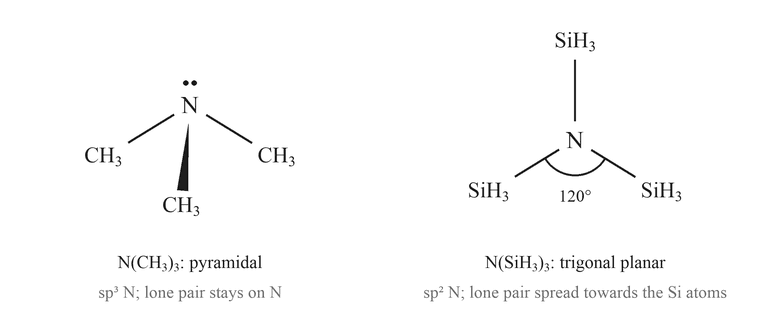
Step 1 — Explain the shape of trimethylamine. In nitrogen is sp³ hybridised: three sp³ orbitals form N–C σ bonds and the fourth holds the lone pair. Carbon (period 2) has no vacant orbital of suitable energy to accept this lone pair, so it stays on nitrogen. Four electron pairs (three bond pairs and one lone pair) give a pyramidal molecule.
Step 2 — Explain the shape of trisilylamine. In the nitrogen atom is joined to three silicon atoms. Silicon (period 3) has low-lying empty orbitals that can take electron density, and the lone pair of nitrogen is delocalised into them (in the ISC description these are vacant 3d orbitals, and the N–Si bonding is called pπ–dπ bonding). For this, the lone pair must sit in an unhybridised 2p orbital of nitrogen, so nitrogen becomes sp² hybridised, and its three N–Si σ bonds lie in one plane at 120°. So the molecule is trigonal planar.
Step 3 — Compare the two shapes. The figure shows the pyramidal molecule with the lone pair on nitrogen beside the planar molecule in which the lone pair is spread towards the silicon atoms.
Note: The pπ–dπ bonding into vacant 3d orbitals of silicon is the older textbook (ISC) model. Calculations since the late 1980s show that the 3d orbitals of silicon take little part in bonding; the nitrogen lone pair is delocalised instead into the empty σ* orbitals of the Si–H bonds. Either way the lone pair is spread towards silicon, nitrogen becomes planar and the lone pair is less available.
Therefore, trimethylamine is pyramidal because its nitrogen is sp³ with a localised lone pair, while trisilylamine is planar because the nitrogen lone pair is delocalised towards the silicon atoms (pπ–dπ bonding in the ISC description), making nitrogen sp² hybridised.