
Question 1015 marksMedium
Explain why exists as a dimer, or while exists as a monomer.
OR
Explain the formation of dimeric structure of in benzene (inert solvent) and in the vapour state.
OR
Explain why all Al – Cl bonds in are not equivalent.
Confirming your payment
Sign up now and get 250 free tokens.
Some p-Block Elements · Question 101 of 111
Explain why exists as a dimer, or while exists as a monomer.
OR
Explain the formation of dimeric structure of in benzene (inert solvent) and in the vapour state.
OR
Explain why all Al – Cl bonds in are not equivalent.
Solution:
Key idea: In and the central atom has only six electrons in its valence shell (an incomplete octet), so both molecules are electron deficient. Boron and aluminium make up this deficiency in different ways: boron by back bonding inside the molecule, aluminium by borrowing a lone pair from a chlorine atom of a neighbouring molecule. All three alternatives of the question are answered below.
Step 1 — Explain why forms a dimer. Aluminium in has only six electrons. Its large, diffuse 3p orbital does not form effective pπ–pπ back bonds with chlorine. Instead, a chlorine atom of one molecule donates one of its lone pairs to the aluminium atom of a second molecule, and a chlorine of the second molecule does the same for the first. Two chlorine bridges are formed, and each aluminium now has eight electrons (a complete octet).
In each aluminium is surrounded by four chlorine atoms, so it is sp³ hybridised with a roughly tetrahedral arrangement.
Step 2 — Explain why stays a monomer. Boron is a small atom. Its empty 2p orbital overlaps sideways with a filled p orbital of chlorine, so pπ–pπ back bonding partly makes up its electron deficiency within the molecule. Also, the small boron atom does not have room for four large chlorine atoms around it (the bridged structure would be too crowded). So exists as a planar monomer.
Step 3 — OR part: dimer in benzene and in the vapour. Benzene is a non-polar, inert solvent with no lone pairs to offer to aluminium. So when dissolves in benzene, aluminium still completes its octet by forming chlorine bridges, and the solute is present as molecules. In the same way, when aluminium chloride sublimes (about 180 °C), the vapour consists of dimers, because no other donor is present. Only at high temperatures (about 1000 K and above) does the dimer break up into planar monomers. In contrast, a donor solvent such as water breaks the bridges, because water gives its lone pairs to aluminium:
Step 4 — OR part: why the Al–Cl bonds are not equivalent. contains two kinds of chlorine atoms:
So the eight Al–Cl bonds are of two types (four terminal, four bridging) and are not equivalent. The figure shows the structure.
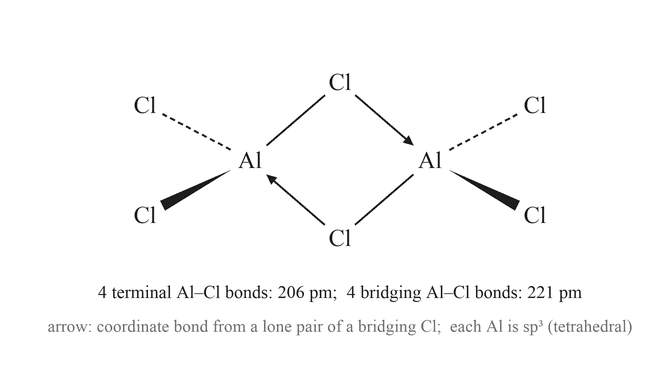
Therefore, dimerises to through two chlorine bridges that complete the octet of each aluminium (in benzene and in the vapour, where no other donor is present), stays a monomer because of pπ–pπ back bonding and the small size of boron, and the Al–Cl bonds are not equivalent because four are terminal (about 206 pm) and four are bridging (about 221 pm).