
Question 81 markMCQMedium
In the structure of diborane
Confirming your payment
Sign up now and get 250 free tokens.
Some p-Block Elements · Question 8 of 111
In the structure of diborane
(A) all hydrogen atoms lie in one plane and boron atoms lie in a plane perpendicular to this plane
(B) 2 boron atoms and 4 terminal hydrogen atoms lie in the same plane and 2 bridging hydrogen atoms lie in the perpendicular plane
(C) 4 bridging hydrogen atoms and boron atoms lie in one plane and two terminal hydrogen atoms lie in a plane perpendicular to this plane
(D) all the atoms are in the same plane
Answer: (B) 2 boron atoms and 4 terminal hydrogen atoms in one plane; 2 bridging hydrogen atoms in the perpendicular plane
Key idea: In diborane, , each boron is hybridised. Each boron forms two ordinary B–H bonds to terminal hydrogen atoms, and the two borons are joined through two bridging hydrogen atoms, each held by a three-centre two-electron (B–H–B) bond.
Step 1 — Place the terminal atoms. The two boron atoms and the four terminal hydrogen atoms all lie in one plane (plane 1 in the figure).
Step 2 — Place the bridging atoms. The two bridging hydrogen atoms lie one above and one below plane 1, in plane 2, which contains both boron atoms and is at right angles to plane 1.
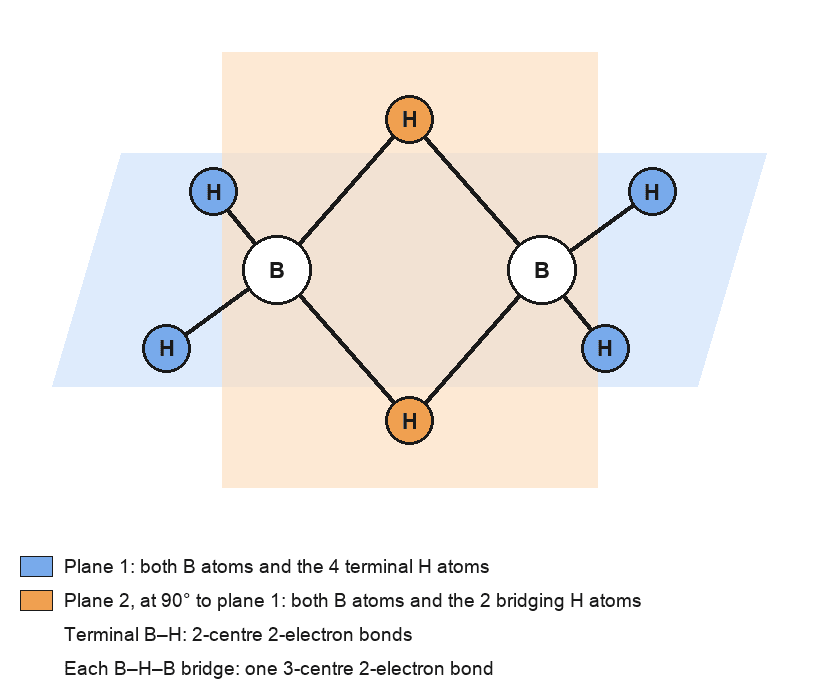
Step 3 — Count the atoms. This accounts for all 8 atoms: 2 B and 4 terminal H in plane 1, and the 2 bridging H in plane 2 (which also contains the two B atoms).
Why the other options are wrong:
Therefore, option (B) describes the structure of diborane.