
Question 661 markMedium
The two types of bonds present in diborane are ______ and ______.
Confirming your payment
Sign up now and get 250 free tokens.
Some p-Block Elements · Question 66 of 111
The two types of bonds present in diborane are ______ and ______.
Solution:
Key idea: Diborane, , contains two kinds of B–H bonds: four ordinary terminal bonds and two bridge bonds.
Step 1 — Count the electrons available. Diborane, , has 2 × 3 + 6 × 1 = 12 valence electrons. Ordinary two-electron bonds joining eight atoms in the shape of ethane would need 14 electrons (7 bonds), so diborane is electron-deficient.
Step 2 — Describe the terminal bonds. Each boron atom is joined to two terminal hydrogen atoms by normal two-centre two-electron (2c–2e) covalent bonds. These four B–H bonds (119 pm) lie in one plane and use 8 of the 12 electrons.
Step 3 — Describe the bridges. The remaining two hydrogen atoms lie above and below this plane, each between the two boron atoms. Each B–H–B bridge holds three atoms together with only one pair of electrons: it is a three-centre two-electron (3c–2e) bond, often called a banana bond because of its curved shape. The bridge B–H distance is longer, 134 pm. The two bridges use the last 4 electrons.
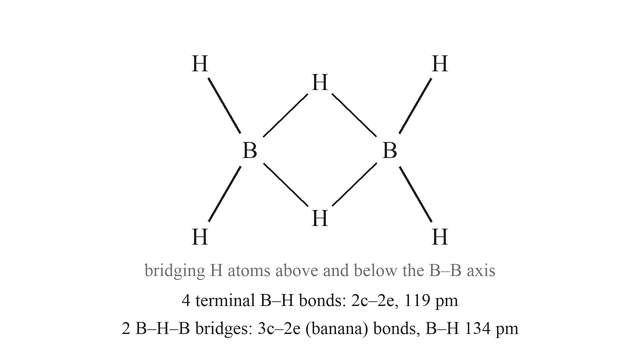
Therefore, the two types of bonds present in diborane are covalent two-centre two-electron (2c–2e) bonds and three-centre two-electron (3c–2e) bonds.