Solution:
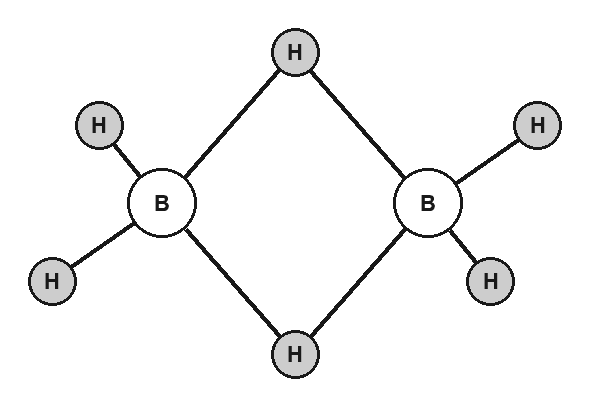
Key idea: The figure shows diborane, B2H6. Its 12 valence electrons (3 from each B and 1 from each H) form four ordinary two-centre two-electron (2c–2e) B–H bonds to the terminal hydrogen atoms and two three-centre two-electron (3c–2e) B–H–B bridges. Counting each bridge as one bond, the book speaks of "six B–H bonds": 4 terminal + 2 bridges.
Step 1 — Judge statement (a). The two bridging hydrogen atoms and the two boron atoms lie in one plane, and this plane is at right angles to the plane of the B atoms and the four terminal H atoms. So (a) is correct.
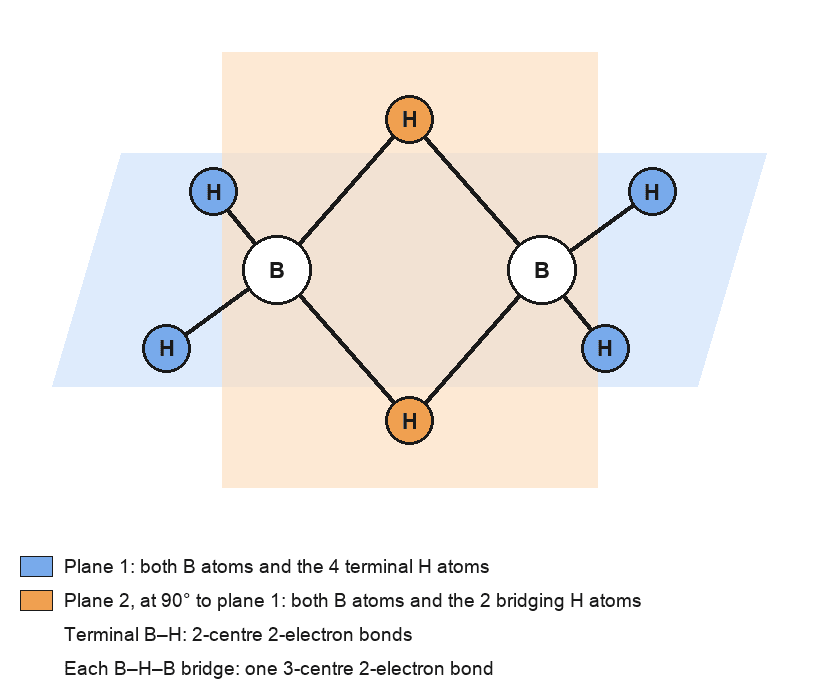
Step 2 — Count the electrons. Each boron atom brings 3 valence electrons and each hydrogen atom brings 1.
2×3+6×1=12 electrons
Twelve electrons make 6 pairs. Four pairs make the four terminal B–H bonds, and the remaining two pairs must hold the two bridges, one pair per bridge.
Step 3 — Judge statements (b) and (c). Each bridge is one bond in which a single pair of electrons holds three atoms (B, H and B), a 3c–2e or "banana" bond. Of the six bonds, therefore, two are 3c–2e bonds, so (b) is correct and (c), which says four, is wrong.
Step 4 — Judge statement (d). Each terminal B–H bond is a normal bond in which two electrons are shared between two atoms, so (d) is correct.
Note: the book accepts three of the four statements (all except the one about four 3c–2e bonds), so this question is answered as a short-answer item. The four B–H contacts in the bridges are not four separate bonds: they make up the two 3c–2e bonds.
Therefore, statements (a), (b) and (d) are correct.