
Question 231 markMCQEasy
Which of the following compounds has a 3-centre bond?
Confirming your payment
Sign up now and get 250 free tokens.
Some p-Block Elements · Question 23 of 111
Which of the following compounds has a 3-centre bond?
(A) Diborane
(B) Carbon dioxide
(C) Boron trifluoride
(D) Ammonia
Answer: (A) Diborane
Key idea: A three-centre two-electron (3c–2e) bond is a bond in which one pair of electrons holds three atoms together. Such bonds are found in electron-deficient molecules that do not have enough electrons for ordinary two-centre bonds.
Step 1 — Look at diborane. Diborane, , has only 12 valence electrons for 8 B–H links. Its two B–H–B bridges are each held by one electron pair spread over the B, H and B atoms, so diborane has two 3c–2e bonds.
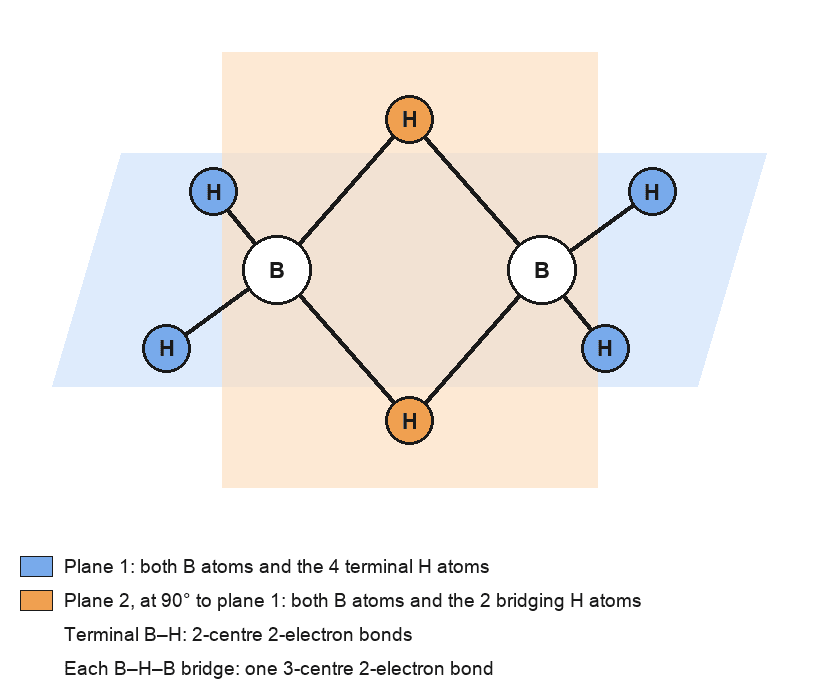
Why the other options are wrong:
Therefore, diborane has 3-centre bonds.