
Opening your dashboard
Class 10 Chemistry Chapter 4: Analytical Chemistry Solutions
31 textbook questions with step-by-step answers, free to read, for ICSE 2026-27.
Get talked through Ch 4, not just shown the answer
Reading a finished solution is not the same as being able to do it. The AI tutor takes one question at a time and works it with you, in your own words, until you can.
- Ask it out loud, in your own words
- It gives you the next step, not the answer
- Stuck on part (ii)? Start there
31 questions with solutions
1–5 marks · Mixed difficulty
- 15 marks
Question 1
What do you understand by the following :
(a) Analysis (b) Qualitative analysis
(c) Reagent (d) Precipitation
Solve with AIWritten solution
Solution:
Concept: Analytical chemistry is the branch of chemistry that finds out what a substance contains and how much of each part it contains. In the laboratory this is done with chemical tests that give something we can see, such as a coloured precipitate.
Step 1 — (a) Analysis.
Analysis is the determination of the chemical components present in a given sample. It is of two types:
- qualitative analysis, which finds out which substances (ions) are present;
- quantitative analysis, which finds out how much of each substance is present, that is, the composition of the mixture.
Step 2 — (b) Qualitative analysis.
Qualitative analysis is the identification of an unknown substance by carrying out chemical tests on it with the help of reagents. For example, if a salt solution gives a pale blue precipitate with sodium hydroxide solution, we conclude that it contains the copper (II) ion, .
Step 3 — (c) Reagent.
A reagent is a substance that reacts with another substance and is used to detect (identify) it. Alkalis such as sodium hydroxide (NaOH) and ammonium hydroxide () are important laboratory reagents, because they give characteristic coloured precipitates of metal hydroxides with salt solutions.
Step 4 — (d) Precipitation.
Precipitation is the process in which an insoluble solid is formed when two solutions are mixed. The insoluble solid is called the precipitate; only a compound that is insoluble in water can come out as a precipitate. For example, iron (III) chloride solution and sodium hydroxide solution give a reddish brown precipitate of iron (III) hydroxide, while sodium chloride stays dissolved.
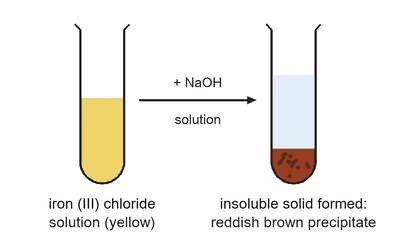
Watch out: 'precipitate' is the solid; 'precipitation' is the process that forms it. Do not mix up the two words.
Therefore, (a) analysis is finding the chemical components of a sample; (b) qualitative analysis is identifying them by chemical tests with reagents; (c) a reagent is a substance used to detect another substance by reacting with it; (d) precipitation is the formation of an insoluble solid (the precipitate) when two solutions are mixed.
- 24 marks
Question 2
Write the probable colour of the following salts :
(a) Iron (III) chloride (b) Potassium nitrate
(c) Ferrous sulphate (d) Aluminium acetate
Solve with AIWritten solution
Solution:
Concept: The colour of a salt comes from its ions. Salts of the transition elements such as iron and copper are generally coloured, while salts of the representative elements (Groups 1, 2 and 13 to 17) are generally colourless (white as solids), unless the anion itself is coloured.
Step 1 — Find the metal ion in each salt.
For each salt we name the cation and decide whether it comes from a transition element or a representative element. All four anions here (chloride, nitrate, sulphate, acetate) are colourless, so the colour depends only on the cation.
Step 2 — (a) Iron (III) chloride.
In the cation is the ferric ion, . Iron is a transition element and the ferric ion is yellowish brown.
Step 3 — (b) Potassium nitrate.
In the cation is . Potassium is a Group 1 (representative) element, so the salt is colourless (a white solid).
Step 4 — (c) Ferrous sulphate.
In the cation is the ferrous ion, , which is light (pale) green.
Step 5 — (d) Aluminium acetate.
Here the cation is . Aluminium is a Group 13 (representative) element, so the salt is colourless (white).

Watch out: Iron gives two different colours: ferrous (Fe²⁺) salts are light green, ferric (Fe³⁺) salts are yellowish brown.
Therefore, (a) iron (III) chloride is yellowish brown, (b) potassium nitrate is colourless, (c) ferrous sulphate is light green and (d) aluminium acetate is colourless.
- 32 marks
Question 3
Name the probable cation present based on the following observations :
(a) White precipitate insoluble in but soluble in NaOH
(b) Blue coloured solution.
Solve with AIWritten solution
Solution:
Concept: A white hydroxide precipitate comes from a colourless metal ion such as calcium, zinc, lead or aluminium. A hydroxide that dissolves in excess caustic soda is amphoteric (zinc, lead, aluminium). Of these, only zinc hydroxide also dissolves in excess ammonium hydroxide.
Step 1 — (a) Use the first clue: soluble in NaOH.
Among the white hydroxides, only the amphoteric ones dissolve in excess sodium hydroxide, so the ion is zinc, lead or aluminium (calcium hydroxide stays undissolved). With lead nitrate, for example, the white precipitate forms and then dissolves as colourless sodium plumbite.
Step 2 — (a) Use the second clue: insoluble in NH₄OH.
Zinc hydroxide dissolves in excess ammonium hydroxide, so zinc is ruled out. Lead hydroxide does not dissolve, so the chalky white precipitate stays.
So the ion is the lead ion, . (The aluminium ion, , behaves in the same way and is also an acceptable answer.)
Step 3 — (b) A blue coloured solution.
Among the common ions, the hydrated copper (II) (cupric) ion is the one that is blue, as in copper sulphate solution. So the cation is .

Watch out: Zinc is the trap in (a): its hydroxide dissolves in excess of both alkalis, so it cannot be the answer.
Therefore, (a) the cation is the lead ion, (or ), and (b) the cation is the copper (II) ion, .
- 44 marks
Question 4
Name the metal hydroxides which are :
(a) Insoluble (b) Soluble
in (i) Caustic soda solution (ii) Ammonium hydroxide solution.
Solve with AIWritten solution
Solution:
Concept: When an alkali is added to a metal salt solution, the metal hydroxide precipitates. Whether that precipitate dissolves in excess alkali depends on the alkali: excess caustic soda dissolves only the amphoteric hydroxides (zinc, lead, aluminium); excess ammonium hydroxide dissolves only the hydroxides of copper and zinc, which form soluble ammine compounds.
Step 1 — (a)(i) Insoluble in caustic soda solution.
These hydroxides are not amphoteric, so they stay as precipitates in excess NaOH:
- , iron (II) hydroxide (dirty green);
- , iron (III) hydroxide (reddish brown);
- , copper (II) hydroxide (pale blue);
- , calcium hydroxide (white), which is only sparingly soluble.
Step 2 — (a)(ii) Insoluble in ammonium hydroxide solution.
These hydroxides do not form soluble ammine compounds, so they stay as precipitates in excess ammonium hydroxide:
- and ;
- , lead hydroxide (chalky white);
- , aluminium hydroxide (white).
Step 3 — (b)(i) Soluble in caustic soda solution.
Being amphoteric, , and react with excess NaOH and dissolve. For zinc hydroxide the colourless product is sodium zincate.
Step 4 — (b)(ii) Soluble in ammonium hydroxide solution.
and dissolve in excess ammonium hydroxide. Copper (II) hydroxide gives a deep blue solution of tetraamminecopper (II) sulphate.
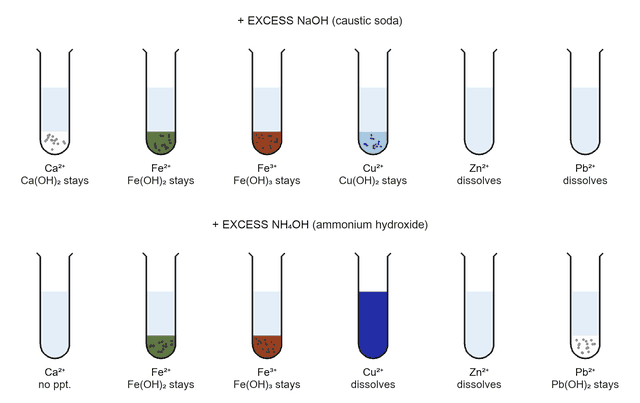
Watch out: Zinc hydroxide is the only one that dissolves in excess of both alkalis; lead hydroxide dissolves in NaOH but not in NH₄OH, and copper hydroxide does the opposite.
Therefore, (a) insoluble: (i) in caustic soda, , and (also ); (ii) in ammonium hydroxide, , and (also ). (b) Soluble: (i) in caustic soda, and (also ); (ii) in ammonium hydroxide, and .
- 52 marks
Question 5
What do you observe when ammonium salt is heated with caustic soda solution ? Write the word equation.
Solve with AIWritten solution
Solution:
Concept: Sodium hydroxide is a strong alkali. When it is heated with any ammonium salt, it drives out ammonia gas. This is the laboratory test for the ammonium ion, .
Step 1 — Say what happens.
On heating, the hydroxide ions of caustic soda take a hydrogen ion from each ammonium ion, so ammonia is set free as a gas and leaves the mixture.
Step 2 — Write the observations.
We observe the following:
- a colourless gas with a sharp, pungent smell (of ammonia) is given off;
- the gas turns moist red litmus paper blue, because ammonia is alkaline.
Step 3 — Write the word equation.
Taking ammonium chloride as the ammonium salt, the word equation is:
ammonium chloride + sodium hydroxide → sodium chloride + water + ammonia
Step 4 — Write the balanced equation.
The same change, written with formulae and balanced, is:
Every ammonium salt behaves in the same way, for example ammonium sulphate:

Watch out: Test the gas with moist red litmus; ammonia shows its alkaline nature only when dissolved in water.
Therefore, a colourless, pungent-smelling gas (ammonia) is evolved which turns moist red litmus blue; word equation: ammonium chloride + sodium hydroxide → sodium chloride + water + ammonia.
- 62 marks
Question 6
How will you distinguish solution from NaOH solution ?
Solve with AIWritten solution
Solution:
Concept: Both alkalis give a pale blue precipitate of copper (II) hydroxide with a copper salt, but only ammonium hydroxide dissolves it in excess, forming a soluble deep blue ammine compound. So copper sulphate solution can tell the two alkalis apart.
Step 1 — Set up the test.
Take copper sulphate solution in two test tubes. Add one alkali to each tube, first drop by drop and then in excess, and watch the precipitate.
Step 2 — Add a few drops.
Both alkalis give a pale blue precipitate of copper (II) hydroxide, so this stage alone does not separate them.
Step 3 — Add the alkali in excess.
Now the two tubes behave differently:
- with NaOH, the pale blue precipitate does not dissolve;
- with , the precipitate dissolves to give a deep (inky) blue solution of tetraamminecopper (II) sulphate.

Step 4 — Another test.
A calcium salt solution can also be used: it gives a white precipitate with NaOH but no precipitate with , even in excess.
Watch out: The first few drops look the same in both tubes; only the result in excess distinguishes the alkalis.
Therefore, the alkali that dissolves the pale blue precipitate of copper (II) hydroxide to a deep blue solution is ; the one in which the precipitate stays is NaOH.
- 72 marks
Question 7
Why the alkali is added drop by drop to the salt solution ?
Solve with AIWritten solution
Solution:
Concept: Some metal hydroxides dissolve in excess alkali: those of zinc, lead and aluminium in NaOH, and those of zinc and copper in . Both the precipitate and its behaviour in excess are needed to identify the metal ion.
Step 1 — See what we must observe.
To identify a metal ion we need two observations: first the colour of the precipitate, then whether it dissolves in excess alkali.
Step 2 — See what goes wrong if the alkali is added quickly.
If a large amount of alkali is poured in at once, the precipitate may form and immediately redissolve in the excess. The tube then stays clear, and we miss the precipitate altogether.
Step 3 — Take an example.
Zinc sulphate solution gives a white gelatinous precipitate with a few drops of NaOH, and the precipitate dissolves when more NaOH is added:
Added drop by drop, both stages are seen; added all at once, the zinc ion could be missed.
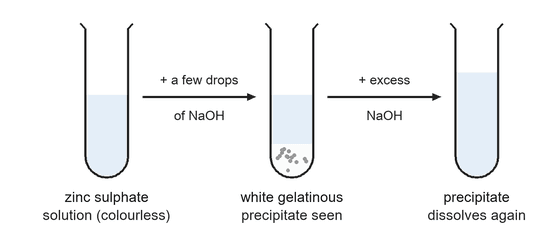
Watch out: A clear tube after adding a lot of alkali does not prove that no precipitate formed.
Therefore, the alkali is added drop by drop so that the precipitate and its colour are seen first, and then we can check whether it dissolves in excess; adding it all at once could dissolve the precipitate before it is noticed.
- 84 marks
Question 8
Write balanced equations :
(a) Reaction of sodium hydroxide solution with Iron (III) chloride solution.
(b) Copper sulphate solution with ammonium hydroxide solution.
Solve with AIWritten solution
Solution:
Concept: An alkali reacts with a metal salt solution to give the insoluble metal hydroxide (the precipitate) and a soluble salt. With a copper salt, excess ammonium hydroxide then dissolves the hydroxide.
Step 1 — (a) Write the reaction of NaOH with iron (III) chloride.
The yellow solution gives a reddish brown precipitate of iron (III) hydroxide, which does not dissolve in excess. Three hydroxide ions are needed for each Fe³⁺ ion, so 3 NaOH are used.
Step 2 — Check the balance of (a).
Counting atoms: 1 Fe, 3 Cl, 3 Na, 3 O and 3 H on each side, so the equation is balanced.
Step 3 — (b) Copper sulphate with a little ammonium hydroxide.
A pale blue precipitate of copper (II) hydroxide forms first.
Step 4 — (b) Copper sulphate with excess ammonium hydroxide.
The precipitate dissolves, giving a deep blue solution of tetraamminecopper (II) sulphate.
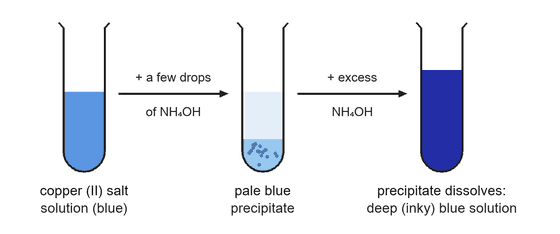
Watch out: Fe³⁺ needs three OH⁻ ions, so the equation needs 3 NaOH and gives 3 NaCl.
Therefore, (a) FeCl₃ + 3NaOH → Fe(OH)₃↓ + 3NaCl; (b) CuSO₄ + 2NH₄OH → Cu(OH)₂↓ + (NH₄)₂SO₄, and in excess Cu(OH)₂ + (NH₄)₂SO₄ + 2NH₄OH → [Cu(NH₃)₄]SO₄ + 4H₂O.
- 91 mark
Question 9
The colour of an aqueous solution of copper sulphate is:
Solve with AIAnswer
(A) Green
(B) Brown
- Correct
(C) Blue
(D) Yellow
Answer: (C) Blue
Concept: The colour of a salt solution comes from its ions. Copper is a transition element, and the copper (II) (cupric) ion, , is blue in water.
Step 1 — Find the ions in the solution.
Copper sulphate, , dissolves in water to give ions and ions.
Step 2 — Decide which ion gives the colour.
The sulphate ion is colourless, so the colour of the solution is the colour of the ion, which is blue.
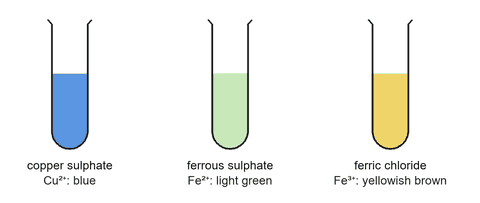
Watch out: The blue colour belongs to the copper ion, not to the sulphate; other sulphates (e.g. sodium sulphate) are colourless.
Why the other options are wrong:
- (A) Green: Green is the colour of ferrous (, light green) and nickel salt solutions, not of a copper (II) salt.
- (B) Brown: Brown is the colour of the iron (III) hydroxide precipitate (reddish brown), not of a copper salt solution.
- (D) Yellow: Yellow is the colour of ferric (, yellowish brown) and chromate solutions, not of copper sulphate.
Therefore, an aqueous solution of copper sulphate is blue, option (C).
- 101 mark
Question 10
The colour of the precipitate formed on adding NaOH solution to iron (II) sulphate solution is :
Solve with AIAnswer
(A) White
(B) Brown
- Correct
(C) Green
(D) Pale blue
Answer: (C) Green
Concept: Sodium hydroxide precipitates the metal hydroxide from a salt solution. Iron (II) hydroxide, , is a dirty green, gelatinous precipitate that does not dissolve in excess NaOH.
Step 1 — Write the reaction.
The light green iron (II) sulphate solution reacts with sodium hydroxide to give iron (II) hydroxide and sodium sulphate.
Step 2 — Decide what is seen.
Sodium sulphate stays dissolved (colourless), while the insoluble settles as a dirty green precipitate.

Watch out: Iron (II) gives a green precipitate, iron (III) a reddish brown one; read the oxidation state carefully.
Why the other options are wrong:
- (A) White: White precipitates are given by calcium, zinc and lead salts, not by an iron (II) salt.
- (B) Brown: A (reddish) brown precipitate is iron (III) hydroxide, which comes from an iron (III) salt.
- (D) Pale blue: A pale blue precipitate is copper (II) hydroxide, which comes from a copper (II) salt.
Therefore, the precipitate formed is (dirty) green, option (C).
- 111 mark
Question 11
A metal which produces hydrogen on reacting with alkali as well as with acid is :
Solve with AIAnswer
(A) Iron
(B) Magnesium
- Correct
(C) Zinc
(D) Copper
Answer: (C) Zinc
Concept: Zinc, aluminium and lead are amphoteric metals: they react with dilute acids and with hot concentrated caustic alkalis (NaOH, KOH). Zinc gives hydrogen in both reactions.
Step 1 — Check the reaction with an acid.
Zinc is above hydrogen in the activity series, so it displaces hydrogen from dilute hydrochloric acid.
Step 2 — Check the reaction with an alkali.
Zinc also dissolves in hot concentrated sodium hydroxide, forming colourless sodium zincate and hydrogen gas.

Step 3 — Choose the metal.
Zinc is the only metal in the list that gives hydrogen with both an acid and an alkali.
Watch out: Magnesium and iron react with acids, but not with alkalis; only amphoteric metals react with both.
Why the other options are wrong:
- (A) Iron: Iron gives hydrogen with dilute acids but does not react with alkalis.
- (B) Magnesium: Magnesium gives hydrogen with dilute acids but does not react with alkalis.
- (D) Copper: Copper is below hydrogen in the activity series, so it gives hydrogen with neither dilute acids nor alkalis.
Therefore, the metal is zinc, option (C).
- 121 mark
Question 12
The salt solution which does not react with ammonium hydroxide is :
Solve with AIAnswer
- Correct
(A) Calcium nitrate
(B) Zinc nitrate
(C) Lead nitrate
(D) Copper nitrate
Answer: (A) Calcium nitrate
Concept: Ammonium hydroxide, , is a weak alkali: it ionises only slightly, so it gives a very low concentration of hydroxide ions. This is too low to precipitate calcium hydroxide, so a calcium salt shows no precipitate, even with excess ammonium hydroxide.
Step 1 — Test the zinc, lead and copper salts.
Each of these gives a precipitate of its hydroxide with ammonium hydroxide, for example zinc nitrate:
Step 2 — Test the calcium salt.
Calcium nitrate solution stays clear: no visible reaction takes place, because the hydroxide ion concentration is too low to precipitate calcium hydroxide.

Watch out: Calcium nitrate does give a white precipitate with NaOH (a strong alkali); it is only with NH₄OH that nothing happens.
Why the other options are wrong:
- (B) Zinc nitrate: Zinc nitrate gives a white gelatinous precipitate of , which dissolves in excess.
- (C) Lead nitrate: Lead nitrate gives a chalky white precipitate of , which does not dissolve in excess.
- (D) Copper nitrate: Copper nitrate gives a pale blue precipitate of , which dissolves in excess to a deep blue solution.
Therefore, calcium nitrate does not react with ammonium hydroxide, option (A).
- 131 mark
Question 13
Which of the following is the best reagent to distinguish lead nitrate and zinc nitrate ?
P NaOH solution Q KOH solution
R solution
Solve with AIAnswer
(A) Only P
(B) Only Q
- Correct
(C) Only R
(D) Both P and Q
Answer: (C) Only R
Concept: A reagent can distinguish two salts only if it gives a different result with each. Lead and zinc salts both give a white precipitate with every alkali, so the difference must show in the excess of the reagent.
Step 1 — Try NaOH and KOH (P and Q).
With caustic soda or caustic potash, both white precipitates dissolve in excess (as sodium plumbite and sodium zincate), so the two tubes end up looking the same.
Step 2 — Try (R).
With ammonium hydroxide both salts give a white precipitate at first. In excess, zinc hydroxide dissolves to a colourless solution, but lead hydroxide does not.
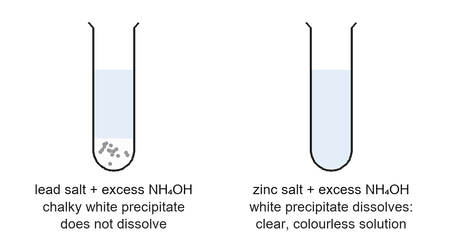
Step 3 — Read the result.
A tube that stays milky with excess ammonium hydroxide holds lead nitrate; a tube that turns clear holds zinc nitrate. So only R distinguishes them.
Watch out: Both precipitates are white, so watching only the first few drops never separates lead from zinc.
Why the other options are wrong:
- (A) Only P: With NaOH both white precipitates dissolve in excess, so P alone cannot tell the salts apart.
- (B) Only Q: KOH behaves exactly like NaOH here (both precipitates dissolve in excess), so Q alone cannot tell them apart.
- (D) Both P and Q: Neither NaOH nor KOH distinguishes the two salts, so 'both P and Q' is wrong.
Therefore, the best reagent is solution only, option (C).
- 141 mark
Question 14
The following questions are Assertion-Reason based questions. Choose the answer based on the codes given below.
(1) Both A and R are true and R is the correct explanation of A.
(2) Both A and R are true but R is not the correct explanation of A.
(3) A is true but R is false.
(4) A is false but R is true.
Assertion (A) : Calcium salt solution does not show any change even after adding an excess of ammonia solution to it.
Reason (R) : The low concentration of hydroxide ion in ammonium hydroxide solution which are unable to precipitate the hydroxide ions of calcium.
Solve with AIAnswer
- Correct
(A) (1)
(B) (2)
(C) (3)
(D) (4)
Answer: (A) (1)
Concept: Ammonium hydroxide is a weak alkali, so it gives only a low concentration of hydroxide ions. A precipitate of calcium hydroxide needs a higher hydroxide ion concentration. (Codes: (1) both true and R explains A; (2) both true but R does not explain A; (3) A true, R false; (4) A false, R true.)
Step 1 — Judge the Assertion.
A calcium salt solution shows no precipitate even with excess ammonia solution. This is true.
Step 2 — Judge the Reason.
The Reason (read as: the low hydroxide ion concentration of ammonium hydroxide cannot precipitate calcium hydroxide) is true, because ionises only slightly.
Step 3 — Decide whether R explains A.
This low hydroxide ion concentration is exactly why no precipitate forms, so R is the correct explanation of A. A strong alkali such as NaOH does give a white precipitate with the same solution.
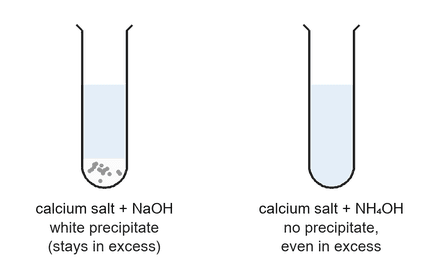
Watch out: The Reason's wording is clumsy (“hydroxide ions of calcium” means calcium hydroxide); judge the idea it states.
Why the other options are wrong:
- (B) (2): Code (2) says R does not explain A, but R gives the exact cause of A.
- (C) (3): Code (3) says R is false, but the hydroxide ion concentration of NH₄OH really is low.
- (D) (4): Code (4) says A is false, but a calcium salt really shows no change with excess ammonia solution.
Therefore, both A and R are true and R explains A, code (1), option (A).
- 151 mark
Question 15
The following questions are Assertion-Reason based questions. Choose the answer based on the codes given below.
(1) Both A and R are true and R is the correct explanation of A.
(2) Both A and R are true but R is not the correct explanation of A.
(3) A is true but R is false.
(4) A is false but R is true.
Assertion (A) : Iron (II) salt solution when reacted with ammonium hydroxide forms a dirty green precipitate.
Reason (R) : Iron salts are brown in colour.
Solve with AIAnswer
(A) (1)
(B) (2)
- Correct
(C) (3)
(D) (4)
Answer: (C) (3)
Concept: The colour depends on the ion: iron (II) (ferrous) and iron (III) (ferric) salts have different colours, and so do their hydroxides. (Codes: (1) both true and R explains A; (2) both true but R does not explain A; (3) A true, R false; (4) A false, R true.)
Step 1 — Judge the Assertion.
An iron (II) salt solution with ammonium hydroxide gives a dirty green precipitate of iron (II) hydroxide, insoluble in excess. This is true.
Step 2 — Judge the Reason.
'Iron salts are brown in colour' is false. Iron (II) (ferrous) salts are light green; only iron (III) (ferric) salts are yellowish brown.

Watch out: Do not treat 'iron salts' as one group; ferrous and ferric salts differ in colour.
Why the other options are wrong:
- (A) (1): Code (1) needs R to be true, but R is false.
- (B) (2): Code (2) also needs R to be true, but R is false.
- (D) (4): Code (4) says A is false, but iron (II) salts do give a dirty green precipitate with NH₄OH.
Therefore, A is true but R is false, code (3), option (C).
- 161 mark
Question 16
The following questions are Assertion-Reason based questions. Choose the answer based on the codes given below.
(1) Both A and R are true and R is the correct explanation of A.
(2) Both A and R are true but R is not the correct explanation of A.
(3) A is true but R is false.
(4) A is false but R is true.
Assertion (A) : Hydrogen gas is liberated when metals like Zn, Al, Pb react with caustic alkalies.
Reason (R) : Alkalies are soluble in water.
Solve with AIAnswer
(A) (1)
- Correct
(B) (2)
(C) (3)
(D) (4)
Answer: (B) (2)
Concept: Zinc, aluminium and lead react with hot concentrated caustic alkalis because they are amphoteric; the products are a soluble salt and hydrogen. (Codes: (1) both true and R explains A; (2) both true but R does not explain A; (3) A true, R false; (4) A false, R true.)
Step 1 — Judge the Assertion.
Hydrogen is given off when zinc, aluminium or lead reacts with a caustic alkali. This is true, for example:
Step 2 — Judge the Reason.
'Alkalis are soluble in water' is also true: an alkali is a base that dissolves in water.
Step 3 — Decide whether R explains A.
Solubility in water is not why hydrogen is given off. Many metals, such as iron and copper, do not react with alkali solutions at all. The reaction happens because these particular metals are amphoteric, so R does not explain A.
Watch out: A true Reason is not automatically the explanation; ask whether it gives the cause of A.
Why the other options are wrong:
- (A) (1): Code (1) says R explains A, but solubility of alkalis is not the cause of the reaction.
- (C) (3): Code (3) says R is false, but alkalis are soluble in water.
- (D) (4): Code (4) says A is false, but zinc, aluminium and lead do liberate hydrogen with caustic alkalis.
Therefore, both A and R are true but R is not the correct explanation of A, code (2), option (B).
- 171 mark
Question 17
The following questions are Assertion-Reason based questions. Choose the answer based on the codes given below.
(1) Both A and R are true and R is the correct explanation of A.
(2) Both A and R are true but R is not the correct explanation of A.
(3) A is true but R is false.
(4) A is false but R is true.
Assertion (A) : Oxides of most of the metals are basic in nature.
Reason (R) : All metal oxides dissolve in water forming alkalies.
Solve with AIAnswer
(A) (1)
(B) (2)
- Correct
(C) (3)
(D) (4)
Answer: (C) (3)
Concept: A basic oxide reacts with an acid to form a salt and water. Only a few basic oxides, those of very reactive metals such as sodium and potassium, dissolve in water to form alkalis. (Codes: (1) both true and R explains A; (2) both true but R does not explain A; (3) A true, R false; (4) A false, R true.)
Step 1 — Judge the Assertion.
Oxides of most metals are basic and neutralise acids, for example copper (II) oxide. This is true.
Step 2 — Judge the Reason.
The word 'all' makes the Reason false. Some metal oxides, such as sodium oxide and potassium oxide, dissolve in water to form alkalis:
But many others, such as and , are insoluble in water and form no alkali.
Watch out: Look for words like 'all', 'only' and 'never' in a Reason; one counter-example makes it false.
Why the other options are wrong:
- (A) (1): Code (1) needs R to be true, but R is false.
- (B) (2): Code (2) also needs R to be true, but R is false.
- (D) (4): Code (4) says A is false, but most metal oxides really are basic.
Therefore, A is true but R is false, code (3), option (C).
- 181 mark
Question 18
The following questions are Assertion-Reason based questions. Choose the answer based on the codes given below.
(1) Both A and R are true and R is the correct explanation of A.
(2) Both A and R are true but R is not the correct explanation of A.
(3) A is true but R is false.
(4) A is false but R is true.
Assertion (A) : Zinc oxide reacts with acids as well as bases to form salt and water.
Reason (R) : Zinc oxide is amphoteric in nature.
Solve with AIAnswer
- Correct
(A) (1)
(B) (2)
(C) (3)
(D) (4)
Answer: (A) (1)
Concept: An amphoteric oxide shows both basic and acidic character: it reacts with both acids and alkalis to form a salt and water. (Codes: (1) both true and R explains A; (2) both true but R does not explain A; (3) A true, R false; (4) A false, R true.)
Step 1 — Judge the Assertion.
Zinc oxide acts as a base with an acid and as an acid with an alkali, giving a salt and water each time. This is true.
Step 2 — Judge the Reason.
Zinc oxide is amphoteric. This is true.
Step 3 — Decide whether R explains A.
Being amphoteric is exactly what makes zinc oxide react with both acids and bases, so R is the correct explanation of A.
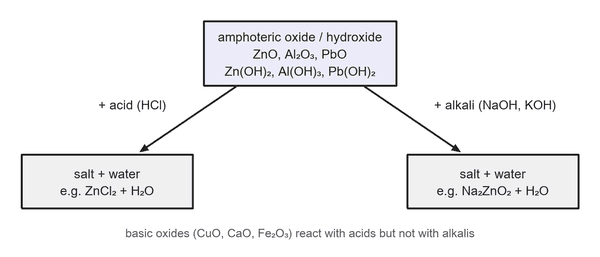
Watch out: With an alkali, zinc oxide gives sodium zincate (Na₂ZnO₂), not zinc hydroxide.
Why the other options are wrong:
- (B) (2): Code (2) says R does not explain A, but amphoteric nature is the exact reason for A.
- (C) (3): Code (3) says R is false, but zinc oxide is amphoteric.
- (D) (4): Code (4) says A is false, but zinc oxide does react with both acids and bases.
Therefore, both A and R are true and R explains A, code (1), option (A).
- 195 marks
Question 19
Name :
(a) two coloured metal ions.
(b) a metal that evolves a gas which burns with a pop sound when boiled with alkali solutions.
(c) two bases which are not alkalis but dissolve in strong alkalis.
(d) a coloured metallic oxide which dissolves in alkalis to yield colourless solutions.
(e) a colourless cation not a representative element.
(f) a yellow monoxide that dissolves in hot and concentrated caustic alkali.
(g) a white, insoluble oxide that dissolves when fused with caustic soda or caustic potash.
(h) a compound containing zinc in the anion.
Solve with AIWritten solution
Solution:
Concept: Two facts answer every part. First, ions of transition elements (such as copper and iron) are generally coloured, while most other ions are colourless. Second, zinc, aluminium and lead, with their oxides and hydroxides, are amphoteric, so they react with caustic alkalis (NaOH, KOH).
Step 1 — (a) Two coloured metal ions.
The copper (II) ion, , is blue, and the ferrous ion, , is light green. (The ferric ion, , yellowish brown, is another.)
Step 2 — (b) A metal giving a gas that burns with a pop.
When zinc is boiled with an alkali solution, it dissolves and gives hydrogen, the gas that burns with a 'pop' sound. (Aluminium does the same.)
Step 3 — (c) Two bases that are not alkalis but dissolve in strong alkalis.
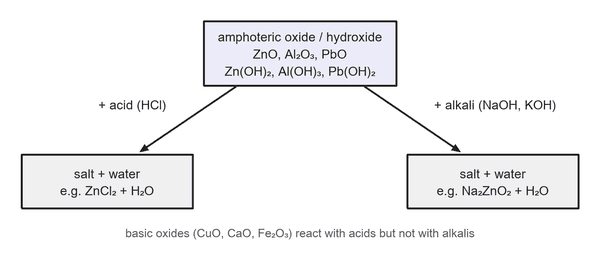
Zinc hydroxide, , and lead hydroxide, , are insoluble in water, so they are not alkalis. Being amphoteric, they dissolve in excess NaOH, for example:
Step 4 — (d) A coloured oxide giving a colourless solution with alkali.
Lead (II) oxide, , is yellow. It dissolves in caustic soda to give colourless sodium plumbite.
Step 5 — (e) A colourless cation that is not of a representative element.
The zinc ion, , is colourless. Zinc is a d-block element of Group 12, so it is not a representative element, yet its salts are colourless.
Step 6 — (f) A yellow monoxide that dissolves in hot concentrated caustic alkali.
Lead monoxide, , is yellow and dissolves in hot concentrated caustic alkali, by the same reaction as in part (d).
Step 7 — (g) A white insoluble oxide that dissolves on fusing with caustic alkali.
Aluminium oxide, , is a white solid insoluble in water. Fused with caustic soda it gives sodium meta-aluminate.
Step 8 — (h) A compound with zinc in the anion.
In sodium zincate, , the zinc is part of the anion, the zincate ion , and not the cation.
Watch out: In (h) the zinc must be in the anion; in zinc salts such as ZnSO₄ it is in the cation.
Therefore, (a) (blue) and (light green); (b) zinc; (c) zinc hydroxide and lead hydroxide; (d) lead (II) oxide, PbO; (e) the zinc ion, ; (f) lead monoxide, PbO; (g) aluminium oxide, ; (h) sodium zincate, .
- 205 marks
Question 20
Write the probable colour of the following salts :
(a) Ferrous salts (b) Ammonium salts
(c) Cupric salts (d) Calcium salts
(e) Aluminium salts.
Solve with AIWritten solution
Solution:
Concept: The colour of a salt comes from its cation (when the anion is colourless). Salts of the transition elements are generally coloured; salts of the representative elements (Groups 1, 2 and 13 to 17) and of the ammonium ion are colourless (white as solids).
Step 1 — (a) Ferrous salts.
Iron is a transition element and the ferrous ion, , is light green, as in ferrous sulphate.
Step 2 — (b) Ammonium salts.
The ammonium ion, , is colourless, so ammonium salts are colourless; ammonium chloride, for example, is a white solid.
Step 3 — (c) Cupric salts.
Copper is a transition element and the cupric ion, , is blue, as in copper sulphate solution.
Step 4 — (d) Calcium salts.
Calcium is a Group 2 (representative) element, and is colourless, so calcium salts are colourless.
Step 5 — (e) Aluminium salts.
Aluminium is a Group 13 (representative) element, and is colourless, so aluminium salts are colourless.

Watch out: 'ferrous' means iron (II) (light green) and 'cupric' means copper (II) (blue); do not swap them.
Therefore, (a) ferrous salts are light green, (b) ammonium salts are colourless, (c) cupric salts are blue, (d) calcium salts are colourless and (e) aluminium salts are colourless.
- 212 marks
Question 21
Name the chloride of a metal which is soluble in excess of ammonium hydroxide. Write the equation for the same.
Solve with AIWritten solution
Solution:
Concept: Copper (II) hydroxide dissolves in excess ammonium hydroxide, forming a soluble ammine compound with a deep blue colour. This special action of ammonium hydroxide is used to detect the ion.
Step 1 — Name the chloride.
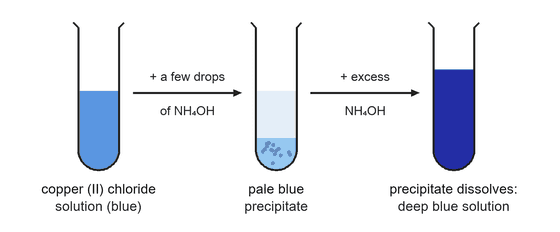
The chloride is copper (II) chloride, (cupric chloride). Its hydroxide, first precipitated by ammonium hydroxide, dissolves in excess.
Step 2 — Add a few drops of ammonium hydroxide.
A pale blue precipitate of copper (II) hydroxide forms, and ammonium chloride stays in solution.
Step 3 — Add excess ammonium hydroxide.
The precipitate dissolves to give a deep (inky) blue solution of tetraamminecopper (II) chloride.
Step 4 — Note another answer.
Zinc chloride also fits: its white precipitate dissolves in excess ammonium hydroxide, but the solution formed is colourless.
Watch out: The precipitate of a chloride is the metal hydroxide; it is the hydroxide, not the chloride, that dissolves in excess.
Therefore, the chloride is copper (II) chloride, CuCl₂: CuCl₂ + 2NH₄OH → Cu(OH)₂↓ + 2NH₄Cl, then Cu(OH)₂ + 2NH₄Cl + 2NH₄OH → [Cu(NH₃)₄]Cl₂ + 4H₂O (deep blue solution).
- 225 marks
Question 22
What happens when ammonia solution is added first dropwise and then in excess to the following solutions :
(i) (ii) (iii) .
Write balanced equations for these reactions.
Solve with AIWritten solution
Solution:
Concept: Ammonia solution () first precipitates the metal hydroxide. In excess it dissolves only the hydroxides of copper and zinc, because these form soluble ammine compounds; iron (III) hydroxide stays.
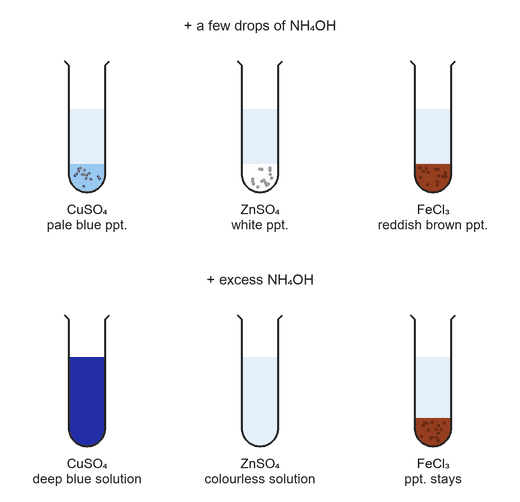
Step 1 — (i) CuSO₄, dropwise.
The blue solution gives a pale blue precipitate of copper (II) hydroxide.
Step 2 — (i) CuSO₄, in excess.
The precipitate dissolves to give a deep (inky) blue solution of tetraamminecopper (II) sulphate.
Step 3 — (ii) ZnSO₄, dropwise.
The colourless solution gives a white gelatinous precipitate of zinc hydroxide.
Step 4 — (ii) ZnSO₄, in excess.
The precipitate dissolves to give a colourless solution of tetraamminezinc (II) sulphate.
Step 5 — (iii) FeCl₃, dropwise.
The yellow solution gives a reddish brown precipitate of iron (III) hydroxide.
Step 6 — (iii) FeCl₃, in excess.
Iron (III) hydroxide does not form an ammine compound, so the reddish brown precipitate is insoluble and stays.
Watch out: Both copper and zinc hydroxides dissolve in excess ammonia; only copper gives a deep blue colour.
Therefore, (i) CuSO₄ gives a pale blue precipitate that dissolves in excess to a deep blue solution; (ii) ZnSO₄ gives a white gelatinous precipitate that dissolves in excess to a colourless solution; (iii) FeCl₃ gives a reddish brown precipitate that is insoluble in excess.
- 235 marks
Question 23
What do you observe when caustic soda solution is added, first a little and then in excess, to the following solutions:
(a) (b)
(c) (d)
Write balanced equations for the above reactions.
Solve with AIWritten solution
Solution:
Concept: Caustic soda (NaOH) first precipitates the metal hydroxide. In excess it dissolves only the amphoteric hydroxides (of zinc and lead), forming soluble sodium zincate and sodium plumbite. Iron and copper hydroxides are not amphoteric, so they stay.
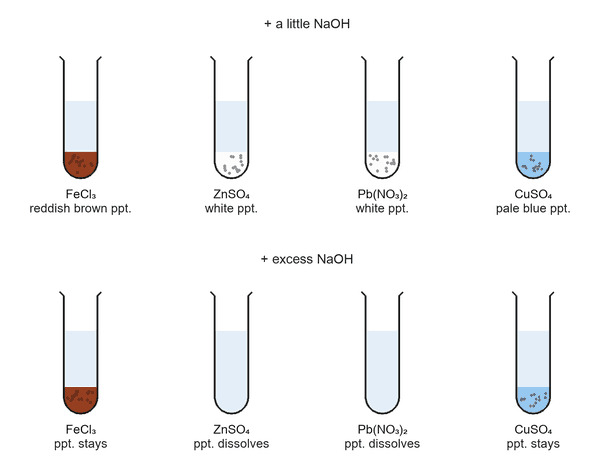
Step 1 — (a) FeCl₃.
A reddish brown precipitate of iron (III) hydroxide forms, and it is insoluble in excess.
Step 2 — (b) ZnSO₄, a little.
A white gelatinous precipitate of zinc hydroxide forms.
Step 3 — (b) ZnSO₄, in excess.
The precipitate dissolves, giving a colourless solution of sodium zincate.
Step 4 — (c) Pb(NO₃)₂, a little.
A chalky white precipitate of lead hydroxide forms.
Step 5 — (c) Pb(NO₃)₂, in excess.
The precipitate dissolves, giving a colourless solution of sodium plumbite.
Step 6 — (d) CuSO₄.
A pale blue precipitate of copper (II) hydroxide forms, and it is insoluble in excess NaOH.
Watch out: Copper hydroxide dissolves in excess NH₄OH but not in excess NaOH; do not carry the ammonia result over.
Therefore, (a) FeCl₃ gives a reddish brown precipitate, insoluble in excess; (b) ZnSO₄ gives a white gelatinous precipitate, soluble in excess; (c) Pb(NO₃)₂ gives a chalky white precipitate, soluble in excess; (d) CuSO₄ gives a pale blue precipitate, insoluble in excess.
- 242 marks
Question 24
What do you observe when freshly precipitated aluminium hydroxide reacts with caustic soda solution ? Give a balanced equation.
Solve with AIWritten solution
Solution:
Concept: Aluminium hydroxide is amphoteric: besides reacting with acids, it reacts like an acid with an alkali to form a salt and water.
Step 1 — State the observation.
The white gelatinous precipitate of aluminium hydroxide dissolves, giving a clear, colourless solution of sodium meta-aluminate (sodium aluminate).
Step 2 — Write the balanced equation.
One aluminium hydroxide reacts with one sodium hydroxide:
Step 3 — Check the balance.
Counting atoms: 1 Al, 1 Na, 4 O and 4 H on each side, so the equation is balanced.

Watch out: The product is sodium meta-aluminate, NaAlO₂, and water; no gas is given off (hydrogen forms only with the metal).
Therefore, the white precipitate dissolves to a clear, colourless solution of sodium meta-aluminate: Al(OH)₃ + NaOH → NaAlO₂ + 2H₂O.
- 254 marks
Question 25
What is observed when hot concentrated caustic soda solution is added to (a) Zinc and (b) Aluminium ? Write balanced equations.
Solve with AIWritten solution
Solution:
Concept: Zinc and aluminium are amphoteric metals. With hot, concentrated caustic alkali they give a soluble salt and hydrogen gas.
Step 1 — (a) Observe what happens with zinc.
The zinc dissolves with effervescence. The colourless gas is hydrogen, which burns with a 'pop' sound when a burning splint is brought near. The colourless solution contains sodium zincate.
Step 2 — (b) Observe what happens with aluminium.
The aluminium also dissolves with effervescence of hydrogen, and a colourless solution of sodium meta-aluminate forms. Water takes part in this reaction.
Step 3 — Check the balance of (b).
Counting atoms: 2 Al, 2 Na, 4 O and 6 H on each side, so the equation is balanced.
Watch out: Aluminium needs water in its equation; without 2H₂O on the left the hydrogen atoms do not balance.
Therefore, (a) zinc dissolves with effervescence of hydrogen (pop test) forming sodium zincate: Zn + 2NaOH → Na₂ZnO₂ + H₂↑; (b) aluminium dissolves with effervescence of hydrogen forming sodium meta-aluminate: 2Al + 2NaOH + 2H₂O → 2NaAlO₂ + 3H₂↑.
- 265 marks
Question 26
Distinguish by adding : Sodium hydroxide solution or ammonium hydroxide solution to
(a) Calcium salt solution and lead salt solution .
(b) Lead nitrate solution and zinc nitrate solution.
(c) Copper salt solution and ferrous salt solution.
(d) Fe(II) salt solution and Fe(III) salt solution.
(e) Ferrous nitrate and lead nitrate
Solve with AIWritten solution
Solution:
Concept: To tell two salts apart, choose the alkali that gives a different result with each: either precipitates of different colours, or a precipitate that stays in one tube and dissolves in the other.
Step 1 — (a) Calcium salt and lead salt: add ammonium hydroxide.
The two solutions behave differently:
- calcium salt: no precipitate, even in excess (the hydroxide ion concentration of NH₄OH is too low);
- lead salt: chalky white precipitate, insoluble in excess.
Step 2 — (b) Lead nitrate and zinc nitrate: add ammonium hydroxide in excess.
Both give a white precipitate at first, but in excess:
- zinc hydroxide dissolves, giving a colourless solution;
- lead hydroxide does not dissolve.
Step 3 — (c) Copper salt and ferrous salt: add sodium hydroxide.
The colours of the precipitates differ:
- copper salt: pale blue precipitate;
- ferrous salt: dirty green precipitate.
Step 4 — (d) Fe(II) salt and Fe(III) salt: add sodium hydroxide.
The colours of the precipitates differ:
- Fe(II) salt: dirty green precipitate of ;
- Fe(III) salt: reddish brown precipitate of .
Step 5 — (e) Ferrous nitrate and lead nitrate: add sodium hydroxide, then excess.
The two precipitates differ in colour and in excess:
- ferrous nitrate: dirty green precipitate, insoluble in excess;
- lead nitrate: chalky white precipitate, which dissolves in excess.

Watch out: In (b) NaOH will not work, because both white precipitates dissolve in excess NaOH.
Therefore, (a) NH₄OH: no precipitate with the calcium salt, chalky white with the lead salt; (b) excess NH₄OH: zinc hydroxide dissolves, lead hydroxide stays; (c) NaOH: pale blue (copper) vs dirty green (ferrous); (d) NaOH: dirty green (Fe²⁺) vs reddish brown (Fe³⁺); (e) NaOH: dirty green, insoluble in excess (ferrous) vs chalky white, soluble in excess (lead).
- 272 marks
Question 27
How will you distinguish calcium nitrate and zinc nitrate solution ?
Solve with AIWritten solution
Solution:
Concept: Both salts give a white hydroxide with NaOH, but only zinc hydroxide is amphoteric, so only it dissolves in excess sodium hydroxide. Calcium hydroxide stays.
Step 1 — Set up the test.
Add sodium hydroxide solution to each solution, first drop by drop and then in excess.
Step 2 — Add a few drops.
Both solutions give a white precipitate, so this stage alone does not separate them.
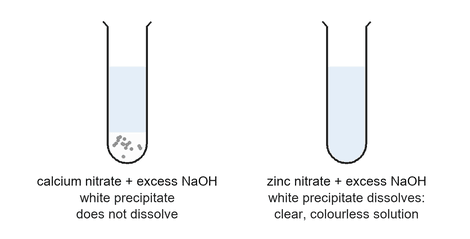
Step 3 — Add excess NaOH.
Now the two tubes behave differently:
- with calcium nitrate, the white precipitate does not dissolve (calcium hydroxide is only sparingly soluble);
- with zinc nitrate, the white gelatinous precipitate dissolves, giving a colourless solution of sodium zincate.
Step 4 — Another test.
With ammonium hydroxide, calcium nitrate gives no precipitate at all, while zinc nitrate gives a white precipitate that dissolves in excess; this also distinguishes them.
Watch out: The first few drops give a white precipitate in both tubes; the difference shows only in excess NaOH.
Therefore, with excess sodium hydroxide the white precipitate from calcium nitrate stays, while the one from zinc nitrate dissolves to a colourless solution.
- 283 marks
Question 28
You are provided with two reagent bottles marked A and B. One contains solution and the other contains NaOH solution. How will you identify them by a chemical test ?
Solve with AIWritten solution
Solution:
Concept: Copper (II) hydroxide dissolves in excess , forming a deep blue ammine compound, but not in excess NaOH. So copper sulphate solution tells the two alkalis apart.
Step 1 — Set up the test.
Take copper sulphate solution in two test tubes. Add the liquid from bottle A to one tube and the liquid from bottle B to the other, first drop by drop and then in excess.
Step 2 — Add a few drops.
Both tubes show a pale blue precipitate of copper (II) hydroxide, so this stage does not yet identify the bottles.
Step 3 — Add excess: the ammonium hydroxide bottle.
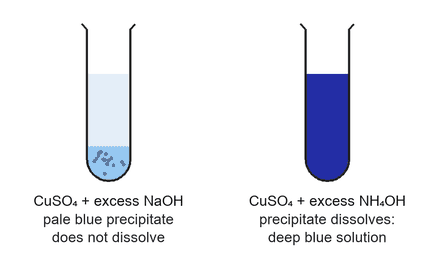
With ammonium hydroxide the precipitate dissolves to give a deep (inky) blue solution of tetraamminecopper (II) sulphate.
Step 4 — Add excess: the sodium hydroxide bottle.
With sodium hydroxide the pale blue precipitate does not dissolve.
Watch out: The same copper sulphate test must be done with both bottles, and the decision is made only after excess has been added.
Therefore, the bottle whose liquid turns the pale blue precipitate into a deep blue solution contains ; the other bottle contains NaOH.
- 295 marks
Question 29
Write balanced equations for the following conversions
(a) .
(b)
Solve with AIWritten solution
Solution:
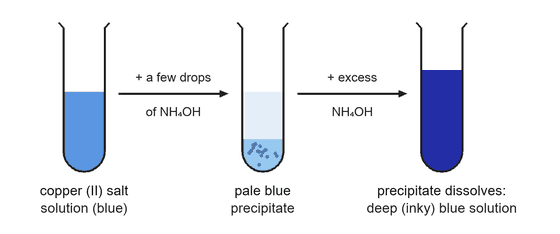
Concept: In each scheme, A is a little alkali, which precipitates the metal hydroxide, and B is an excess of the same alkali, which dissolves the precipitate. The final product tells us which alkali is used.
Step 1 — (a) Identify the alkali.
The product contains sodium, so the alkali in (a) is sodium hydroxide.
Step 2 — (a) Step A: a little NaOH.
A white gelatinous precipitate of zinc hydroxide forms.
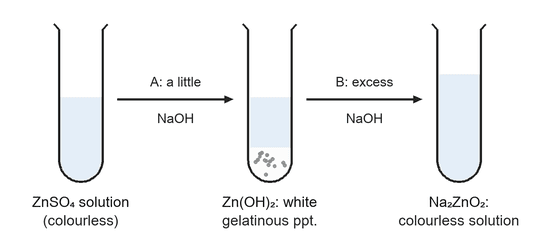
Step 3 — (a) Step B: excess NaOH.
The amphoteric zinc hydroxide dissolves, forming colourless sodium zincate.
Step 4 — (b) Identify the alkali.
The product contains ammonia, so the alkali in (b) is ammonium hydroxide.
Step 5 — (b) Step A: a little NH₄OH.
A pale blue precipitate of copper (II) hydroxide forms.
Step 6 — (b) Step B: excess NH₄OH.
The precipitate dissolves, giving a deep blue solution of tetraamminecopper (II) sulphate.
Watch out: In (b) the alkali must be NH₄OH; excess NaOH does not dissolve copper (II) hydroxide.
Therefore, (a) ZnSO₄ + 2NaOH → Zn(OH)₂↓ + Na₂SO₄ and Zn(OH)₂ + 2NaOH → Na₂ZnO₂ + 2H₂O; (b) CuSO₄ + 2NH₄OH → Cu(OH)₂↓ + (NH₄)₂SO₄ and Cu(OH)₂ + (NH₄)₂SO₄ + 2NH₄OH → [Cu(NH₃)₄]SO₄ + 4H₂O.
- 305 marks
Question 30
(a) What do you understand by amphoteric oxide ?
(b) Give the balanced equations for the reaction with two different amphoteric oxides with a caustic alkali.
(c) Name the products formed.
Solve with AIWritten solution
Solution:
Concept: Most metal oxides are basic: they react only with acids. A few, those of zinc, aluminium and lead, show both basic and acidic character.
Step 1 — (a) Define an amphoteric oxide.
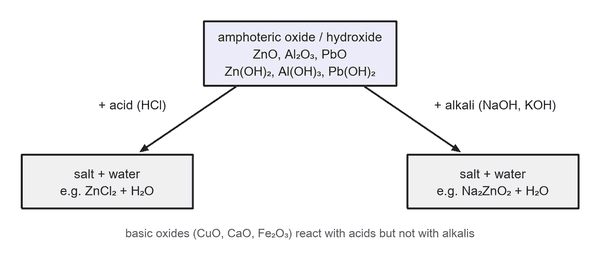
An amphoteric oxide is a metallic oxide that reacts with both acids and alkalis to form a salt and water. Examples are zinc oxide (ZnO), aluminium oxide () and lead (II) oxide (PbO). With an acid, zinc oxide acts as a base:
Step 2 — (b) Zinc oxide with caustic soda.
With an alkali, zinc oxide acts as an acid and forms a salt and water:
Step 3 — (b) Aluminium oxide with caustic soda.
Aluminium oxide reacts in the same way:
Step 4 — (c) Name the products.
The products of the two reactions are:
- with zinc oxide: sodium zincate (, soluble and colourless) and water;
- with aluminium oxide: sodium meta-aluminate (sodium aluminate, ) and water.
Watch out: The salt formed with an alkali has the metal in the anion (zincate, aluminate), not a metal hydroxide.
Therefore, (a) an amphoteric oxide reacts with both acids and alkalis to form salt and water; (b) ZnO + 2NaOH → Na₂ZnO₂ + H₂O and Al₂O₃ + 2NaOH → 2NaAlO₂ + H₂O; (c) the products are sodium zincate and water, and sodium meta-aluminate and water.
- 315 marks
Question 31
On adding dilute ammonia solution to a colourless solution of a salt, a white gelatinous precipitate appears. This precipitate however dissolves on addition of excess of ammonia solution.
(a) From the following list, identify which metal salt solution is used above ?
Na, Al, Zn, Pb, Fe
(b) What is the formula of the white gelatinous precipitate obtained ?
(c) Give the balanced equation(s) when sulphate of this metal reacts with ammonia solution in excess.
Solve with AIWritten solution
Solution:
Concept: With ammonia solution, the only metal in the list whose hydroxide is white and gelatinous and dissolves in excess is zinc, because zinc hydroxide forms a soluble ammine compound.
Step 1 — (a) Test each metal in the list.
We check each metal against both clues:
- Na: sodium hydroxide is soluble, so no precipitate forms;
- Fe: iron salts give coloured precipitates (dirty green or reddish brown);
- Pb: a chalky white precipitate, insoluble in excess ammonia;
- Al: a white gelatinous precipitate, but insoluble in excess ammonia;
- Zn: a white gelatinous precipitate that dissolves in excess ammonia.
So the salt is a salt of zinc (Zn).
Step 2 — (b) Give the formula of the precipitate.
The white gelatinous precipitate is zinc hydroxide, .
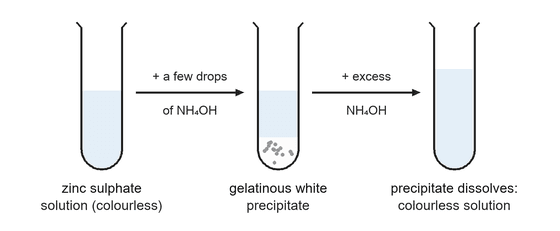
Step 3 — (c) Zinc sulphate with a little ammonia solution.
The precipitate forms first:
Step 4 — (c) Zinc sulphate with excess ammonia solution.
The precipitate dissolves to a colourless solution of tetraamminezinc (II) sulphate.
Watch out: Aluminium also gives a white gelatinous precipitate, but it does not dissolve in excess ammonia.
Therefore, (a) the salt is of zinc; (b) the precipitate is Zn(OH)₂; (c) ZnSO₄ + 2NH₄OH → Zn(OH)₂↓ + (NH₄)₂SO₄, then Zn(OH)₂ + (NH₄)₂SO₄ + 2NH₄OH → [Zn(NH₃)₄]SO₄ + 4H₂O.
What Class 10 Chemistry Ch 4 covers
The sections of the chapter, in the order the book takes them. Every question above comes from one of these.
- 01Colours of the Salts and Their Solutions
- 02Action of Sodium Hydroxide Solution on Salt Solutions
- 03Action of Ammonium Hydroxide on Certain Salt Solutions
- 04Action of Alkalis on Certain Metals
- 05Action of Alkalis on Metal Oxides
More ways to study this chapter
The same chapter asked three other ways. Practise it, revise it, and see what the board has set on Ch 4 before.
- Competency-Based Questions (CBQ)Case study questions: a situation, and the part of the chapter that answers it.40questionsOpen
- Previous Year QuestionsQuestions that have actually appeared in board papers, each tagged with its year.39questionsOpen
- Practice QuestionsExtra questions per chapter, for when one attempt at a method is not enough.47questionsOpen
Ch 4 in past ICSE papers
The same chapter as the board has actually asked it. These are worded differently from the textbook exercise, which is the point of reading them.
- 11 mark
Board paper question 1
Fill in the blanks with the choices given in brackets.
............... (AgCl / ), a white precipitate is soluble in excess .
Solve with AIWritten solution
Solution:
Concept: Silver chloride and lead chloride are both white solids that do not dissolve in water. Ammonium hydroxide dissolves silver chloride by forming a soluble complex, but it does not dissolve lead chloride.
Step 1 — Look at what the blank asks for.
The blank needs the white precipitate that dissolves in excess . So we test each choice against ammonium hydroxide.
Step 2 — Silver chloride dissolves.
Silver chloride reacts with ammonium hydroxide to form diammine silver (I) chloride, which is soluble in water, so the white solid disappears:
Step 3 — Lead chloride does not dissolve.
Lead ions form a chalky white solid with ammonium hydroxide that stays even in excess , so lead chloride does not fit the blank.

Watch out: Both chlorides are white, so the colour does not help; only their behaviour in excess NH₄OH decides it.
Therefore, the answer is AgCl: AgCl (silver chloride), a white precipitate, is soluble in excess NH₄OH.
- 22 marks
Board paper question 2
State your observations when ammonium hydroxide solution is added drop by drop and then in excess to each of the following solutions:
(i) copper sulphate solution
(ii) zinc sulphate solution.
Solve with AIWritten solution
Solution:
Concept: When an alkali is added to a salt solution, its hydroxide ions () join the metal ions and form the metal hydroxide. Most metal hydroxides are insoluble in water, so they appear as a precipitate. The colour of the precipitate, and whether it dissolves when more alkali is added, tell us which metal ion is present. Copper (II) hydroxide and zinc hydroxide dissolve in excess ammonium hydroxide because they form soluble ammine complexes: tetraammine copper (II) ions, which are deep (inky) blue, and tetraammine zinc (II) ions, which are colourless.
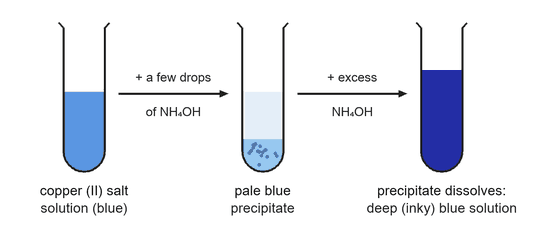
Step 1 — (i) Copper sulphate: add NH₄OH drop by drop.
The few ions from the first drops join the copper (II) ions, so a pale blue precipitate of copper (II) hydroxide forms:
Step 2 — (i) Copper sulphate: add excess NH₄OH.
In excess ammonium hydroxide the pale blue precipitate dissolves, giving a deep (inky) blue solution of tetraammine copper (II) sulphate:
Step 3 — (ii) Zinc sulphate: add NH₄OH drop by drop.
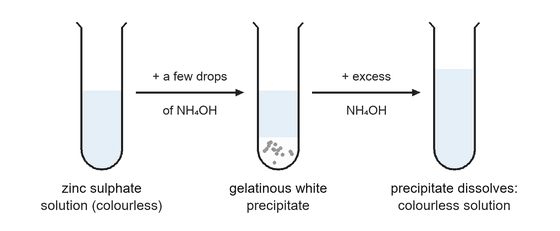
The ions join the zinc ions, so a white gelatinous precipitate of zinc hydroxide forms:
Step 4 — (ii) Zinc sulphate: add excess NH₄OH.
In excess ammonium hydroxide the white precipitate dissolves, giving a colourless solution of tetraammine zinc (II) sulphate:
Watch out: Both precipitates dissolve in excess NH₄OH; what tells them apart is the colour: pale blue → deep blue for copper, white → colourless for zinc.
Therefore, (i) copper sulphate gives a pale blue precipitate that dissolves in excess NH₄OH to a deep (inky) blue solution; (ii) zinc sulphate gives a white gelatinous precipitate that dissolves in excess NH₄OH to a colourless solution.
- 33 marks
Board paper question 3
Identify the cations in each of the following case:
(i) NaOH solution when added to the solution 'A' gives a reddish brown precipitate.
(ii) solution when added to the solution 'B' gives a white ppt which does not dissolve in excess.
(iii) NaOH solution when added to the solution 'C' gives a white ppt which is insoluble in excess.
Solve with AIWritten solution
Solution:
Concept: When an alkali is added to a salt solution, its hydroxide ions () join the metal ions and form the metal hydroxide. Most metal hydroxides are insoluble in water, so they appear as a precipitate. The colour of the precipitate, and whether it dissolves when more alkali is added, tell us which metal ion is present. Ammonium hydroxide is a weak alkali: it is only slightly ionised, so it gives only a few ions. Sodium hydroxide is a strong alkali and gives many ions.
Step 1 — (i) Reddish brown precipitate with NaOH.
Iron (III) hydroxide is the only reddish brown hydroxide in the tests we study, so solution A contains the iron (III) (ferric) ion:

Step 2 — (ii) White precipitate with NH₄OH, insoluble in excess.
Zinc hydroxide is white but dissolves in excess , and calcium ions give no precipitate with at all. Lead hydroxide is chalky white and stays in excess , so solution B contains the lead ion:
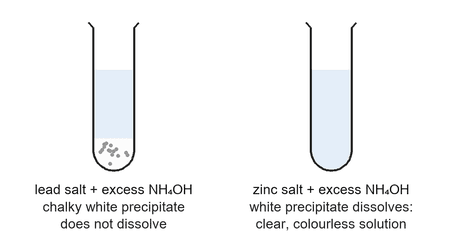
Step 3 — (iii) White precipitate with NaOH, insoluble in excess.
Zinc and lead also give white hydroxides with NaOH, but both dissolve in excess (as sodium zincate and sodium plumbite). Calcium hydroxide is white and only sparingly soluble, so it stays. Solution C contains the calcium ion:
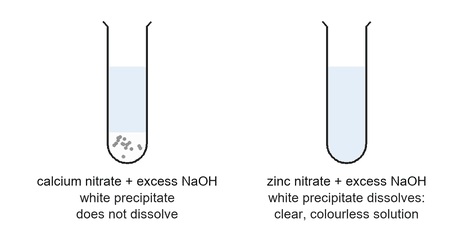
Watch out: In (ii) and (iii) the colour is white every time; the answer is decided by what happens in EXCESS of each alkali.
Note: Pb²⁺ and Ca²⁺ are the expected answers from the ions in the ICSE tables. Outside those tables, Al³⁺ also gives a white precipitate that stays in excess NH₄OH, and Mg²⁺ a white precipitate that stays in excess NaOH.
Therefore, (i) A contains Fe³⁺ (ferric ion); (ii) B contains Pb²⁺ (lead ion); (iii) C contains Ca²⁺ (calcium ion).
- 41 mark
Board paper question 4
A chloride which forms a precipitate that is soluble in excess of ammonium hydroxide, is:
Solve with AIAnswer
(A) Calcium chloride
(B) Ferrous chloride
(C) Ferric chloride
- Correct
(D) Copper chloride
Answer: (D) Copper chloride
Concept: When an alkali is added to a salt solution, its hydroxide ions () join the metal ions and form the metal hydroxide. Most metal hydroxides are insoluble in water, so they appear as a precipitate. The colour of the precipitate, and whether it dissolves when more alkali is added, tell us which metal ion is present. Copper (II) hydroxide and zinc hydroxide dissolve in excess ammonium hydroxide because they form soluble ammine complexes: tetraammine copper (II) ions, which are deep (inky) blue, and tetraammine zinc (II) ions, which are colourless.
Step 1 — Add a little NH₄OH to copper chloride.
Copper chloride solution contains copper (II) ions, which give a pale blue precipitate of copper (II) hydroxide:
Step 2 — Add excess NH₄OH.
In excess ammonium hydroxide the precipitate dissolves, forming a deep blue solution of tetraammine copper (II) chloride, so copper chloride is the chloride we want:
Watch out: The question needs TWO things: a precipitate forms, and then it dissolves in excess. Calcium chloride fails the first; the iron chlorides fail the second.
Why the other options are wrong:
- (A) Calcium chloride: calcium ions give no precipitate at all with ammonium hydroxide, because the ion concentration is too low to precipitate calcium hydroxide.
- (B) Ferrous chloride: it gives a dirty green precipitate of that does not dissolve in excess.
- (C) Ferric chloride: it gives a reddish brown precipitate of that does not dissolve in excess.
Therefore, the chloride is copper chloride, option (D).
- 51 mark
Board paper question 5
Identify the substance underlined, in each of the following cases:
Cation that does not form a precipitate with ammonium hydroxide but forms one with sodium hydroxide.
Solve with AIWritten solution
Solution:
Concept: Ammonium hydroxide is a weak alkali: it is only slightly ionised, so it gives only a few ions. Sodium hydroxide is a strong alkali and gives many ions.
Step 1 — Find the ion that NH₄OH cannot precipitate.
The few ions from ammonium hydroxide are enough to precipitate the hydroxides of iron, copper, zinc and lead, but not calcium hydroxide, which is much more soluble in water than those hydroxides. So a calcium salt solution shows no precipitate, even with excess .
Step 2 — Check that NaOH does precipitate it.
Sodium hydroxide gives many ions, enough to exceed the small solubility of calcium hydroxide, so a white precipitate forms. For example, with calcium nitrate:

Watch out: Every other cation in the tables gives a precipitate with BOTH alkalis; calcium is the only one that needs the strong alkali.
Therefore, the cation is the calcium ion, Ca²⁺.
- 61 mark
Board paper question 6
State one relevant observation for each of the following reactions:
Action of Sodium hydroxide solution on ferrous sulphate solution.
Solve with AIWritten solution
Solution:
Concept: When an alkali is added to a salt solution, its hydroxide ions () join the metal ions and form the metal hydroxide. Most metal hydroxides are insoluble in water, so they appear as a precipitate. The colour of the precipitate, and whether it dissolves when more alkali is added, tell us which metal ion is present.
Step 1 — Name the ion present.
Ferrous sulphate solution contains the iron (II) ion, , so sodium hydroxide will precipitate iron (II) hydroxide.
Step 2 — Write the reaction and the observation.
Iron (II) hydroxide is a dirty green, gelatinous precipitate, and it does not dissolve in excess sodium hydroxide:
Watch out: Dirty green is iron (II); reddish brown is iron (III). Don't mix up ferrous and ferric.
Therefore, a dirty green precipitate of iron (II) hydroxide forms, which is insoluble in excess sodium hydroxide.
All 39 board paper questions for this chapter, solved the same way.
Class 10 Chemistry Ch 4 questions students ask
How many questions are there in Class 10 Chemistry Ch 4?
31 questions. Every one is solved step by step on this page.
Are these Class 10 Chemistry solutions free?
Yes. Every question and its full working is free to read, with no account needed.
Can I download the Class 10 Chemistry Ch 4 solutions as a PDF?
There is no PDF to download. Every solution is on this page instead, which means it is searchable, always the current syllabus, and readable on a phone. Use your browser's print option if you want it on paper.