
Question 15 marksEasy
What do you understand by the following :
(a) Analysis (b) Qualitative analysis
(c) Reagent (d) Precipitation
Confirming your payment
Sign up now and get 250 free tokens.
Analytical Chemistry · Question 1 of 31
What do you understand by the following :
(a) Analysis (b) Qualitative analysis
(c) Reagent (d) Precipitation
Solution:
Concept: Analytical chemistry is the branch of chemistry that finds out what a substance contains and how much of each part it contains. In the laboratory this is done with chemical tests that give something we can see, such as a coloured precipitate.
Step 1 — (a) Analysis.
Analysis is the determination of the chemical components present in a given sample. It is of two types:
Step 2 — (b) Qualitative analysis.
Qualitative analysis is the identification of an unknown substance by carrying out chemical tests on it with the help of reagents. For example, if a salt solution gives a pale blue precipitate with sodium hydroxide solution, we conclude that it contains the copper (II) ion, .
Step 3 — (c) Reagent.
A reagent is a substance that reacts with another substance and is used to detect (identify) it. Alkalis such as sodium hydroxide (NaOH) and ammonium hydroxide () are important laboratory reagents, because they give characteristic coloured precipitates of metal hydroxides with salt solutions.
Step 4 — (d) Precipitation.
Precipitation is the process in which an insoluble solid is formed when two solutions are mixed. The insoluble solid is called the precipitate; only a compound that is insoluble in water can come out as a precipitate. For example, iron (III) chloride solution and sodium hydroxide solution give a reddish brown precipitate of iron (III) hydroxide, while sodium chloride stays dissolved.
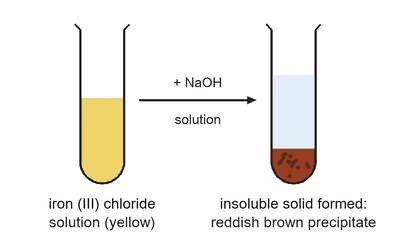
Watch out: 'precipitate' is the solid; 'precipitation' is the process that forms it. Do not mix up the two words.
Therefore, (a) analysis is finding the chemical components of a sample; (b) qualitative analysis is identifying them by chemical tests with reagents; (c) a reagent is a substance used to detect another substance by reacting with it; (d) precipitation is the formation of an insoluble solid (the precipitate) when two solutions are mixed.