
Question 235 marksMedium
What do you observe when caustic soda solution is added, first a little and then in excess, to the following solutions:
(a) (b)
(c) (d)
Write balanced equations for the above reactions.
Confirming your payment
Sign up now and get 250 free tokens.
Analytical Chemistry · Question 23 of 31
What do you observe when caustic soda solution is added, first a little and then in excess, to the following solutions:
(a) (b)
(c) (d)
Write balanced equations for the above reactions.
Solution:
Concept: Caustic soda (NaOH) first precipitates the metal hydroxide. In excess it dissolves only the amphoteric hydroxides (of zinc and lead), forming soluble sodium zincate and sodium plumbite. Iron and copper hydroxides are not amphoteric, so they stay.
Step 1 — (a) FeCl₃.
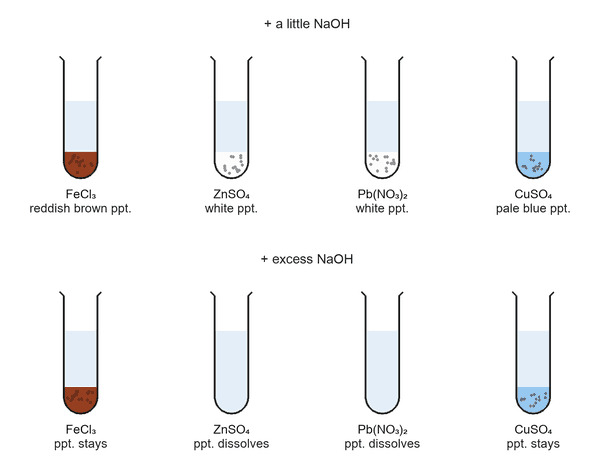
A reddish brown precipitate of iron (III) hydroxide forms, and it is insoluble in excess.
Step 2 — (b) ZnSO₄, a little.
A white gelatinous precipitate of zinc hydroxide forms.
Step 3 — (b) ZnSO₄, in excess.
The precipitate dissolves, giving a colourless solution of sodium zincate.
Step 4 — (c) Pb(NO₃)₂, a little.
A chalky white precipitate of lead hydroxide forms.
Step 5 — (c) Pb(NO₃)₂, in excess.
The precipitate dissolves, giving a colourless solution of sodium plumbite.
Step 6 — (d) CuSO₄.
A pale blue precipitate of copper (II) hydroxide forms, and it is insoluble in excess NaOH.
Watch out: Copper hydroxide dissolves in excess NH₄OH but not in excess NaOH; do not carry the ammonia result over.
Therefore, (a) FeCl₃ gives a reddish brown precipitate, insoluble in excess; (b) ZnSO₄ gives a white gelatinous precipitate, soluble in excess; (c) Pb(NO₃)₂ gives a chalky white precipitate, soluble in excess; (d) CuSO₄ gives a pale blue precipitate, insoluble in excess.