
Question 225 marksMedium
What happens when ammonia solution is added first dropwise and then in excess to the following solutions :
(i) (ii) (iii) .
Write balanced equations for these reactions.
Confirming your payment
Sign up now and get 250 free tokens.
Analytical Chemistry · Question 22 of 31
What happens when ammonia solution is added first dropwise and then in excess to the following solutions :
(i) (ii) (iii) .
Write balanced equations for these reactions.
Solution:
Concept: Ammonia solution () first precipitates the metal hydroxide. In excess it dissolves only the hydroxides of copper and zinc, because these form soluble ammine compounds; iron (III) hydroxide stays.
Step 1 — (i) CuSO₄, dropwise.
The blue solution gives a pale blue precipitate of copper (II) hydroxide.
Step 2 — (i) CuSO₄, in excess.
The precipitate dissolves to give a deep (inky) blue solution of tetraamminecopper (II) sulphate.
Step 3 — (ii) ZnSO₄, dropwise.
The colourless solution gives a white gelatinous precipitate of zinc hydroxide.
Step 4 — (ii) ZnSO₄, in excess.
The precipitate dissolves to give a colourless solution of tetraamminezinc (II) sulphate.
Step 5 — (iii) FeCl₃, dropwise.
The yellow solution gives a reddish brown precipitate of iron (III) hydroxide.
Step 6 — (iii) FeCl₃, in excess.
Iron (III) hydroxide does not form an ammine compound, so the reddish brown precipitate is insoluble and stays.
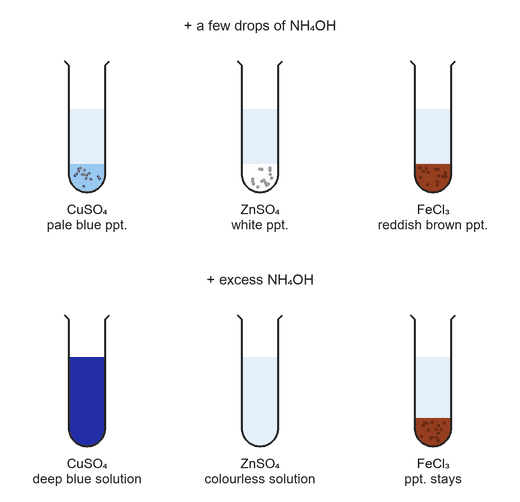
Watch out: Both copper and zinc hydroxides dissolve in excess ammonia; only copper gives a deep blue colour.
Therefore, (i) CuSO₄ gives a pale blue precipitate that dissolves in excess to a deep blue solution; (ii) ZnSO₄ gives a white gelatinous precipitate that dissolves in excess to a colourless solution; (iii) FeCl₃ gives a reddish brown precipitate that is insoluble in excess.