
Question 44 marksMedium
Name the metal hydroxides which are :
(a) Insoluble (b) Soluble
in (i) Caustic soda solution (ii) Ammonium hydroxide solution.
Confirming your payment
Sign up now and get 250 free tokens.
Analytical Chemistry · Question 4 of 31
Name the metal hydroxides which are :
(a) Insoluble (b) Soluble
in (i) Caustic soda solution (ii) Ammonium hydroxide solution.
Solution:
Concept: When an alkali is added to a metal salt solution, the metal hydroxide precipitates. Whether that precipitate dissolves in excess alkali depends on the alkali: excess caustic soda dissolves only the amphoteric hydroxides (zinc, lead, aluminium); excess ammonium hydroxide dissolves only the hydroxides of copper and zinc, which form soluble ammine compounds.
Step 1 — (a)(i) Insoluble in caustic soda solution.
These hydroxides are not amphoteric, so they stay as precipitates in excess NaOH:
Step 2 — (a)(ii) Insoluble in ammonium hydroxide solution.
These hydroxides do not form soluble ammine compounds, so they stay as precipitates in excess ammonium hydroxide:
Step 3 — (b)(i) Soluble in caustic soda solution.
Being amphoteric, , and react with excess NaOH and dissolve. For zinc hydroxide the colourless product is sodium zincate.
Step 4 — (b)(ii) Soluble in ammonium hydroxide solution.
and dissolve in excess ammonium hydroxide. Copper (II) hydroxide gives a deep blue solution of tetraamminecopper (II) sulphate.
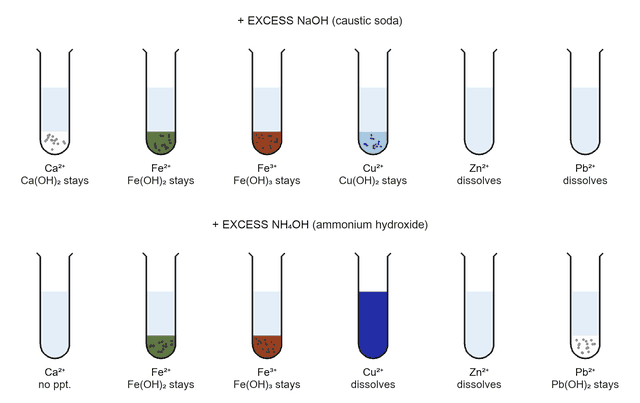
Watch out: Zinc hydroxide is the only one that dissolves in excess of both alkalis; lead hydroxide dissolves in NaOH but not in NH₄OH, and copper hydroxide does the opposite.
Therefore, (a) insoluble: (i) in caustic soda, , and (also ); (ii) in ammonium hydroxide, , and (also ). (b) Soluble: (i) in caustic soda, and (also ); (ii) in ammonium hydroxide, and .