
Opening your dashboard
Class 10 Chemistry Chapter 4 Analytical Chemistry: Competency-Based Questions (CBQ)
40 questions on Chapter 4, each worked through on its own page with the AI tutor. Class 10 Chemistry, ICSE 2026-27.
40 questions
1–5 marks · Mixed difficulty
- 11 mark
Question 1
Cognitive domain: Understanding · CISCE Competency-Focused Practice Questions 2024, Q1
Ravi was asked to identify the cation present in the salt solution. He added one of the reagents given below and got a reddish-brown precipitate. The reagent that he used is:
- 23 marks
Question 2
Cognitive domain: Understanding & Application · CISCE Competency-Focused Practice Questions 2024, Q114
Observe the reactions given below and answer the following questions:

(a) Identify compound P.
(b) Give the chemical formula of Z.
(c) Write the reaction taking place between the identified compound P and sulphuric acid.
(d) Name compound Y.
- 31 mark
Question 3
Cognitive domain: Analysis
For a 'colours of chemistry' table at the school science fair, Tanvi dissolves four salts in water and notes the colour of each solution.
Salt dissolved Ions in the solution Colour of the solution potassium chloride and colourless potassium dichromate and orange chromium(III) chloride and green potassium chromate and yellow Which conclusion do her results support?
- 41 mark
Question 4
Cognitive domain: Application
Ira and Joseph are each given a portion of the same colourless salt solution to test with sodium hydroxide solution. Joseph adds the alkali one drop at a time. He sees a white precipitate, which disappears as he goes on adding the alkali. Ira is in a hurry and pours in a large amount of the alkali at once. She sees only a clear, colourless liquid and writes 'no precipitate'.
The salt solution could be either of which pair?
- 51 mark
Question 5
Cognitive domain: Application
A pottery studio has a jar of grey powder, which is a mixture of white zinc oxide and black copper(II) oxide. Copper(II) oxide is a basic oxide. To separate the two, Lakshmi warms the powder with an excess of hot, concentrated sodium hydroxide solution, stirs well and filters.
What does she obtain?
- 61 mark
Question 6
Cognitive domain: Understanding
Assertion (A): The white precipitate formed when ammonium hydroxide solution is added to lead nitrate solution dissolves when excess ammonium hydroxide is added.
Reason (R): Lead hydroxide is an amphoteric hydroxide and dissolves in excess sodium hydroxide solution to form soluble sodium plumbite.
- 71 mark
Question 7
Cognitive domain: Analysis
Assertion (A): Freshly precipitated aluminium hydroxide dissolves when caustic soda solution is added to it.
Reason (R): Aluminium hydroxide reacts with dilute hydrochloric acid to form a salt and water.
- 81 mark
Question 8
Cognitive domain: Understanding
A farmer finds an old bag of white fertiliser crystals whose label has been torn off. His daughter Nandini warms a pinch of the crystals with sodium hydroxide solution in a test tube. A colourless gas with a sharp, pungent smell comes off.
Fill in the blanks.
The gas turns moist ________ litmus paper ________, so the gas is ________. This shows that the fertiliser is a salt containing the ________ ion.
- 91 mark
Question 9
Cognitive domain: Application
Anjali warms a little yellow lead(II) oxide with concentrated caustic potash solution. The yellow solid disappears and a colourless solution is left. A second portion of the yellow oxide also dissolves when it is warmed with dilute nitric acid.
Name the salt present in the colourless solution made with caustic potash, and give the one word that describes an oxide which behaves in this way.
- 101 mark
Question 10
Cognitive domain: Application
Dev adds sodium hydroxide solution, a little at a time, to copper(II) sulphate solution until no more precipitate forms. Without filtering, he then pours an excess of ammonium hydroxide solution into the same test tube and shakes it.
Predict what Dev sees after adding the ammonium hydroxide, and name the kind of copper compound responsible for it.
- 112 marks
Question 11
Cognitive domain: Application
To fill soap bubbles with hydrogen for a classroom demonstration, a teacher drops 2.7 g of clean aluminium foil into an excess of boiling sodium hydroxide solution. All the foil reacts.
(a) Write the balanced equation for the reaction and name the salt formed.
(b) Calculate the volume of hydrogen formed, measured at S.T.P. (Al = 27; one mole of a gas occupies 22.4 litres at S.T.P.)
- 122 marks
Question 12
Cognitive domain: Evaluation
To save money, the laboratory in-charge of a school proposes: "Ammonium hydroxide solution can do everything that sodium hydroxide solution does when we test salts. So we need not buy sodium hydroxide for salt analysis."
Evaluate this proposal. Support your answer with two tests in which ammonium hydroxide cannot do the work of sodium hydroxide.
- 134 marks
Question 13
Cognitive domain: Analysis
Zinc sulphate is spread on paddy fields whose soil is short of zinc. Ferrous sulphate is sprayed on crops whose leaves turn yellow for want of iron. Copper sulphate is mixed with lime to make Bordeaux mixture, which protects grapevines from fungus. Calcium nitrate is a fertiliser. In Harpreet's farm shed, the packets of these four salts have lost their labels. His niece Simran dissolves a little from each packet in water and adds sodium hydroxide solution to each, drop by drop and then in excess.
Packet Crystals Solution With a little NaOH With excess NaOH 1 white colourless white precipitate precipitate remains 2 light green light green dirty green precipitate precipitate remains 3 white colourless white gelatinous precipitate precipitate dissolves 4 blue blue pale blue precipitate precipitate remains (a) Identify the salt in each packet. Which two packets could Simran have named from their colour alone, and which ion gives each of them its colour?
(b) Write the equations for the two changes seen with packet 3, and state what the second change shows about the precipitate.
(c) Simran keeps the solution of packet 2 in an open beaker. A week later it has turned yellowish brown, and it now gives a reddish-brown precipitate with sodium hydroxide. In this time, oxygen from the air has changed the metal ion into another ion of the same metal. Identify the ion now present and explain how both new observations support your answer.
- 144 marks
Question 14
Cognitive domain: Evaluation
A small scrap unit recovers iron from old galvanised (zinc-coated) iron sheets. The supervisor, Mrs Fernandes, soaks the cut sheets in a tank of hot, concentrated caustic soda solution. Bubbles of a colourless gas rise from every sheet. After some time the bubbling stops by itself, although plenty of alkali is left in the tank. The sheets are then lifted out, washed and sold as clean iron. Iron does not react with caustic soda solution. A trainee, Imran, says that dilute hydrochloric acid would do the same job and should be used in the tank instead.
(a) Name the gas and the salt formed in the tank, and write the balanced equation for the reaction.
(b) Explain why the bubbling stops by itself, and state one safety precaution that is needed near the tank, with a reason.
(c) Evaluate Imran's suggestion.
- 155 marks
Question 15
Cognitive domain: Creativity
For the school science exhibition, Zara's team wants to make a 'magic painting'. A picture is painted on thick white filter paper with dilute salt solutions, which leave only faint marks. When the paper is sprayed with a colourless reagent, the picture appears in colour.
The team has dilute solutions of iron(III) chloride, iron(II) sulphate, copper(II) sulphate, zinc sulphate, lead nitrate and calcium nitrate, and two spray bottles, one of ammonium hydroxide solution and one of sodium hydroxide solution. The picture needs a reddish-brown tree trunk, dirty green leaves and a blue pond.
Design the painting.
(a) State which solution you would use to paint each of the three parts, and name the coloured substance that appears in each part when the paper is sprayed lightly with ammonium hydroxide.
(b) Write balanced equations for the three reactions in (a).
(c) The team wants the pond to change from pale blue to deep blue while visitors watch. State what they should do and which spray bottle they must use, and explain the change.
(d) A teammate wants to add a white cloud that vanishes when it is sprayed a second time with ammonium hydroxide. Which solution should be used to paint the cloud? Explain why neither lead nitrate nor calcium nitrate would work.
- 161 mark
Question 16
Cognitive domain: Analysis
In a school laboratory, a student pours copper(II) sulphate, iron(II) sulphate, iron(III) chloride and lead nitrate solutions into four test tubes, P, Q, R and S, but not in this order. To each tube she adds ammonium hydroxide solution a little at a time until it is in excess, and then lets the tube stand. The figure shows what each tube looks like at the end.

Which option gives the correct salt solution in each tube?
- 171 mark
Question 17
Cognitive domain: Understanding
At a 'spot the difference' stall, Mehul is given four pairs of salt solutions and must say whether the two solutions in each pair can be told apart just by looking at their colours. For which pair is this not possible?
- 181 mark
Question 18
Cognitive domain: Application
A technician dissolves 7.8 g of freshly precipitated aluminium hydroxide in hot caustic soda solution. The reaction is
What mass of sodium hydroxide is needed to dissolve all of the aluminium hydroxide? (Al = 27, O = 16, H = 1, Na = 23)
- 191 mark
Question 19
Cognitive domain: Analysis
Assertion (A): A solution of iron(II) sulphate is light green, but a solution of iron(III) chloride is yellow.
Reason (R): The anions in the two solutions, sulphate and chloride, are different.
- 201 mark
Question 20
Cognitive domain: Understanding
Assertion (A): After a lead nitrate test, a test tube coated with chalky white lead hydroxide can be cleaned by rinsing it with dilute acetic acid.
Reason (R): Towards an acid, lead hydroxide behaves as a base and gives water and lead acetate, a salt that dissolves in water.
- 211 mark
Question 21
Cognitive domain: Evaluation
Four pupils each write the 'expected observation' for a test in their laboratory notebooks. Exactly one entry is wrong. Which entry is wrong?
- 221 mark
Question 22
Cognitive domain: Application
Aanya drops 5.4 g of aluminium foil into one flask and 13.0 g of zinc granules into another flask. Each flask holds an excess of boiling concentrated sodium hydroxide solution, and both metals react completely. (Al = 27, Zn = 65)
Which statement compares the hydrogen collected from the two flasks at the same temperature and pressure?
- 231 mark
Question 23
Cognitive domain: Analysis
A student adds sodium hydroxide solution slowly from a burette to a beaker holding a salt solution. After every few cm³ she weighs the precipitate present and plots the graph below.
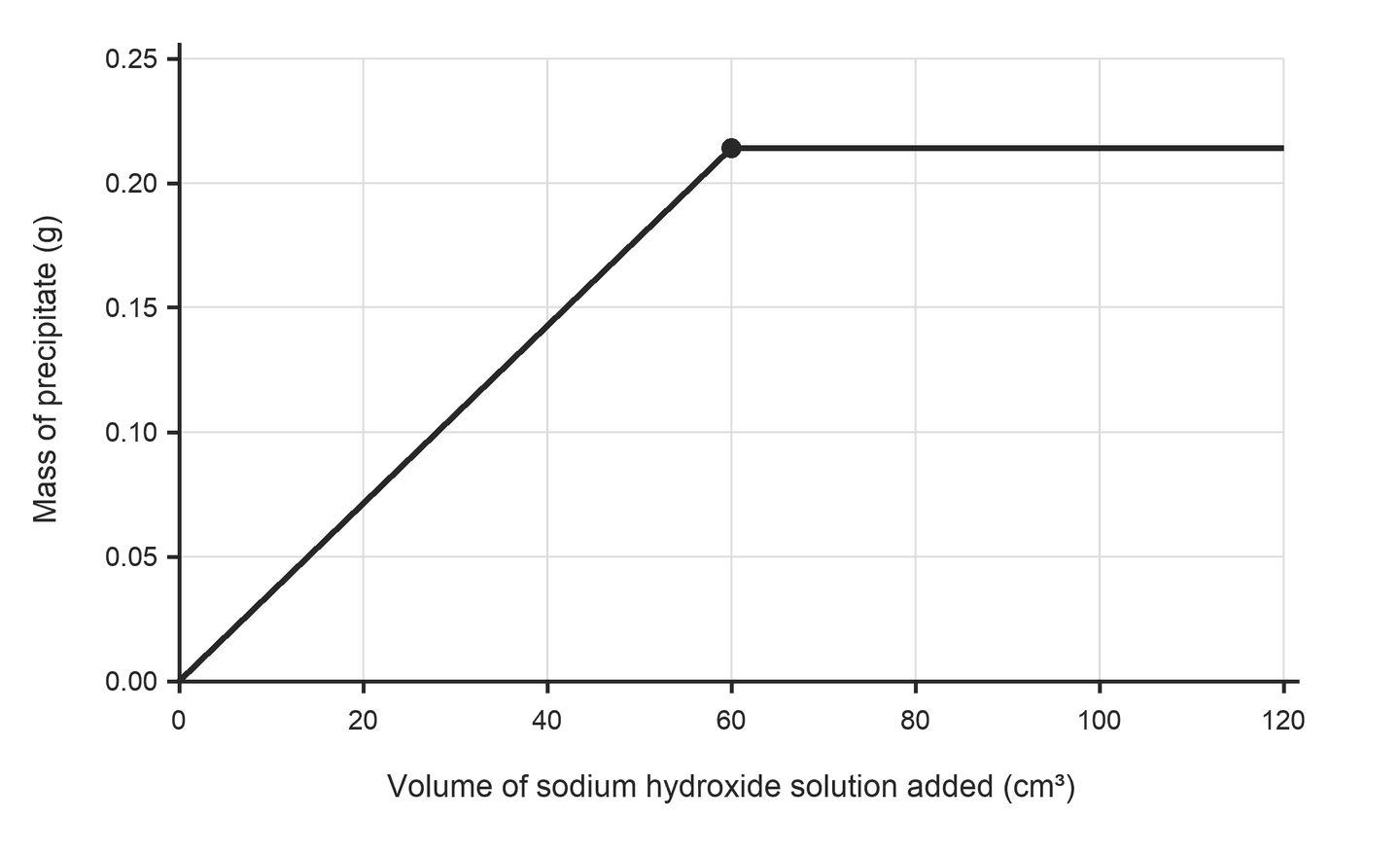
Which salt solution was in the beaker?
- 241 mark
Question 24
Cognitive domain: Evaluation
A teacher writes four statements on the board and asks the class to decide which are correct.
-
Zinc oxide reacts with both dilute hydrochloric acid and sodium hydroxide solution to form a salt and water.
-
Copper(II) oxide dissolves in hot concentrated sodium hydroxide solution, because every metal oxide is amphoteric.
-
Sodium zincate, formed when zinc oxide reacts with sodium hydroxide, is a colourless salt that dissolves in water.
-
Aluminium hydroxide is amphoteric, so it reacts with acids but not with alkalis.
Which statements are correct?
-
- 251 mark
Question 25
Cognitive domain: Application
Aluminium reacts with boiling sodium hydroxide solution to form sodium meta-aluminate, , and with fused (molten, water-free) sodium hydroxide to form sodium aluminate, . Hydrogen is given off in both reactions. A technician treats two samples of aluminium turnings, each of mass 8.1 g, one by each method, until all the metal has reacted. (Al = 27)
Which statement about the two methods is correct?
- 262 marks
Question 26
Cognitive domain: Application
For a demonstration, a teacher drops 6.5 g of zinc granules into an excess of hot concentrated sodium hydroxide solution. All the zinc reacts. (Zn = 65, Na = 23, O = 16, H = 1)
(a) Write the balanced equation for the reaction.
(b) Calculate the mass of sodium hydroxide that reacts and the mass of sodium zincate that forms.
- 272 marks
Question 27
Cognitive domain: Analysis
Kabir tests a white crystalline solid to find out whether it is an ammonium salt. He warms a little of it with sodium hydroxide solution in a test tube and holds a strip of moist red litmus paper at the mouth of the tube, taking care that the paper does not touch the glass or the liquid.
(a) Why must the litmus paper be moist, and why must it not touch the glass or the liquid?
(b) Why is the mixture warmed? If the paper turns blue, what can Kabir conclude?
- 282 marks
Question 28
Cognitive domain: Application
A student wants to collect 224 cm³ of ammonia, measured at S.T.P., by warming ammonium chloride with an excess of sodium hydroxide solution. (N = 14, H = 1, Cl = 35.5; one mole of a gas occupies 22.4 dm³ at S.T.P.)
(a) Write the balanced equation for the reaction.
(b) Calculate the mass of ammonium chloride she must use, assuming that all of it reacts.
- 292 marks
Question 29
Cognitive domain: Evaluation
A small workshop etches copper circuit boards with iron(III) chloride solution, which dissolves the unwanted copper. The used liquid contains copper(II) ions and iron(II) ions formed during the etching, together with some iron(III) ions that have not reacted, all as chlorides. The owner must remove all the copper and iron as solids before the liquid goes to the drain. He can add an excess of either sodium hydroxide solution or ammonium hydroxide solution and then filter.
(a) Which alkali should he choose? Give a reason.
(b) State what the filter paper holds with the alkali you chose, and what would go wrong with the other alkali.
- 302 marks
Question 30
Cognitive domain: Analysis
On the shelf of a workshop are two white powders, P and Q, with their labels lost. One is ammonium chloride (used as a soldering flux) and the other is zinc oxide (used in skin ointment). A pupil warms a little of each with hot concentrated sodium hydroxide solution. Powder P gives off a colourless gas with a pungent smell, which turns moist red litmus paper blue. Powder Q dissolves to give a clear, colourless solution and no gas.
(a) Identify P and Q, giving a reason for each.
(b) Write the balanced equation for the reaction of Q with the alkali.
- 311 mark
Question 31
Cognitive domain: Recall
For a science club quiz, Tara prepares cards for coloured ions. Complete her answer key.
The ion gives a ________ solution, the ion gives a ________ solution and the ion gives a ________ solution.
- 323 marks
Question 32
Cognitive domain: Understanding
Precipitation is the formation of an insoluble solid when two solutions are mixed. Aditi mixes these pairs of solutions in separate test tubes:
(i) potassium nitrate solution and sodium hydroxide solution;
(ii) lead nitrate solution and sodium hydroxide solution (a little alkali);
(iii) copper(II) sulphate solution and sodium chloride solution.
Sodium sulphate, copper(II) chloride, potassium hydroxide and sodium nitrate all dissolve in water.
(a) Which mixture forms a precipitate? Name the precipitate and state its colour.
(b) For each of the other two mixtures, name the new compounds that could form and explain why no precipitate appears.
(c) Write the balanced equation for the precipitation.
- 333 marks
Question 33
Cognitive domain: Analysis
Neha writes three equations in her notebook for the action of hot concentrated alkali on metals.
(i)
(ii)
(iii)
(a) Decide which equation is correct, and show by counting atoms why.
(b) Correct each faulty equation and say what mistake Neha made.
- 343 marks
Question 34
Cognitive domain: Evaluation
Nikhil reads that zinc hydroxide dissolves in excess ammonium hydroxide, and he writes: "Every hydroxide that dissolves in excess ammonium hydroxide is amphoteric." His teacher gives him the results of tests on three hydroxides.
Hydroxide Excess ammonium hydroxide Excess sodium hydroxide Dilute nitric acid Copper(II) hydroxide dissolves does not dissolve dissolves Zinc hydroxide dissolves dissolves dissolves Lead hydroxide does not dissolve dissolves dissolves (a) Which hydroxides dissolve in excess ammonium hydroxide?
(b) Which of the three hydroxides are amphoteric? Give the test you used.
(c) Evaluate Nikhil's statement, using two of the hydroxides to support your answer.
- 353 marks
Question 35
Cognitive domain: Analysis
A metalworker wants to find the percentage of zinc in a 10.0 g sample of brass, an alloy of copper and zinc. Copper does not react with an alkali. He warms the sample with an excess of hot concentrated sodium hydroxide solution until the bubbling stops, and collects 1.12 dm³ of hydrogen at S.T.P. (Hypothetical data.) (Zn = 65; one mole of a gas occupies 22.4 dm³ at S.T.P.)
(a) Write the balanced equation for the reaction that gives hydrogen, and name the metal that reacts.
(b) Calculate the number of moles of hydrogen and the mass of zinc in the sample.
(c) Find the percentage of zinc in the brass and state what is left in the flask.
- 363 marks
Question 36
Cognitive domain: Application
A farmer is told not to mix ammonium sulphate fertiliser with slaked lime, which is calcium hydroxide, a base, in the same heap. A student tests the advice by mixing a little of each in a damp test tube, and a pungent smell soon comes from it. (N = 14, H = 1, S = 32, O = 16)
(a) Explain why the farmer should not mix the two.
(b) Write the balanced equation for the reaction between ammonium sulphate and calcium hydroxide.
(c) Find the mass of ammonia that would be lost if 6.6 g of ammonium sulphate reacted completely.
- 374 marks
Question 37
Cognitive domain: Analysis
A teacher wants to show how much sodium hydroxide is needed to precipitate zinc hydroxide and then to dissolve it again. She dissolves 0.805 g of zinc sulphate in 25 cm³ of water and adds a sodium hydroxide solution containing 4.0 g of NaOH per dm³ from a burette. As the alkali is added, the class records the mass of precipitate present in the beaker and plots the graph below. (Hypothetical data.) (Zn = 65, S = 32, O = 16, H = 1, Na = 23)
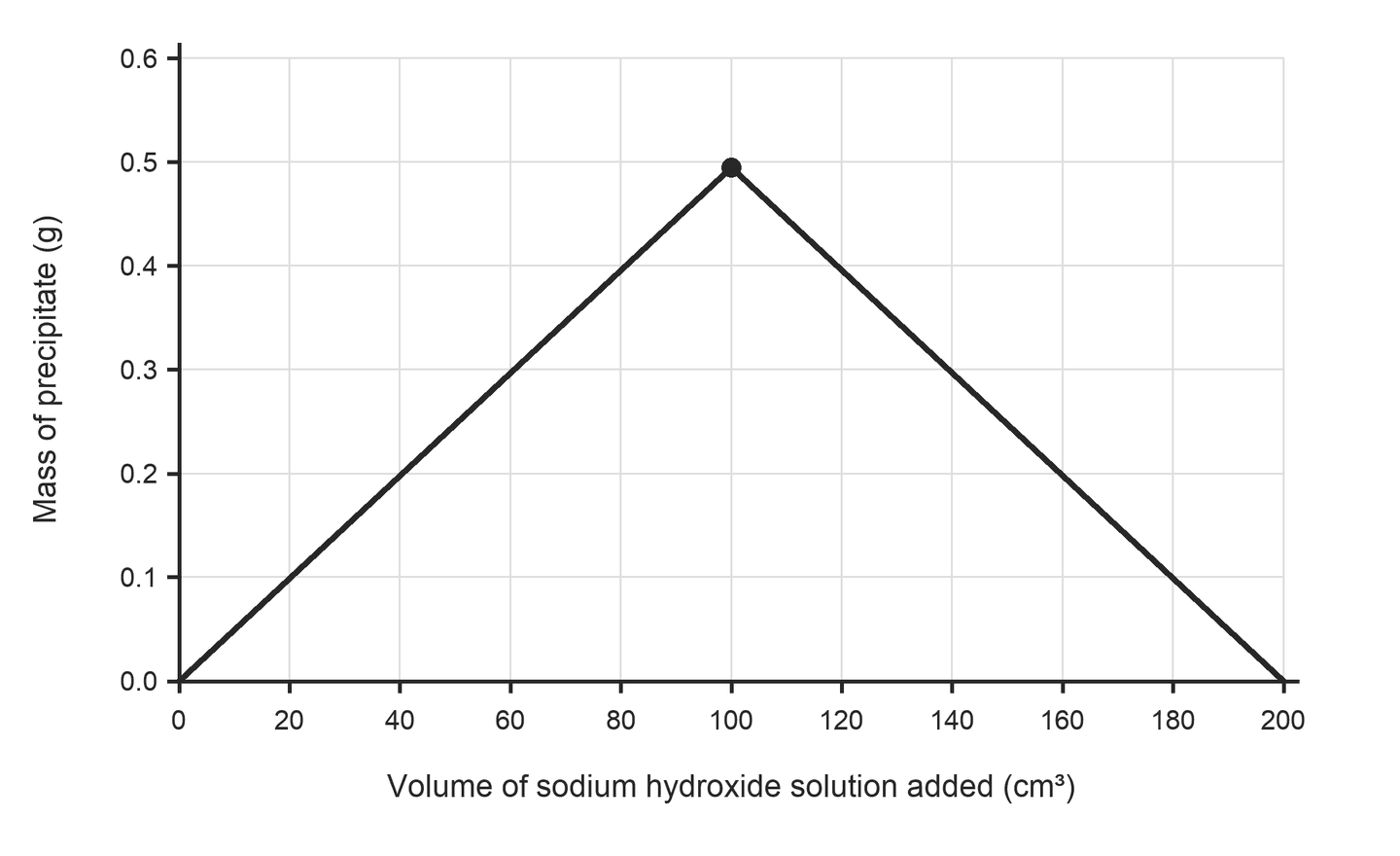
(a) From the graph, state the volume of alkali at which the mass of precipitate is greatest and the volume at which the precipitate has just disappeared.
(b) Write the balanced equations for the two changes, and explain why the falling line is as long as the rising line.
(c) Calculate the greatest mass of zinc hydroxide that can form from 0.805 g of zinc sulphate, and say whether it agrees with the graph.
- 384 marks
Question 38
Cognitive domain: Evaluation
A pharmacy store sells zinc oxide powder for skin ointment, and its label says 'pure'. An inspector stirs 5.00 g of the powder with an excess of hot concentrated sodium hydroxide solution. The white powder dissolves, but a reddish-brown solid remains. He filters it off, washes and dries it, and finds that its mass is 0.30 g. He knows that this residue is iron(III) oxide, a basic oxide, and that no other impurity is present. (Hypothetical data.)
(a) Explain why zinc oxide dissolves in the alkali but iron(III) oxide does not, and write the equation for the dissolving.
(b) Calculate the percentage of zinc oxide in the powder.
(c) The inspector could have used either the hot concentrated alkali or dilute hydrochloric acid for this test. Compare the two reagents and choose the better one, giving a reason.
- 394 marks
Question 39
Cognitive domain: Creativity
The science club of a school is planning a stall for Chemistry Day. The members want a demonstration, using only a few test tubes, which shows that zinc hydroxide is amphoteric. They have zinc sulphate solution, sodium hydroxide solution, dilute hydrochloric acid, copper(II) sulphate solution, droppers and test tubes. Visitors should see a clear change in each tube, and the club wants a second set that shows how a basic hydroxide behaves differently.
(a) Design the demonstration for zinc hydroxide in numbered steps, and write the equations for the reactions.
(b) State what a visitor will see at each stage, and explain what it proves.
(c) Design a matching set with copper(II) sulphate solution, state what visitors will see and explain the contrast.
- 405 marks
Question 40
Cognitive domain: Analysis
A shop sells a blue solution as a pond algae killer. To check how much copper(II) sulphate it holds, a student takes 50.0 cm³ of the solution and adds an excess of sodium hydroxide solution. She filters off the pale blue precipitate, washes it and dries it carefully. (Hypothetical data.) (Cu = 63.5, S = 32, O = 16, H = 1)
Quantity measured Value Volume of blue solution taken 50.0 cm³ Mass of dry pale blue precipitate 0.975 g (a) Name the precipitate, write the balanced equation, and explain why the student used excess sodium hydroxide and not ammonium hydroxide.
(b) Calculate the number of moles of precipitate and the mass of copper(II) sulphate in the 50.0 cm³ sample.
(c) Find the mass of copper(II) sulphate in 1 dm³ of the solution, and say whether this is qualitative or quantitative analysis.