
Question 84 marksEasy
Write balanced equations :
(a) Reaction of sodium hydroxide solution with Iron (III) chloride solution.
(b) Copper sulphate solution with ammonium hydroxide solution.
Confirming your payment
Sign up now and get 250 free tokens.
Analytical Chemistry · Question 8 of 31
Write balanced equations :
(a) Reaction of sodium hydroxide solution with Iron (III) chloride solution.
(b) Copper sulphate solution with ammonium hydroxide solution.
Solution:
Concept: An alkali reacts with a metal salt solution to give the insoluble metal hydroxide (the precipitate) and a soluble salt. With a copper salt, excess ammonium hydroxide then dissolves the hydroxide.
Step 1 — (a) Write the reaction of NaOH with iron (III) chloride.
The yellow solution gives a reddish brown precipitate of iron (III) hydroxide, which does not dissolve in excess. Three hydroxide ions are needed for each Fe³⁺ ion, so 3 NaOH are used.
Step 2 — Check the balance of (a).
Counting atoms: 1 Fe, 3 Cl, 3 Na, 3 O and 3 H on each side, so the equation is balanced.
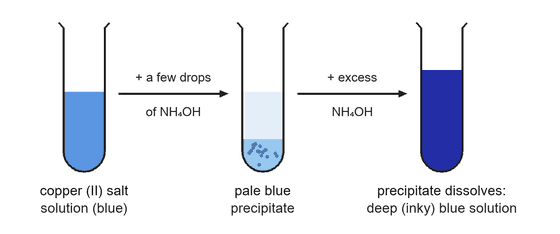
Step 3 — (b) Copper sulphate with a little ammonium hydroxide.
A pale blue precipitate of copper (II) hydroxide forms first.
Step 4 — (b) Copper sulphate with excess ammonium hydroxide.
The precipitate dissolves, giving a deep blue solution of tetraamminecopper (II) sulphate.
Watch out: Fe³⁺ needs three OH⁻ ions, so the equation needs 3 NaOH and gives 3 NaCl.
Therefore, (a) FeCl₃ + 3NaOH → Fe(OH)₃↓ + 3NaCl; (b) CuSO₄ + 2NH₄OH → Cu(OH)₂↓ + (NH₄)₂SO₄, and in excess Cu(OH)₂ + (NH₄)₂SO₄ + 2NH₄OH → [Cu(NH₃)₄]SO₄ + 4H₂O.