
Question 283 marksEasy
You are provided with two reagent bottles marked A and B. One contains solution and the other contains NaOH solution. How will you identify them by a chemical test ?
Confirming your payment
Sign up now and get 250 free tokens.
Analytical Chemistry · Question 28 of 31
You are provided with two reagent bottles marked A and B. One contains solution and the other contains NaOH solution. How will you identify them by a chemical test ?
Solution:
Concept: Copper (II) hydroxide dissolves in excess , forming a deep blue ammine compound, but not in excess NaOH. So copper sulphate solution tells the two alkalis apart.
Step 1 — Set up the test.
Take copper sulphate solution in two test tubes. Add the liquid from bottle A to one tube and the liquid from bottle B to the other, first drop by drop and then in excess.
Step 2 — Add a few drops.
Both tubes show a pale blue precipitate of copper (II) hydroxide, so this stage does not yet identify the bottles.
Step 3 — Add excess: the ammonium hydroxide bottle.
With ammonium hydroxide the precipitate dissolves to give a deep (inky) blue solution of tetraamminecopper (II) sulphate.
Step 4 — Add excess: the sodium hydroxide bottle.
With sodium hydroxide the pale blue precipitate does not dissolve.
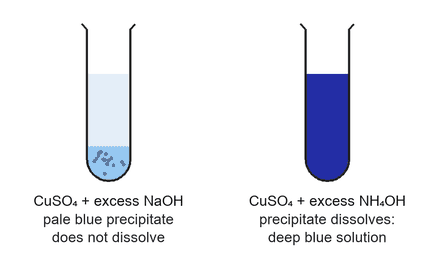
Watch out: The same copper sulphate test must be done with both bottles, and the decision is made only after excess has been added.
Therefore, the bottle whose liquid turns the pale blue precipitate into a deep blue solution contains ; the other bottle contains NaOH.