
Question 295 marksMedium
Write balanced equations for the following conversions
(a) .
(b)
Confirming your payment
Sign up now and get 250 free tokens.
Analytical Chemistry · Question 29 of 31
Write balanced equations for the following conversions
(a) .
(b)
Solution:
Concept: In each scheme, A is a little alkali, which precipitates the metal hydroxide, and B is an excess of the same alkali, which dissolves the precipitate. The final product tells us which alkali is used.
Step 1 — (a) Identify the alkali.
The product contains sodium, so the alkali in (a) is sodium hydroxide.
Step 2 — (a) Step A: a little NaOH.
A white gelatinous precipitate of zinc hydroxide forms.
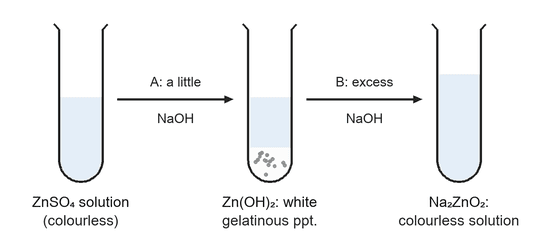
Step 3 — (a) Step B: excess NaOH.
The amphoteric zinc hydroxide dissolves, forming colourless sodium zincate.
Step 4 — (b) Identify the alkali.
The product contains ammonia, so the alkali in (b) is ammonium hydroxide.
Step 5 — (b) Step A: a little NH₄OH.
A pale blue precipitate of copper (II) hydroxide forms.
Step 6 — (b) Step B: excess NH₄OH.
The precipitate dissolves, giving a deep blue solution of tetraamminecopper (II) sulphate.
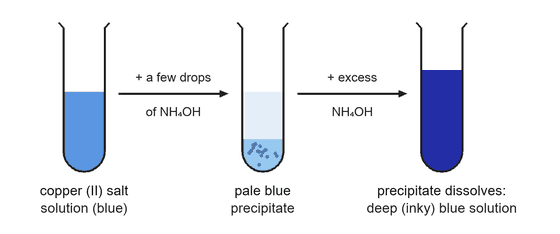
Watch out: In (b) the alkali must be NH₄OH; excess NaOH does not dissolve copper (II) hydroxide.
Therefore, (a) ZnSO₄ + 2NaOH → Zn(OH)₂↓ + Na₂SO₄ and Zn(OH)₂ + 2NaOH → Na₂ZnO₂ + 2H₂O; (b) CuSO₄ + 2NH₄OH → Cu(OH)₂↓ + (NH₄)₂SO₄ and Cu(OH)₂ + (NH₄)₂SO₄ + 2NH₄OH → [Cu(NH₃)₄]SO₄ + 4H₂O.