Answer: (A) (1)
Concept: An amphoteric oxide shows both basic and acidic character: it reacts with both acids and alkalis to form a salt and water. (Codes: (1) both true and R explains A; (2) both true but R does not explain A; (3) A true, R false; (4) A false, R true.)
Step 1 — Judge the Assertion.
Zinc oxide acts as a base with an acid and as an acid with an alkali, giving a salt and water each time. This is true.
ZnO+2HCl→ZnCl2+H2O
ZnO+2NaOH→Na2ZnO2+H2O
Step 2 — Judge the Reason.
Zinc oxide is amphoteric. This is true.
Step 3 — Decide whether R explains A.
Being amphoteric is exactly what makes zinc oxide react with both acids and bases, so R is the correct explanation of A.
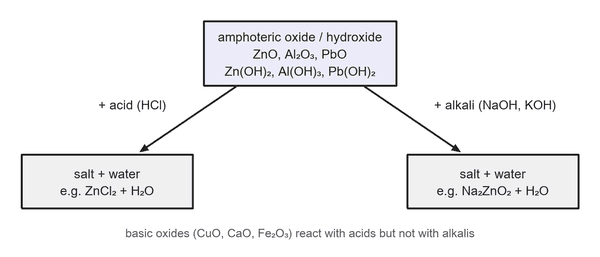
Watch out: With an alkali, zinc oxide gives sodium zincate (Na₂ZnO₂), not zinc hydroxide.
Why the other options are wrong:
- (B) (2): Code (2) says R does not explain A, but amphoteric nature is the exact reason for A.
- (C) (3): Code (3) says R is false, but zinc oxide is amphoteric.
- (D) (4): Code (4) says A is false, but zinc oxide does react with both acids and bases.
Therefore, both A and R are true and R explains A, code (1), option (A).
