Answer: (A) (1)
Concept: Ammonium hydroxide is a weak alkali, so it gives only a low concentration of hydroxide ions. A precipitate of calcium hydroxide needs a higher hydroxide ion concentration. (Codes: (1) both true and R explains A; (2) both true but R does not explain A; (3) A true, R false; (4) A false, R true.)
Step 1 — Judge the Assertion.
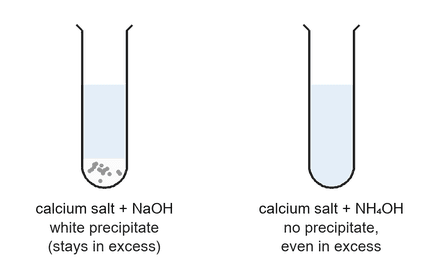
A calcium salt solution shows no precipitate even with excess ammonia solution. This is true.
Step 2 — Judge the Reason.
The Reason (read as: the low hydroxide ion concentration of ammonium hydroxide cannot precipitate calcium hydroxide) is true, because NH4OH ionises only slightly.
Step 3 — Decide whether R explains A.
This low hydroxide ion concentration is exactly why no Ca(OH)2 precipitate forms, so R is the correct explanation of A. A strong alkali such as NaOH does give a white precipitate with the same solution.
Watch out: The Reason's wording is clumsy (“hydroxide ions of calcium” means calcium hydroxide); judge the idea it states.
Why the other options are wrong:
- (B) (2): Code (2) says R does not explain A, but R gives the exact cause of A.
- (C) (3): Code (3) says R is false, but the hydroxide ion concentration of NH₄OH really is low.
- (D) (4): Code (4) says A is false, but a calcium salt really shows no change with excess ammonia solution.
Therefore, both A and R are true and R explains A, code (1), option (A).
