Solution:
Concept: With ammonia solution, the only metal in the list whose hydroxide is white and gelatinous and dissolves in excess is zinc, because zinc hydroxide forms a soluble ammine compound.
Step 1 — (a) Test each metal in the list.
We check each metal against both clues:
- Na: sodium hydroxide is soluble, so no precipitate forms;
- Fe: iron salts give coloured precipitates (dirty green or reddish brown);
- Pb: a chalky white precipitate, insoluble in excess ammonia;
- Al: a white gelatinous precipitate, but insoluble in excess ammonia;
- Zn: a white gelatinous precipitate that dissolves in excess ammonia.
So the salt is a salt of zinc (Zn).
Step 2 — (b) Give the formula of the precipitate.
The white gelatinous precipitate is zinc hydroxide, Zn(OH)2.
Step 3 — (c) Zinc sulphate with a little ammonia solution.
The precipitate forms first:
ZnSO4+2NH4OH→Zn(OH)2↓+(NH4)2SO4
Step 4 — (c) Zinc sulphate with excess ammonia solution.
The precipitate dissolves to a colourless solution of tetraamminezinc (II) sulphate.
Zn(OH)2+(NH4)2SO4+2NH4OH→[Zn(NH3)4]SO4+4H2O
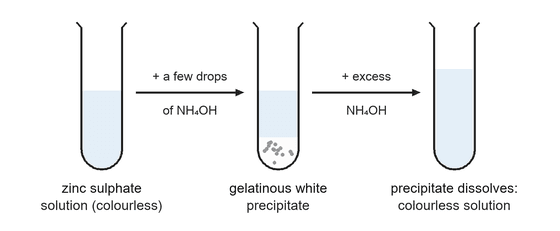
Watch out: Aluminium also gives a white gelatinous precipitate, but it does not dissolve in excess ammonia.
Therefore, (a) the salt is of zinc; (b) the precipitate is Zn(OH)₂; (c) ZnSO₄ + 2NH₄OH → Zn(OH)₂↓ + (NH₄)₂SO₄, then Zn(OH)₂ + (NH₄)₂SO₄ + 2NH₄OH → [Zn(NH₃)₄]SO₄ + 4H₂O.
